
Choosing personal defense ammo: safety, reliability, and smart decisions
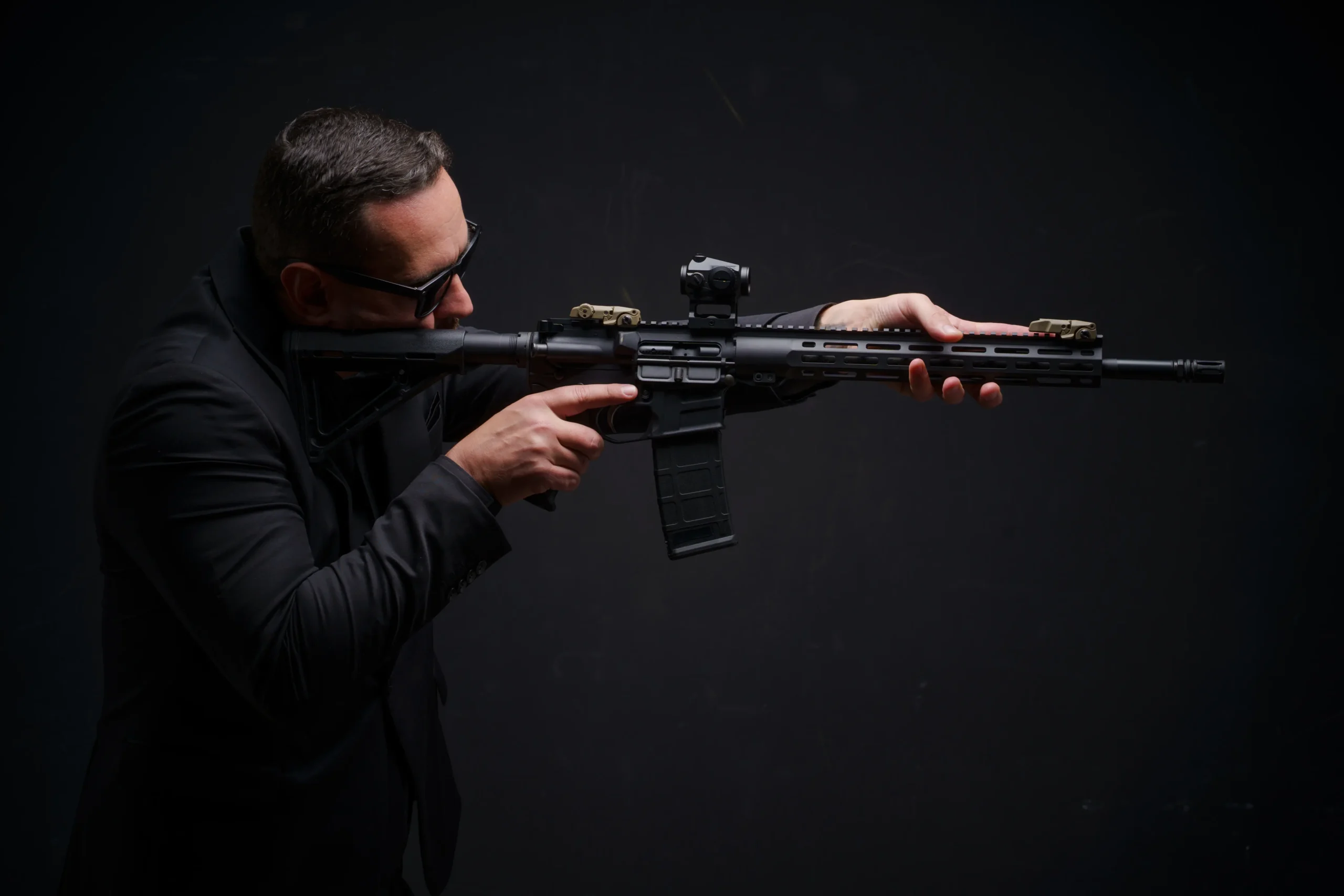

Most firearm owners spend considerable time selecting the right pistol but treat ammunition as an afterthought. That’s a costly assumption. The round you chamber can determine whether you stop a threat effectively, whether your firearm cycles without a hiccup, and even how a prosecutor frames your actions after a defensive incident. FMJ ammo penetrates barriers better than hollow points but raises serious bystander risk. This guide walks you through what separates personal defense ammunition from target rounds, how to match ammo to your firearm and situation, and the storage practices that keep your rounds reliable when it counts.
Table of Contents
- What makes personal defense ammo different from target rounds?
- How to choose the right defense ammo for your needs
- Special considerations for less powerful calibers: .380 and beyond
- Practical tips for safely storing and handling defense ammo
- Why the usual advice isn’t enough: Lessons from seasoned firearm owners
- Take the next step with Tungsten Creek Tactical
- Frequently asked questions
Key Takeaways
| Point | Details |
|---|---|
| Ammo type matters | Choosing the right defense ammo impacts safety, reliability, and legal outcomes. |
| FMJ vs JHP | JHP is typically safer for defense by reducing over-penetration compared to FMJ. |
| Test before trusting | Always test defense ammo in your firearm to ensure it cycles reliably and performs as needed. |
| Proper storage is essential | Store and rotate ammo correctly to maintain its safety and effectiveness. |
What makes personal defense ammo different from target rounds?
Now that you know why ammo selection matters, let’s break down what truly separates personal defense rounds from practice ammo.
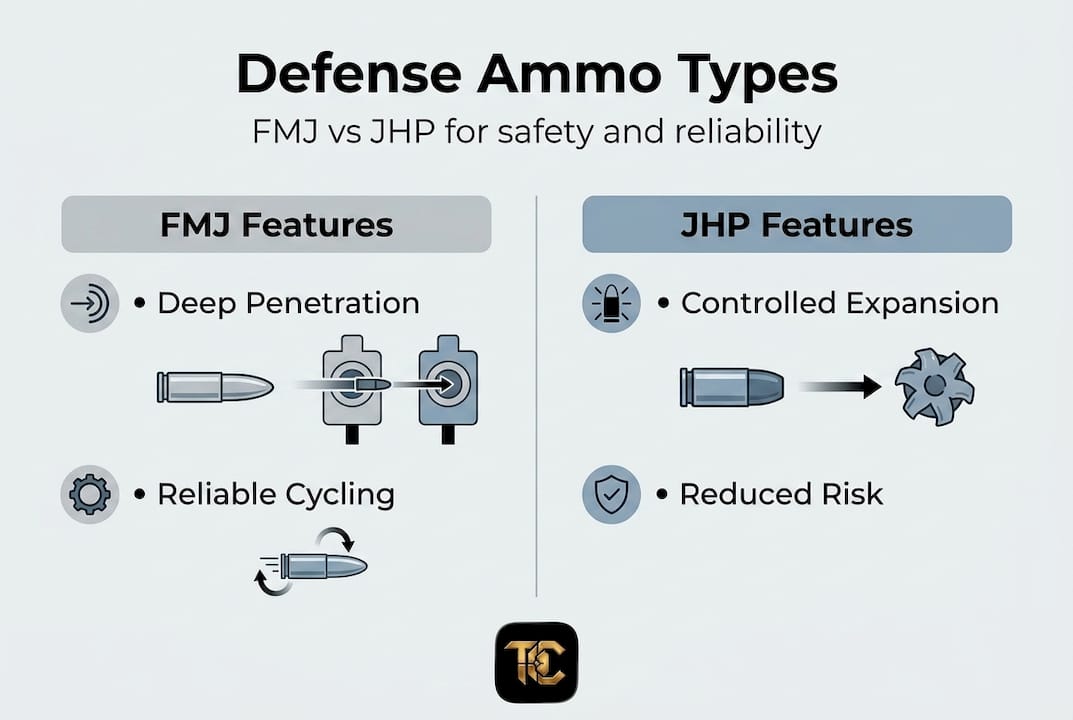
At the most basic level, the difference comes down to bullet design. Full metal jacket (FMJ) rounds use a soft lead core encased in a harder metal shell. They feed smoothly, they’re inexpensive, and they’re ideal for range sessions. Jacketed hollow point (JHP) rounds have a cup-shaped cavity at the tip that causes the bullet to expand on impact, slowing it down and transferring more energy into the target.
That expansion matters for three reasons:
- Stopping power: A JHP that expands to nearly twice its original diameter creates a larger wound channel, increasing the likelihood of stopping a threat quickly.
- Over-penetration risk: FMJ penetrates barriers better but risks injuring bystanders behind the target. JHP typically stops inside the threat, reducing that danger significantly.
- Legal considerations: Courts and prosecutors have scrutinized ammo choices in defensive shootings. Using standard defense loads signals responsible decision-making.
Here’s a quick comparison to anchor the differences:
| Feature | FMJ | JHP |
|---|---|---|
| Bullet tip design | Rounded, enclosed | Hollow cavity |
| Expansion on impact | None | Yes, expands 1.5x to 2x |
| Penetration depth | High | Moderate and controlled |
| Bystander risk | Higher | Lower |
| Typical use | Range practice | Personal defense |
| Cost per round | Lower | Higher |
Reliability is another factor worth taking seriously. Some firearms, particularly older designs or those with tighter chambers, can have trouble feeding the wider profile of a hollow point. This is why pairing the right ammo with the right platform matters as much as the bullet design itself. Review your options alongside a look at best conceal carry pistols to find a platform designed to feed modern defense rounds without issue.
Pro Tip: Run at least 100 rounds of your chosen defense ammo through your carry firearm before you trust it. If it feeds every time without a hiccup, you’ve found a reliable match. If it doesn’t, switch loads before you switch holsters. Speaking of which, good best holster options are just as important as the round itself for a complete carry setup.
Understanding these fundamentals is a smart early step, especially if you’re still navigating the firearm buying process and haven’t yet settled on a platform.
How to choose the right defense ammo for your needs
With an understanding of what defense ammo is, let’s show you how to choose the best option for your situation.
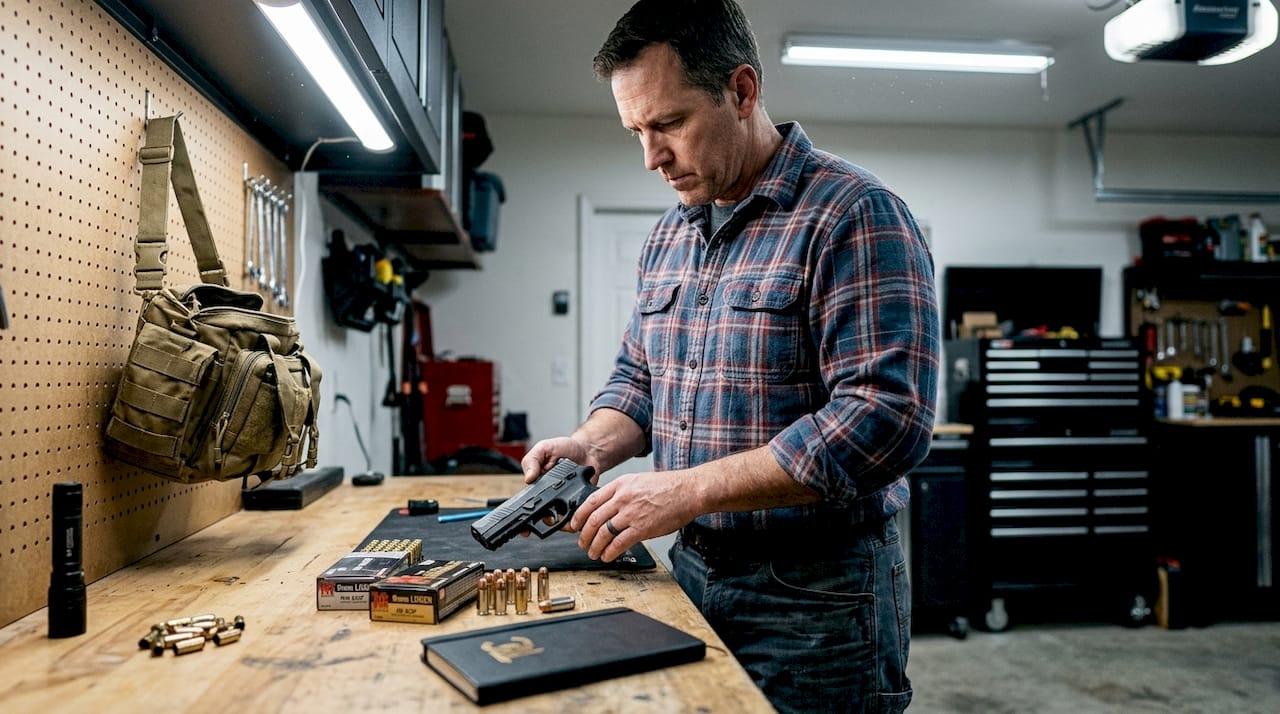
Choosing personal defense ammunition isn’t a one-size-fits-all decision. The right round depends on your firearm’s caliber, its mechanical design, your carry environment, and even local laws. Think of it the way you’d approach selecting a well-made cigar: the wrapper, the filler, and the origin all combine to create a specific experience. Ammo works the same way.
Here’s a step-by-step process to guide your selection:
- Identify your caliber. Start with what your firearm is chambered for. Common defense calibers include 9mm, .45 ACP, .40 S&W, and .380 ACP. Each has its own performance envelope.
- Research JHP options in that caliber. Look for loads tested to FBI penetration standards, which require 12 to 18 inches of gel penetration after passing through barriers.
- Check your firearm’s manual. Some manufacturers specify which bullet weights and designs cycle best in their platform.
- Consider your carry environment. Indoors, in a vehicle, or in densely populated areas, over-penetration risk increases. JHP mitigates this.
- Verify local laws. Some jurisdictions restrict certain ammo types. Know your state and local regulations before you load up.
- Purchase a small quantity first. Test before you commit to a bulk purchase.
Features to prioritize when evaluating defense loads:
- Consistent, reliable expansion across a range of impact velocities
- Feeding reliability with your specific firearm
- Penetration depth within the 12 to 18 inch FBI standard range
- Brass-cased construction for reliable primer ignition
- Established manufacturer with verifiable test data
Some users prefer FMJ for reliable cycling in certain firearms with tighter tolerances or older feed ramp designs. If that’s your situation, factor bystander risk into your decision carefully.
For owners carrying a Makarov-chambered pistol, purpose-built options like makarov defense ammo solve the caliber-specific challenge without compromise. Pairing your ammo decision with proper firearm maintenance also ensures your firearm feeds your chosen round consistently over time. And once you’ve made your selection, good firearm storage solutions keep both firearm and ammo protected.
Pro Tip: Don’t rely solely on online reviews to validate your ammo choice. What cycles flawlessly in one shooter’s pistol may fail in yours. Real-world testing in your specific firearm is the only true benchmark.
Special considerations for less powerful calibers: .380 and beyond
Choosing defense ammo gets even trickier with less powerful calibers like .380. Here’s what to know.
The .380 ACP occupies an interesting position in the personal defense world. It’s compact, easy to carry, and chambered in some of the most concealable pistols available. But its lower velocity creates a genuine challenge: will a hollow point expand reliably, or will it fail to meet minimum penetration standards?
This is where the FMJ versus JHP debate gets genuinely complicated. FMJ is used for better penetration in .380 and similar calibers, but it raises risks for bystanders. Some defense-oriented JHP loads for .380 have been tested and found to under-penetrate, stopping at only 8 to 10 inches in ballistic gel, well short of the FBI standard.
“FMJ penetrates barriers better but increases risks for others. In marginal calibers, this trade-off deserves serious thought, not a quick answer.”
Here’s a data snapshot of common .380 ammo types and their performance benchmarks:
| Ammo type | Average penetration (gel) | Expansion diameter | Bystander risk |
|---|---|---|---|
| FMJ 95gr | 14 to 17 inches | None | Higher |
| Standard JHP 90gr | 8 to 11 inches | 0.50 to 0.60 inches | Lower |
| Premium JHP (e.g., Hornady XTP) | 12 to 14 inches | 0.55 to 0.65 inches | Moderate |
Premium .380 JHP loads from reputable manufacturers close the gap considerably. They’re engineered to expand even at the lower velocities inherent to the caliber.
Tips for selecting marginal caliber ammo:
- Prioritize tested JHP loads with published gel results from credible sources
- Avoid bargain-brand hollow points without verifiable test data
- If your firearm won’t reliably feed JHP, consider a platform upgrade before switching to FMJ for defense
- Test expansion by researching independent ballistic gel tests, not just manufacturer claims
- Consider pistols purpose-built for the caliber, like the Beretta .380 ACP options that are designed to feed and fire modern defense loads consistently
For those evaluating a more versatile platform that handles ammo variety well, the Centurion CP9 details are worth reviewing as a reference point for dependable feeding across load types.
Practical tips for safely storing and handling defense ammo
Once you’ve selected your defense ammo, here’s how to store and handle it with confidence.
Selecting the right ammo is only half the job. How you store and maintain it determines whether it performs when you actually need it. Ammo choice can impact firearm reliability and safety, and degraded ammo compounds that risk. Moisture, extreme heat, and physical damage are the three most common culprits behind ammo failures.
Follow these steps to keep your defense rounds ready:
- Store in a cool, dry location. Humidity is the primary enemy of ammunition. A temperature-controlled space under 75 degrees Fahrenheit and below 60% relative humidity is ideal.
- Use airtight containers. Ammo cans with rubber gaskets or sealed plastic containers prevent moisture intrusion and protect primers.
- Keep ammo away from solvents and lubricants. Chemical exposure can degrade the primer compound and propellant over time.
- Rotate your defensive loads every 6 to 12 months. Rounds that have been chambered and unchambered repeatedly can experience bullet setback, which changes internal pressure. Replace them on a schedule.
- Inspect visually before loading. Look for corrosion on the case, deformed bullet tips, or compromised primer pockets. Discard anything questionable.
- Store securely. Ammo stored alongside a firearm should be in a locked, secure firearm storage solution to prevent unauthorized access.
Using practice targets when running your defensive loads through periodic range sessions also helps you verify performance while building practical muscle memory.
Pro Tip: Never load a round that has been dropped onto a hard surface from more than a few feet. The impact can shift the bullet slightly into the case, creating dangerous overpressure when fired. When in doubt, toss it out.
Why the usual advice isn’t enough: Lessons from seasoned firearm owners
Let’s wrap up by sharing a real-world perspective from seasoned firearm owners.
Most ammo advice you’ll find online boils down to two points: buy JHP, and pick a reputable brand. That’s a reasonable starting point, but it glosses over the most important variable: your specific situation. A round that performs beautifully in a 4-inch barrel 9mm may under-expand badly in a compact subcompact with a 3-inch barrel. The same velocity drop that’s negligible in a full-size pistol becomes a genuine concern in a pocket carry.
Seasoned firearm owners know that relying on forum consensus or trend-driven recommendations creates false confidence. The uncomfortable truth is that ammo selection is an ongoing, personalized process. It requires testing, not just reading. It requires revisiting your choice when you change firearms, change your carry environment, or when new load data becomes available.
Insights on modular firearms insights reinforce this point well: adaptability isn’t just a hardware feature, it’s a mindset. Your ammo decision should evolve alongside your experience and your platform.
“Testing ammo in your actual firearm, under realistic conditions, is the only way to know it works when it matters.”
Treat your ammo choice the way a craftsman treats his tools: with deliberate selection, regular evaluation, and zero tolerance for guesswork.
Take the next step with Tungsten Creek Tactical
Ready to put this guidance into action? Here’s how Tungsten Creek Tactical helps you get started.
At Tungsten Creek Tactical, we carry the defense loads, platforms, and accessories that serious firearm owners rely on. Whether you’re stocking up on PRIVI JHP defense ammo for your carry rotation or exploring custom gun builds built around your specific carry needs, we bring the same standard of precision and honesty to every product we offer.

Our team also supports ongoing reliability through our firearm maintenance guide, so your firearm and your chosen ammo always perform together at their best. When you’re ready to make a confident, informed decision, we’re here to back it up.
Frequently asked questions
What is the main difference between FMJ and JHP ammo for personal defense?
FMJ penetrates more barriers but raises bystander risk, while JHP expands on impact to increase stopping power and reduce over-penetration in defensive situations.
How can I ensure my chosen defense ammo will be reliable in my firearm?
Test your chosen ammo under realistic conditions to confirm it cycles reliably. Some users pick FMJ for reliability in finicky guns, but always weigh that against the bystander risk trade-off.
Is it safe to use .380 or other marginal calibers for personal defense?
You can use .380 for defense, but ammo selection is critical. FMJ used in .380 improves penetration, but premium JHP loads from reputable manufacturers now close that gap with much lower bystander risk.
What storage practices help keep defense ammo safe and functional?
Store ammo in a cool, dry, airtight container and rotate your defensive loads every 6 to 12 months. Proper storage ensures reliability and prevents failures caused by moisture, heat, or bullet setback from repeated chambering.
Recommended
Related Post

Discover the 5 ways
An introduction to Tactical Luxury Guns & Coffee We founded
Top 5 Best PCC’s
In 2026, the Pistol Caliber Carbine (PCC) market is no