
How to compare firearm prices and get a fair deal


Two buyers walk into different transactions for the same Glock 19 Gen 5. One pays $520 out the door. The other pays $610 for what looks like the same pistol at a glance. The difference? Hidden fees, a platform listing that excluded transfer costs, and a comparison built on asking prices rather than actual sales. That gap is real, it happens constantly, and it is entirely avoidable. This guide breaks down every layer of firearm pricing so you can compare with precision, negotiate with confidence, and walk away knowing you paid what the market actually demands.
Table of Contents
- What factors influence firearm price comparisons?
- Matching apples to apples: Make, model, and condition
- Sold comps vs active listings: What reveals the real market price?
- Online tools, platforms, and reference guides for price discovery
- Market trends, platform differences, and buyer discipline
- Why most gun buyers pay more than they need to (and how to fix it)
- Ready to compare and buy smarter?
- Frequently asked questions
Key Takeaways
| Point | Details |
|---|---|
| Total cost matters | Always compare the full price—including fees, shipping, and transfer costs—not just the listing price. |
| Sold comps are key | Completed sales reveal the most reliable market values; avoid relying only on active listings. |
| Exact match is vital | Compare prices for identical make, model, variant, and grade to ensure fairness and accuracy. |
| Use trusted tools | Leverage market aggregators and reference guides for quick scans but double-check the final checkout price. |
| Market trends impact price | Understand segment-specific trends and platform differences before making a purchase decision. |
What factors influence firearm price comparisons?
Now that we recognize price discrepancies exist, let’s break down every cost component that shapes what you really pay. Most buyers focus on the headline number and move forward. That instinct costs money every single time.
The real price of any firearm is the sum of several distinct layers. When you see a pistol listed at $499, that number is just the starting point. Shipping, insurance, and handling fees from online retailers can add $25 to $50. State and local sales taxes in many jurisdictions will push the number up another 6 to 10 percent. The FFL (Federal Firearms License) transfer fee, paid to your local dealer when a firearm ships to them, commonly runs between $25 and $75. Platform fees on auction sites like GunBroker may not be visible to you as a buyer, but they shape seller behavior and sometimes get passed along in pricing. As GunBroker’s fee structure makes clear, compare total landed cost rather than the listing price alone, because the gap between what you see and what you pay is where most buyers get burned.
Here is a clear breakdown of what feeds into the true out-the-door price:
| Cost component | Typical range | Notes |
|---|---|---|
| Listing price | Base | What you see advertised |
| Shipping and handling | $20 to $50 | Varies by retailer and firearm weight |
| Insurance | $5 to $20 | Often optional but advisable |
| Sales tax | 0% to 10%+ | Depends on state and platform |
| FFL transfer fee | $25 to $75 | Paid to receiving dealer |
| Platform or auction fees | Variable | May inflate seller’s price |
Every one of these elements deserves a line in your comparison spreadsheet. Skipping any of them produces a number that does not reflect reality.
- Always collect itemized quotes before committing to a purchase
- Call your receiving FFL dealer first to confirm their transfer fee
- Factor sales tax based on your state, not the seller’s state
- Account for platform-specific fees that may inflate seller pricing
- Review the firearm buying guide for a full walkthrough of the purchase sequence
Pro Tip: Before you finalize any online purchase, contact the seller directly and ask for a complete breakdown of all fees to checkout. The difference between the listed price and the actual cost is often 15 to 20 percent once all layers are included.
Matching apples to apples: Make, model, and condition
Once you understand the price components, next it is crucial to ensure you are actually comparing the same thing. This is where many buyers make a costly logical error, comparing a Gen 3 to a Gen 5, a blued finish to a stainless, or a well-worn range gun to one with 200 rounds through it.
Small configuration differences change value in ways that are not always obvious. A Glock 19 Gen 5 MOS (the optics-ready variant) commands a meaningfully different price than a standard Gen 5. A factory night sight package on a Smith and Wesson M&P adds real dollars to the comparison. Aftermarket modifications, whether a trigger job, custom stippling, or a compensator, can increase or decrease value depending on the buyer. As explained in detail in resources on used gun valuation, you should match exact make, model, generation, variant, and condition before any price comparison is meaningful.
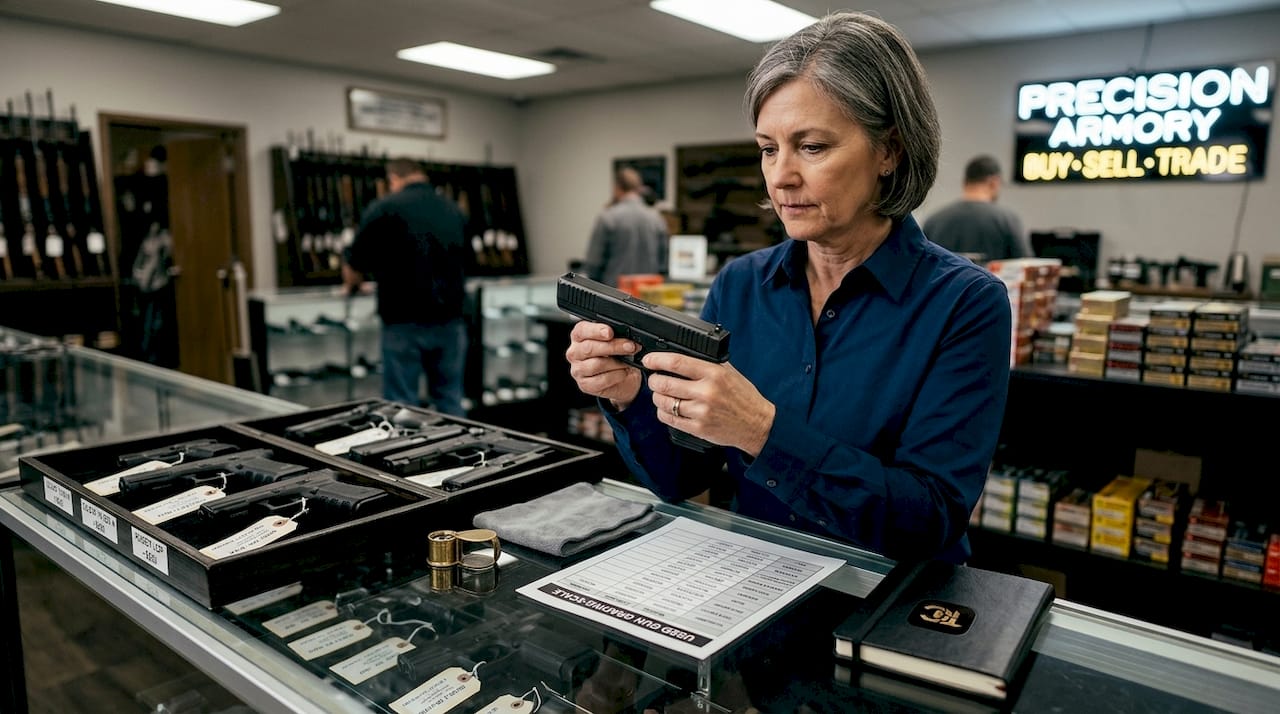
Condition grading is a discipline of its own. Here is how to approach it systematically:
Condition grading reference:
| Grade | Description | Price impact |
|---|---|---|
| New in box (NIB) | Unfired, all original packaging | Full retail or above |
| Excellent | Minimal wear, no notable marks | 85 to 95% of NIB |
| Very good | Light handling marks, mechanically perfect | 70 to 85% of NIB |
| Good | Visible wear, fully functional | 55 to 70% of NIB |
| Fair | Heavy wear or minor issues | 40 to 55% of NIB |
Grading requires looking at specific wear indicators. Check the finish at muzzle wear points, along the slide rails, and at the ejection port. Inspect the bore and crown under good lighting. A pitted bore drops condition grade regardless of how clean the exterior looks. Aftermarket modifications, even high-quality ones, need to be documented separately because not every buyer assigns them equal value. If you are interested in how professional customization affects both value and comparability, custom gun options demonstrate the range of what professional work can look like.
Follow this numbered workflow every time you compare used firearm prices:
- Identify the exact variant and model number, including generation
- Confirm all factory features present (sights, grip panels, magazine count)
- Assess condition using standardized grading criteria
- Document all modifications with estimated market values
- Record serial number range if relevant to production period value
Pro Tip: When comparing used firearms, photograph or note every wear point before you finalize a grade. Sellers often describe condition generously. Independent grading protects your comparison from inflated claims.
Sold comps vs active listings: What reveals the real market price?
With variants and conditions matched, let’s dig into where market value is really set: completed sales, not hopeful ads. This distinction is the single most important habit separating disciplined buyers from people who consistently overpay.
Active listings represent what sellers want to receive. Sold comps represent what buyers actually paid. These two numbers diverge significantly during market shifts, and 2026 has seen meaningful price movement across multiple firearm categories. Resources tracking the used gun market in 2026 confirm that sold comps provide far more reliable ground truth than active listings, which can reflect wishful pricing rather than buyer behavior.
“Active listings are aspirational, not actual value. The market clearing price lives in completed sales and cleared auctions, not in what sellers are hoping to get today.”
Consider a concrete example. A seller lists a used Sig Sauer P365 XL at $550. Three identical pistols in the same condition sold in the last 30 days at $480, $490, and $505. If you anchor your negotiation to the $550 asking price, you are negotiating from the wrong starting line. Anchoring to asking prices when you have sold comp data available is one of the most common and most expensive mistakes buyers make. Analysis of gun price trends in 2026 reinforces that asking prices diverge materially from actual clearing prices in volatile segments.
Where to source reliable sold comp data:
- GunBroker completed auctions: Filter by “sold” listings for exact model and condition
- Gun.deals: Tracks price history across retailers for new firearms
- Local shop networks: Dealers with high turnover accumulate real-world comp data fast
- Private sale platforms: Check recently sold listings on platforms serving your region
- Auction house records: For collectible and high-value firearms, specialized auction results matter
If you are looking at platforms beyond the major names, reviewing alternatives to Bearsgunroom gives you additional sourcing options worth checking.
Online tools, platforms, and reference guides for price discovery
Having established how to source sold comps, it is time to leverage technology and trusted resources for fast, efficient price checks. The right tools compress research that once took hours into a focused 20-minute session.
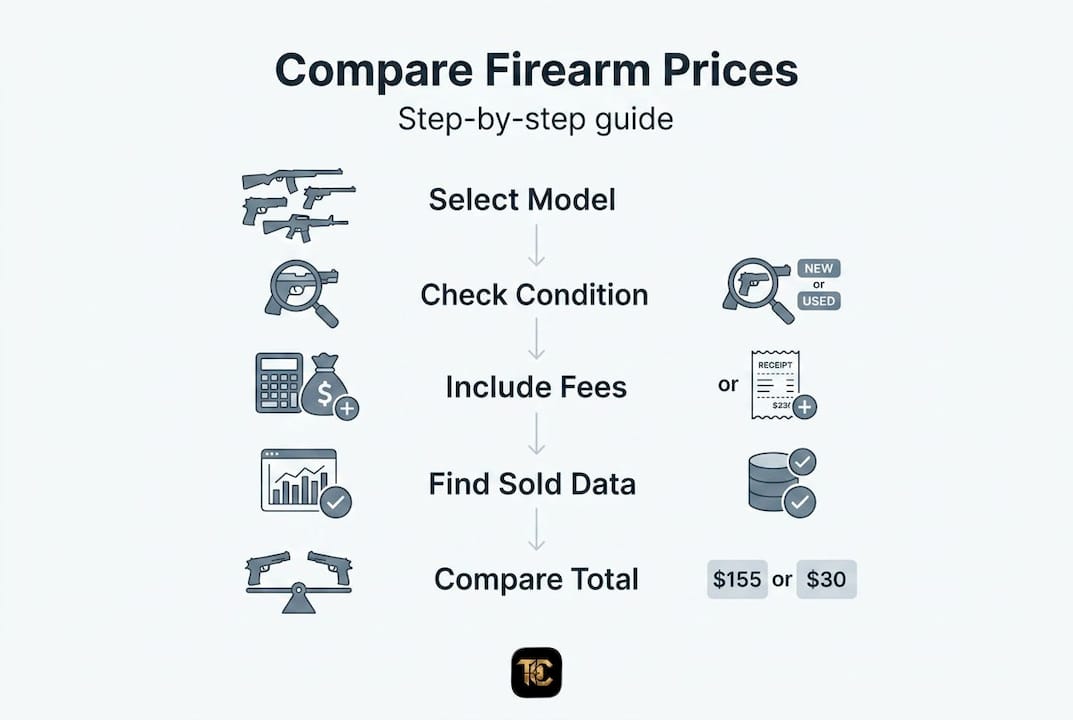
Deal aggregators like gun.deals scan dozens of retailers simultaneously, letting you see the range of current new-in-box pricing across the market in a single search. This is valuable for new firearm benchmarking. The important caveat: verify final checkout price after clicking through, because shipping, tax, and fees vary significantly from retailer to retailer even for the same listed price.
The Blue Book of Gun Values has served firearm buyers as a pricing baseline for decades. For used gun pricing, it provides standardized condition grades and historical value ranges that give you a starting framework. That said, the Blue Book is a starting point and not a live market feed. During high-demand periods or supply disruptions, published reference values can lag actual market conditions by months.
Key resources for price discovery:
- gun.deals: Multi-retailer aggregator for new firearms, tracks price drops over time
- GunBroker completed auctions: Best source for used firearm sold comps
- Blue Book of Gun Values: Standardized baseline for used pricing, treat as a floor not a ceiling
- Armslist and regional platforms: Local private sale data, useful for understanding your geographic market
- 2A Marketplace and similar: Growing sources of transaction-based data for used guns
Reference guides lag in hot markets. Use them as a baseline, not gospel. Real-market velocity demands real-market data.
Supplement any reference guide research with recent completed sales. If the Blue Book says a used Ruger 10/22 in excellent condition is worth $220 and every sold comp from the past 60 days shows $275 to $310, trust the comps. When you want to see how competitive pricing looks across channels, browsing alternatives to Junipercreekarms can expand your research base.
Market trends, platform differences, and buyer discipline
Finally, to validate your comparisons, map them against real market dynamics and platform specifics. A technically perfect comp that ignores broader market direction can still lead you to the wrong conclusion.
Firearm pricing is not monolithic. Handgun prices, particularly in the polymer-framed defensive pistol segment, move differently than rimfire rifle prices or collectible revolver values. Specific calibers, capacity restrictions in some states, and accessory ecosystem depth all affect segment-specific demand. Analysis of gun price direction in 2026 shows that price trends vary by segment rather than moving as one uniform market. Applying a broad average to your specific target firearm produces an imprecise benchmark.
Platform behavior matters just as much. On GunBroker, auction vs. fixed-price listings produce different realized prices. Auction formats with low starting bids often clear below fixed-price listings when demand is moderate, but they can spike dramatically when a rare variant attracts competitive bidding. The starting bid is not the relevant number. The final realized price is. Always compare realized prices, not auction start points.
Key platform and market discipline factors:
- Track the Consumer Price Index for durable goods as a macro sanity check on whether price moves are firearm-specific or inflation-driven
- Monitor NICS (National Instant Criminal Background Check System) data monthly as a leading demand indicator
- Understand that auction format realized prices often differ from fixed-price sales for identical items
- Account for regional demand variation, a carry pistol that sells quickly in one state may sit in another
- Note seasonal patterns: end-of-year demand typically increases, affecting both new and used pricing
Pro Tip: Use NICS monthly check data as a forward-looking demand signal. When checks spike, prices follow within 30 to 60 days. When checks drop off, the market softens and negotiating room opens up. Timing your purchase with this awareness is a real advantage. For a step-by-step breakdown of the entire process, the firearm buying process for first timers covers everything from selection through transfer.
Why most gun buyers pay more than they need to (and how to fix it)
Here is the honest, experience-based observation: most buyers overpay not because they are uninformed, but because they shortcut the process at exactly the wrong moment. They do the research, they find a reasonable listing, and then they let impatience or deal momentum override their discipline.
The most common pattern looks like this: a buyer identifies the right pistol, checks a few active listings, sees prices cluster around a number, and treats that cluster as confirmation. But active listing clusters are not market consensus. They are multiple sellers sharing the same aspirational pricing. The real market sits in what cleared, and buyers who skip that step are anchoring to fiction.
Contrarian wisdom says this: disciplined comparison is not about being cheap or difficult. It is about respecting your own money with the same care you apply to choosing the right firearm. Just as you would not settle for a poorly fitted holster or a cigar that does not match the occasion, you should not settle for a price built on incomplete data.
The hard-won lesson is that verification matters most for rare or custom builds. Standard production firearms have abundant comp data. That data is easy to find and easy to interpret. Where buyers consistently get hurt is on modified pistols, limited-run variants, or firearms with complex histories. For those, shortcuts are especially expensive. Explore what professional-grade custom-built firearms actually look like so you understand what you are valuing before you compare.
Ask sellers directly for completed sale references rather than negotiating purely from their current asking price. Most experienced sellers respect a buyer who comes prepared with sold comp data. It moves the conversation from emotional to transactional, which is exactly where you want it.
Ready to compare and buy smarter?
Applying these principles in the field is straightforward when you have the right resources behind you. At Tungsten Creek Tactical, we build transparency into every part of the buying experience.
Our inventory is priced with total landed cost in mind, not as a starting point for a fee-stacking exercise. Whether you are browsing standard production handguns or exploring what a purpose-built configuration looks like, you will find clear pricing and knowledgeable guidance at every step. Check out our custom guns service if you want a firearm built to your exact specifications, or shop tactical firearms across our full inventory to benchmark what competitive, honest pricing looks like. Our team is here to help you make a confident, well-informed decision, every time.
Frequently asked questions
What is the most accurate way to compare firearm prices?
The most accurate method is to compare sold prices from completed sales for the exact make, model, and condition, including all fees and transfer costs. Active listings reflect seller hopes, not buyer-confirmed market values.
Do online platforms show the true price I’ll pay?
Online platforms typically display headline prices only, and real costs include shipping, taxes, and FFL transfer fees. As GunBroker’s fee breakdown illustrates, total landed cost is always higher than the listing price and must be calculated for an accurate comparison.
How does condition grading affect firearm price?
Condition grading directly determines how much of a firearm’s original value it retains, and even one grade difference can shift price by 10 to 20 percent. Standardized grading, as outlined for used gun valuation, ensures you are comparing items of equivalent condition rather than guessing.
Where should I look for benchmark firearm prices?
The Blue Book of Gun Values is a solid starting reference, but it can lag fast-moving markets significantly. Pair it with gun.deals for cross-retailer comparisons and recent GunBroker completed auctions for a current, accurate picture of what buyers are actually paying right now.
Recommended
Related Post

Discover the 5 ways
An introduction to Tactical Luxury Guns & Coffee We founded
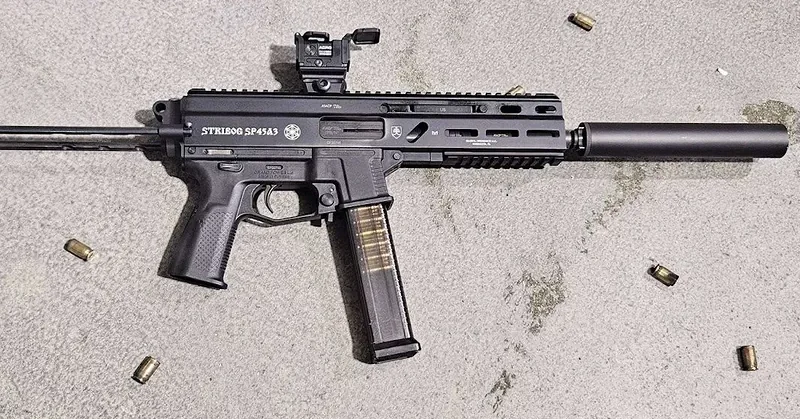
Top 5 Best PCC’s
In 2026, the Pistol Caliber Carbine (PCC) market is no