
Serialized firearms explained: what every owner must know
Most gun owners assume that every firearm has a serial number and that any gun without one is automatically illegal. Neither of those assumptions is completely accurate. The reality is more layered, and getting it wrong can expose you to serious legal risk. Serialization sits at the intersection of federal regulation, state law, and practical ownership responsibility. Whether you’re buying your first pistol through a dealer, building a rifle at home, or picking up a used firearm from a private seller, understanding what serialization means and what it requires of you is one of the most practical steps you can take toward responsible ownership.
Table of Contents
- What is a serialized firearm?
- How serialization works: Process, standards, and exceptions
- Why serialization matters: Ownership, safety, and the law
- Serialization in practice: Key differences by scenario
- The real value and hidden complexity of firearm serialization
- Connect with Tungsten Creek Tactical: Support for every step
- Frequently asked questions
Key Takeaways
| Point | Details |
|---|---|
| Definition clarity | A serialized firearm bears a unique, permanent serial number for legal identification and tracing. |
| Legal standards matter | Serialization requirements and placement vary by context, manufacturer, and state law. |
| PMF exceptions | Not every privately made firearm needs serialization under federal law—rules differ widely. |
| Ownership implications | Proper serialization helps you prove ownership, comply with transfer laws, and protect your investment. |
| Safety and compliance | Meeting serialization and recordkeeping standards strengthens responsible gun ownership and law enforcement. |
What is a serialized firearm?
Let’s cut straight to the definition. A serialized firearm is a firearm, or more precisely the frame or receiver of a firearm, that carries a unique serial number permanently marked on it by a licensed manufacturer, importer, or through a required marking process so it can be identified and traced. That definition comes directly from regulatory language, and it’s more specific than most people realize.
The serial number isn’t just a product label. It’s the legal identity of that firearm. Think of it like a VIN number on a vehicle. Without it, no one can confirm who made the gun, where it was sold, or who owns it now. Every time a firearm changes hands through a federally licensed dealer, that number gets recorded. It follows the gun through its entire commercial life.
The key component being serialized is typically the frame (for handguns) or the receiver (for long guns like rifles and shotguns). These are the regulated parts under federal law, the components that legally constitute “the firearm.” A barrel or trigger group, for example, can often be bought or sold without paperwork. The frame or receiver cannot be treated that way.
Here’s a quick breakdown of what defines a properly serialized firearm:
- A unique alphanumeric serial number permanently marked on the frame or receiver
- The marking must be conspicuous and placed where it cannot be easily altered or obscured
- Serialization must be performed by a licensed manufacturer, importer, or, in specific cases, by a private maker following legal requirements
- The number must allow law enforcement to trace the firearm through the chain of ownership
- For commercial sales, the serial number is recorded in dealer logs and ATF Form 4473
Understanding the firearm buying process from purchase to transfer gives you a clearer picture of how serialization connects every step of legal ownership. Once you’ve internalized what a serialized firearm is, the next step is understanding how serialization actually gets done.
“A serialized firearm is one that has a unique serial number permanently marked on it by a manufacturer or licensee so it can be identified and traced.” — 501 CMR 20: Serialization of Firearms
How serialization works: Process, standards, and exceptions
Serialization isn’t just about stamping a number somewhere on metal. The process follows specific legal standards for depth, visibility, durability, and placement. And the rules can differ depending on where you live and what type of firearm you own.
Federal standards generally require that serial numbers be engraved or cast into the metal of the frame or receiver to a minimum depth of .003 inches and a minimum print size of 1/16 inch. For firearms with frames or receivers made from non-metal materials, such as polymer, the number must be placed on a metal plate permanently embedded in the material. The goal is permanence. A serial number that can be scratched off with a knife isn’t compliant.
As the regulatory standard notes, serial numbers must be permanently marked and placed so they are not susceptible to being readily obliterated or altered. That durability standard exists for a good reason. A number that can be easily removed defeats the entire purpose of the tracing system.
Here’s how federal and Massachusetts standards compare side by side:
| Standard | Federal (ATF) | Massachusetts (501 CMR 20) |
|---|---|---|
| Minimum depth | .003 inches | .003 inches |
| Minimum height | 1/16 inch | 1/16 inch |
| Placement requirement | Frame or receiver | Frame or receiver, conspicuous |
| Non-metal firearms | Metal plate embedded | Metal plate embedded |
| Who must serialize | Licensed manufacturers, importers | Includes private makers in some cases |
| PMF requirements | Required before transfer | Broader requirements apply |
Privately made firearms (PMFs), sometimes called “ghost guns,” are where the rules get more nuanced. According to ATF guidance on PMFs, not every privately made firearm is automatically illegal, and serialization requirements depend heavily on context. If you build a firearm for personal use and never sell or transfer it, federal law may not require you to serialize it. But the moment that firearm enters commercial channels or crosses into certain states, serialization requirements kick in immediately.
Pro Tip: Before you assume your firearm’s serial number is compliant, check three things. First, locate the number on the frame or receiver. Second, confirm it’s deeply engraved or cast, not just painted or laser etched to a shallow depth. Third, verify it matches your transfer paperwork. Any discrepancy should be addressed through your FFL dealer immediately.
Our FFL serialization policies page and FFL transfer services can help you navigate this process if you’re unsure where your firearm stands.
Why serialization matters: Ownership, safety, and the law
Serial numbers aren’t just administrative red tape. They connect your firearm to a legal framework that protects you as an owner, supports law enforcement, and keeps the broader system of accountability functioning.
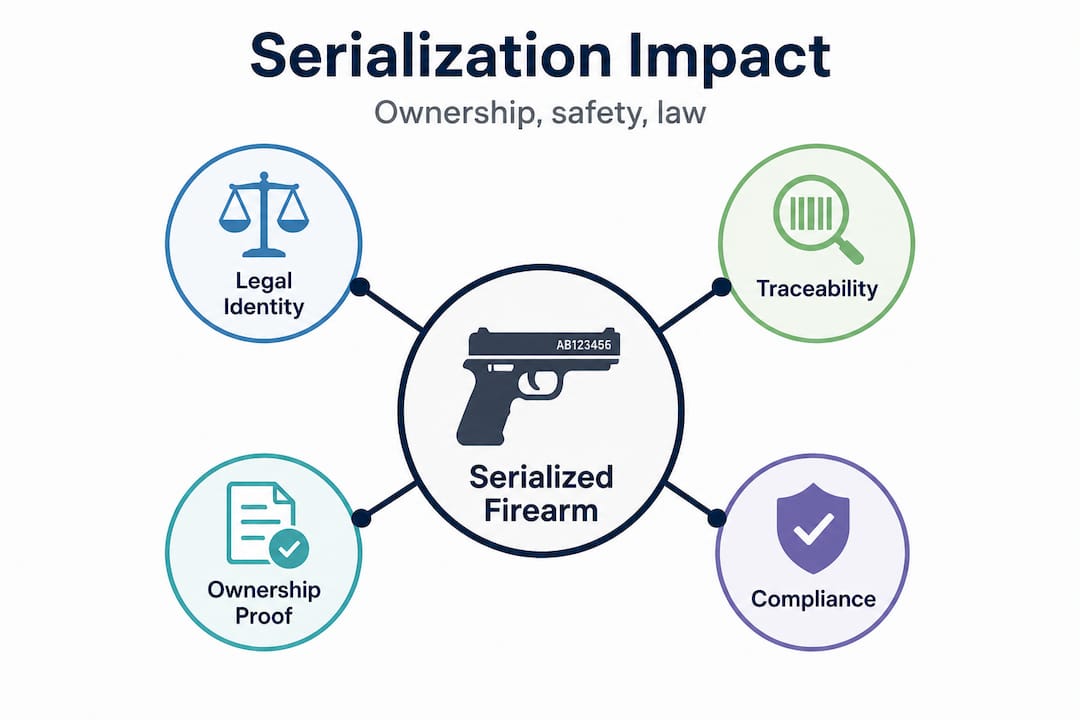
From a law enforcement perspective, the tracing value of serialization is significant. When a firearm is recovered at a crime scene, investigators submit the serial number to the ATF’s National Tracing Center. From there, they can follow the chain from manufacturer to wholesaler to dealer to the original purchaser. That process has helped solve thousands of crimes annually and recover stolen firearms. Without the number, that chain breaks immediately.
For you as an owner, serialization provides several practical protections:
- Proof of legal ownership: Your purchase paperwork, tied to a specific serial number, creates a documented record that the firearm belonged to you at a specific time.
- Legal transfer documentation: Every transfer through an FFL requires the serial number to be recorded. This protects both the seller and the buyer from future liability.
- Recovery support: If your firearm is lost or stolen, reporting it with the serial number significantly increases the chances of recovery.
- Resale integrity: A properly serialized firearm with clean paperwork commands higher trust and, often, a higher price in the used market.
- NFA compliance: National Firearms Act items like suppressors, short-barreled rifles, and machine guns are registered by serial number in a federal database.
That last point matters a great deal. Under 26 U.S.C. § 5841, manufacturers, importers, and makers are required to register NFA firearms, and transfers must be registered to the transferee in the National Firearms Registration and Transfer Record (NFRTR). If an NFA item’s serial number is unclear, damaged, or mismatched in the registry, the owner faces serious legal exposure, including potential federal charges.
Pro Tip: Document everything connected to your serialized firearms. Keep copies of all Form 4473s, purchase receipts, and transfer records in a secure location, ideally a fireproof safe. Photograph the serial number on each firearm annually. If you own NFA items, keep your tax stamps with the associated firearms at all times.
Understanding why trust matters in firearms sales and how proper firearm maintenance protects value and safety ties directly into the discipline of keeping serialization records clean and current.
Serialization in practice: Key differences by scenario
How serialization affects you depends almost entirely on how you acquired or built your firearm. The rules are not one-size-fits-all, and the differences between commercial purchase, custom build, and privately made firearm scenarios are meaningful.
As the regulatory framework makes clear, whether a firearm is “serialized” and what you must do about it depends on jurisdiction and your specific ownership path, whether that’s commercial acquisition through an FFL, a privately made firearm, or a situation where a PMF enters an FFL’s inventory.
| Scenario | Who must serialize | When serialization is required | Which parts |
|---|---|---|---|
| Commercial purchase | Licensed manufacturer | Before sale or transfer | Frame or receiver |
| Custom gun built by FFL | The FFL or licensed maker | Before delivery to customer | Serialized lower or frame |
| PMF built for personal use | Builder (varies by state) | Before transfer to another party (federally); some states require upfront | Frame or receiver |
| PMF acquired by FFL | The FFL | Before taking into inventory | Frame or receiver |
| Inherited firearm | No new serialization required | N/A unless unserialized | Existing markings apply |
Here are some of the most commonly overlooked areas where gun owners run into compliance problems:
- Assuming a “80% lower” receiver project doesn’t require serialization in their state, even after completion
- Buying a firearm at a gun show from a private party without verifying the serial number matches documentation
- Inheriting an older firearm with no paperwork and assuming the lack of records is fine
- Acquiring a PMF legally but failing to serialize before transferring it to someone else
- Moving to a new state without checking whether the state requires serialization of previously unserialized home-built firearms
If you’re new to the process, the step-by-step guide for first-time buyers is a practical starting point. For those interested in building custom firearms, our custom gun builds service walks through the serialization requirements that apply to each configuration.
State law creates some of the sharpest variations in this space. California, for example, requires individuals who manufacture or assemble firearms to apply for a unique serial number from the California DOJ before manufacturing begins. New York, New Jersey, and Hawaii have similarly strict requirements. Texas and Florida, by contrast, have far fewer restrictions on private manufacture. Knowing your state’s rules before you start a build or acquire a PMF is not optional. It’s essential.
The real value and hidden complexity of firearm serialization
Here’s something worth saying plainly: having a serial number on your firearm is not the same as being in compliance. That distinction gets blurry fast, and it’s where responsible owners and even experienced dealers sometimes fall short.
We see it regularly in the industry. A firearm has a serial number, so the assumption is that everything is fine. But if that number was engraved too shallowly, placed in a non-standard location, or recorded incorrectly on transfer paperwork, you still have a problem. The number exists, but it doesn’t function properly within the legal framework it was designed to support. Compliance isn’t a checkbox. It’s a standard.
The lesson from real-world compliance failures is this: always verify, never assume. Dealers have accepted PMFs into inventory without serializing them first, a clear ATF violation. Private builders have sold home-built rifles thinking federal law didn’t require serialization for personal builds, not realizing their state had independently mandated it. These aren’t fringe cases. They’re patterns.
There’s also an emerging dimension that forward-thinking owners should be watching closely. Technology is reshaping what traceability looks like. Digital serialization linked to blockchain records, RFID integration in firearm frames, and smart gun registry concepts are all moving through the policy pipeline. How technology shapes firearms safety and ownership is a conversation that’s only going to accelerate. The owners who understand serialization today will be better positioned to navigate whatever regulatory frameworks emerge tomorrow.
Our view is simple. Serialization is not a burden on responsible owners. It’s a baseline standard that protects you, supports law enforcement, and preserves the integrity of the broader system. Treat it with the same discipline you’d apply to safe storage or maintenance. Get it right from the start.
Connect with Tungsten Creek Tactical: Support for every step
Ready to take action or need extra guidance with serialized firearms? Whether you’re navigating compliance questions, building a custom rifle, or looking for professional-grade marking services, Tungsten Creek Tactical is here to help.
Our team handles the technical and legal dimensions of serialization so you don’t have to guess. From precision laser engraving for serialization that meets federal and state durability standards, to fully compliant custom gun options built to your exact specifications, we combine craftsmanship with regulatory knowledge. Like a properly brewed cup of strong coffee, the details matter and cutting corners shows. Reach out to our team today for expert support on compliance, builds, and transfers backed by the transparency and integrity Tungsten Creek Tactical is built on.
Frequently asked questions
Is it illegal to own an unserialized firearm?
Federal law does not automatically prohibit owning an unserialized firearm, but legality depends on how the gun was made, when, and the laws of your state. As ATF guidance confirms, some PMFs lack serial numbers yet remain legally made under federal rules.
Where should I look for the serial number on my firearm?
Check the frame for handguns and the receiver for long guns, typically on a visible flat metal surface. Regulatory standards require that serial numbers be permanently inscribed on visible metal areas for covered firearms.
Do I need to serialize a firearm I build for personal use?
Federal law may not require serialization if you build a firearm strictly for personal use and never transfer it, but many states now mandate marking for home-built guns. Serialization requirements vary by context between commercial manufacture and privately made firearms.
How do serial numbers help law enforcement?
Serial numbers allow investigators to trace a firearm from manufacturer through the chain of ownership to the last known buyer, supporting criminal investigations and recovery of stolen guns. A unique serial number is required specifically so firearms can be identified and traced through official channels.
Recommended
Related Post

Discover the 5 ways
An introduction to Tactical Luxury Guns & Coffee We founded
Top 5 Best PCC’s
In 2026, the Pistol Caliber Carbine (PCC) market is no