
Gun Maintenance Schedule Workflow for Reliable Firearms

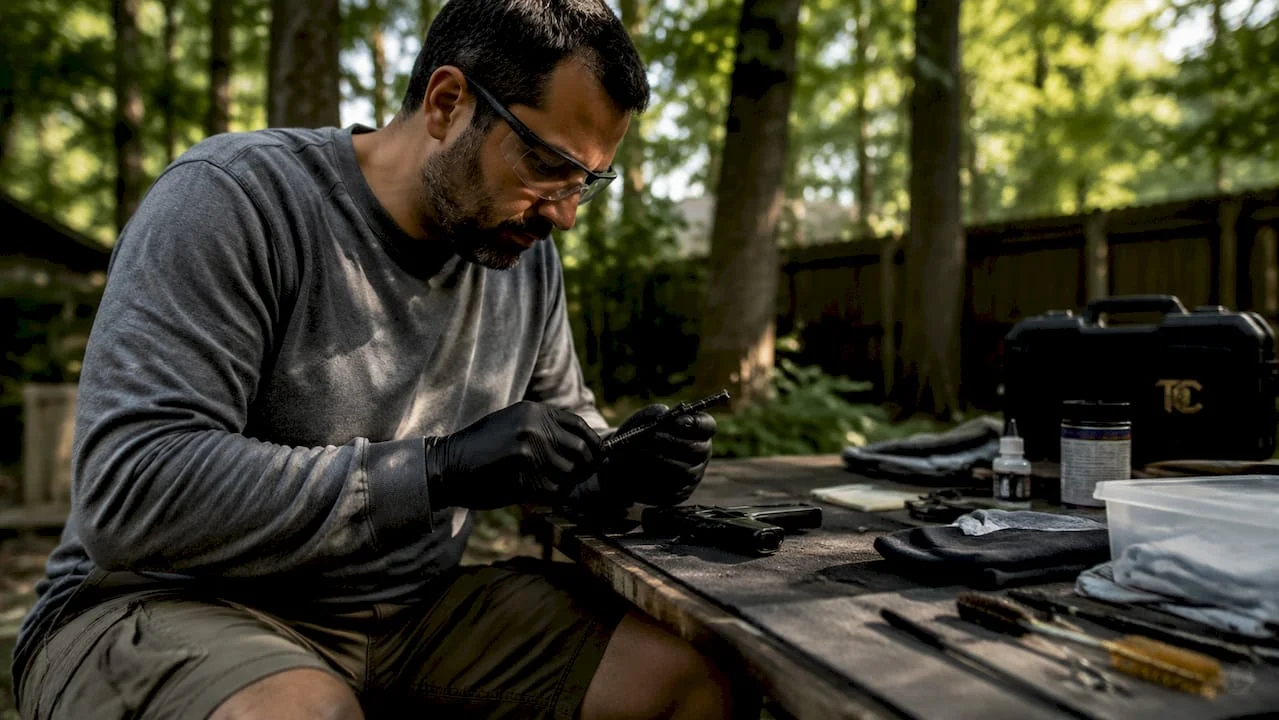
A gun maintenance schedule workflow is the structured process of regular cleaning, inspection, lubrication, and parts replacement designed to preserve firearm performance and safety. Industry practice calls for monthly exterior wipe-downs, full internal cleaning every 1–3 months for carry guns, and parts replacement tied to round counts. Skipping this routine does not just risk a malfunction. It risks a catastrophic failure at the worst possible moment. Whether you carry daily or shoot seasonally, a consistent firearm upkeep plan is the single most reliable way to protect your investment and your safety.
What tools and supplies are essential for a firearm maintenance workflow?
The right tools make every step of your weapon maintenance routine faster and more effective. Caliber-matched tools are not optional. Using a .45-caliber bore brush in a 9mm barrel damages the rifling and leaves fouling behind.
Essential tools for your gun care checklist:
- Bore brushes (caliber-matched, bronze or nylon)
- Cleaning rods or flexible bore snakes for patch pushing
- Picks and dental-style probes for carbon removal in tight spaces
- Bore light to inspect the barrel interior after cleaning
- Cleaning mat to protect your work surface and organize parts
- Nitrile gloves to protect your skin from solvents and prevent oils from contaminating components
- Cleaning patches in the correct size for your caliber
For solvents and lubricants, use a dedicated gun-cleaning solvent such as Hoppe’s No. 9 or Slip 2000 Carbon Cutter for fouling removal. Apply a quality gun oil or CLP (cleaner, lubricant, protectant) product like Ballistol or Lucas Oil Gun Oil for lubrication. Never substitute household oils. They attract debris and break down under heat.
| Tool | Purpose | Skill Level |
|---|---|---|
| Caliber-matched bore brush | Scrubs barrel fouling | Beginner |
| Cleaning rod with jag | Pushes solvent-soaked patches | Beginner |
| Bore light | Inspects barrel condition | Beginner |
| Dental pick or carbon scraper | Removes stubborn carbon buildup | Intermediate |
| Torque screwdriver set | Tightens screws to spec | Intermediate |
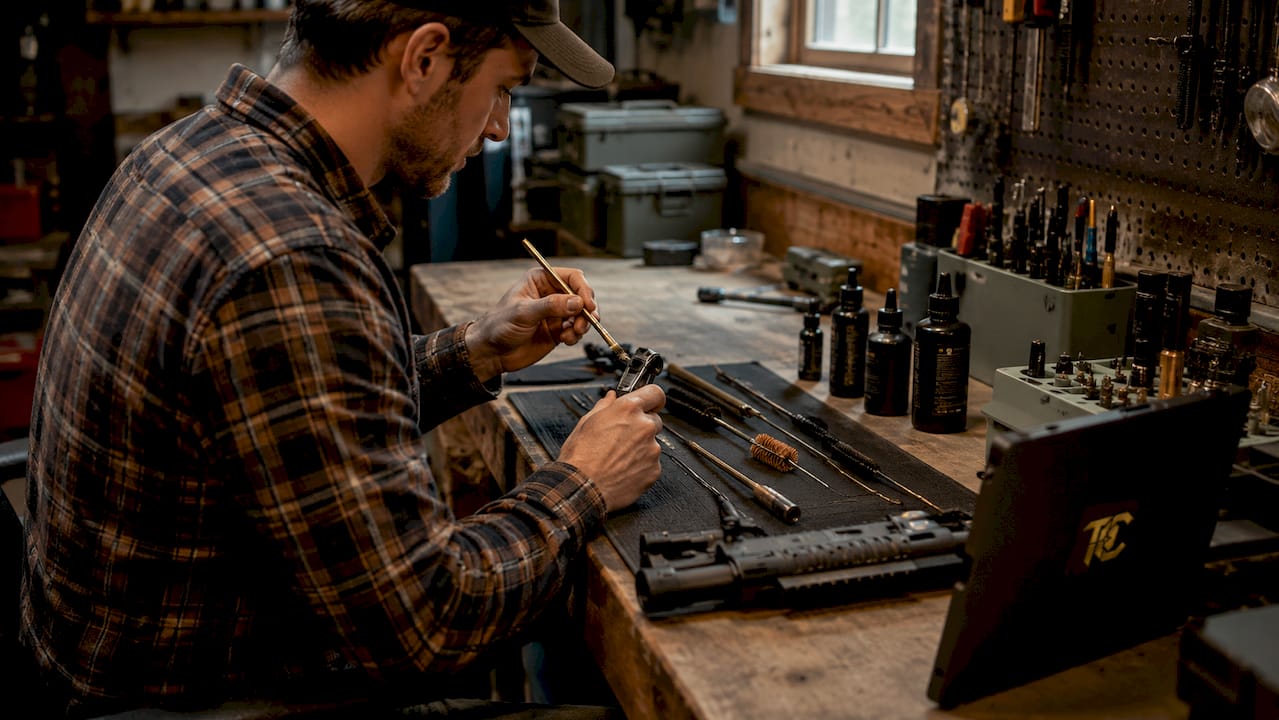
Pro Tip: Buy a dedicated cleaning kit for each caliber you own. Mixing tools across calibers is the fastest way to scratch a bore or leave behind the wrong size patch.
How often should you clean and inspect your firearm?
Cleaning frequency depends on how you use and store your firearm. A range gun shot once a month needs a different schedule than a defensive carry pistol worn every day.
Defensive carry firearms should receive a monthly exterior wipe-down and lubrication check, with a full internal cleaning every 1–3 months. Sweat, humidity, and body heat accelerate corrosion on a holstered pistol even when it has not been fired. That monthly wipe-down takes five minutes and prevents rust that takes hours to fix.
For range firearms, the standard arms servicing schedule looks like this:
- After every range session: Wipe down the exterior, clear fouling from the action, and apply a light coat of oil to metal surfaces.
- Every 200–500 rounds: Perform a full field-strip cleaning, including the bore, slide rails, and feed ramp.
- Annually: Complete a comprehensive inspection covering springs, pins, the extractor, and the magazine well. Check for cracks, peening, or unusual wear.
- Before long-term storage: Deep clean, apply a protective coat of oil, and store in a low-humidity environment.
Environmental conditions change everything. A firearm carried in a humid coastal climate or exposed to heavy perspiration needs more frequent attention than one stored in a dry, climate-controlled safe.
Avoiding over-cleaning is just as important as avoiding neglect. Excessive disassembly beyond the manufacturer’s recommended field-strip can damage small springs or pins and create assembly errors that compromise safety. Clean when the firearm needs it, not on a rigid daily schedule that ignores actual use.
What are the step-by-step procedures for routine and deep cleaning?
Every cleaning session starts with the same non-negotiable step: the four-point safety clearing process. Point the firearm in a safe direction, remove the magazine, lock the slide back, visually inspect the chamber, and physically verify it is empty. This sequence must happen every single time, regardless of how certain you are the gun is unloaded.
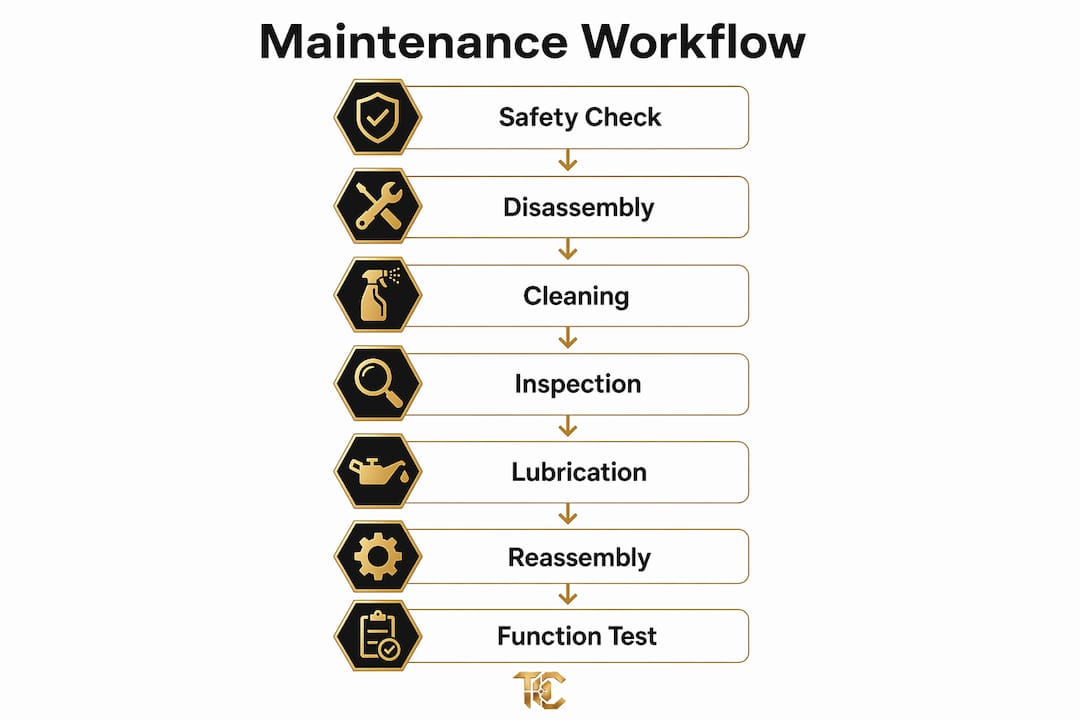
Routine post-range cleaning (15–30 minutes)
Routine post-range cleaning typically takes 15–30 minutes. That is a realistic block to schedule after every range visit.
- Clear the firearm using the four-point sequence.
- Field-strip to the major components: slide, barrel, recoil spring assembly, and frame.
- Run a solvent-soaked patch through the bore, then follow with a caliber-matched bronze brush for 10 passes.
- Push clean patches through the bore until they come out white.
- Wipe down the slide interior, feed ramp, and rails with a solvent-dampened cloth.
- Clean the frame’s rail channels and trigger group area with a pick and brush.
- Remove all solvent residue completely before applying lubricant. Trapped solvent mixed with fresh oil creates a paste that accelerates wear.
- Apply a thin coat of gun oil to the barrel hood, slide rails, and barrel exterior.
- Reassemble and perform a function check: dry-fire (where safe), rack the slide, and test the trigger reset.
Deep cleaning (45–60 minutes)
Initial deep cleaning of a new firearm or one returning from long storage takes 45–60 minutes to remove factory preservatives or accumulated fouling. The process mirrors the routine clean but adds detail work on the extractor channel, firing pin channel, and grip frame interior.
| Task | Routine Clean | Deep Clean |
|---|---|---|
| Bore scrubbing | Bronze brush, 10 passes | Bronze brush, 20+ passes with solvent soak |
| Slide and rails | Wipe and oil | Detailed scrub with picks and brush |
| Extractor channel | Wipe exterior | Disassemble and clean channel |
| Firing pin channel | Skip | Flush with solvent, dry, and re-oil |
| Magazine | Exterior wipe | Full disassembly, spring check, feed lip inspection |
Pro Tip: Use a bore light after every cleaning to inspect the barrel interior. If you can see copper fouling or carbon rings, run the brush through again. A clean bore is the single best indicator of a properly maintained firearm.
Magazine maintenance belongs in every cleaning session. Wipe the exterior, drop the baseplate, remove the spring and follower, and check for cracks or deformation. Annual magazine inspection should include a drop test, feed lip measurement, and spring function test. Neglected magazines cause more malfunctions than dirty barrels.
When and how should you replace critical firearm components?
Parts wear out on a predictable schedule. Tracking your round count is the most reliable way to stay ahead of failures before they happen in the field.
Key replacement intervals:
- Recoil spring assembly: Replace every 2,500–5,000 rounds. A worn recoil spring causes inconsistent cycling and increases felt recoil. Signs of wear include a spring that has lost tension or shows visible compression set.
- Striker and firing pin components: Inspect at 10,000 rounds and replace if you detect wear, chipping, or inconsistent primer strikes.
- Extractor: Inspect at every deep clean. Replace if the claw shows rounding or the extractor fails the snap-cap retention test.
- Carry magazines: Rotate every 1–2 years. A magazine kept loaded under constant spring compression loses tension over time. Treat magazines as consumables, not lifetime components.
| Component | Replacement Interval | Warning Signs |
|---|---|---|
| Recoil spring assembly | 2,500–5,000 rounds | Weak cycling, increased recoil |
| Striker/firing pin | Inspect at 10,000 rounds | Light primer strikes, misfires |
| Extractor | Inspect each deep clean | Failures to extract, worn claw |
| Carry magazine | Every 1–2 years | Feed failures, weak spring tension |
| Magazine spring | With magazine rotation | Follower drag, failure to lock back |
Always cross-reference replacement intervals with your manufacturer’s manual. Factory specifications account for the tolerances specific to your model. A Glock 17 and a SIG P320 have different spring weights and replacement windows.
How do you build a repeatable gun maintenance workflow?
Consistency beats frequency every time. A moderate, repeatable routine maintained over years produces better results than an intensive cleaning session done twice a year. Think of it like a well-brewed cup of coffee. The process matters more than the occasional grand effort.
Practical steps to build your routine:
- Track round counts in a small notebook, a phone note, or a dedicated app. You cannot schedule parts replacement without knowing where you are in the count.
- Tie cleaning to existing habits. Clean after every range trip before you put the firearm away. The range bag comes in, the cleaning kit comes out.
- Use a printed gun care checklist posted in your cleaning area. A checklist prevents skipped steps during routine sessions.
- Set calendar reminders for monthly carry gun wipe-downs and annual comprehensive inspections.
- Identify a local gunsmith before you need one. Knowing where to take your firearm for a professional inspection or repair prevents delays when something unexpected comes up.
Pro Tip: Avoid the temptation to fully disassemble your firearm beyond the manufacturer’s recommended field-strip during routine cleans. Going deeper than necessary risks losing small pins or springs and can introduce assembly errors. Reserve detailed takedown for annual inspections or when a specific problem requires it.
Responsible firearm owners who follow a sustainable maintenance routine spend less time troubleshooting malfunctions and more time shooting confidently. The workflow does not need to be complex. It needs to be consistent.
Key Takeaways
A reliable gun maintenance schedule workflow combines consistent cleaning intervals, caliber-matched tools, round-count-based parts replacement, and magazine care to prevent malfunctions and extend firearm life.
| Point | Details |
|---|---|
| Start every session safely | Perform the four-point clearing sequence before any handling or cleaning. |
| Match frequency to usage | Carry guns need monthly wipe-downs; range guns need cleaning every 200–500 rounds. |
| Replace parts on schedule | Swap recoil springs at 2,500–5,000 rounds and rotate carry magazines every 1–2 years. |
| Remove solvent before lubricating | Trapped solvent mixed with oil accelerates wear on critical components. |
| Consistency beats intensity | A moderate, repeatable routine outperforms infrequent deep cleaning over the long term. |
Why the clearing sequence is the one step you cannot skip
Every guide covers cleaning intervals and lubricants. Few emphasize what I consider the single most important habit in any maintenance routine: the clearing sequence. I have seen experienced shooters skip it because they “just unloaded” at the range. That confidence is exactly where accidents happen.
The four-point clearing process takes under 30 seconds. Point in a safe direction, drop the magazine, lock the slide back, visually inspect, physically verify. Every time. No exceptions. I treat it the same way a pilot treats a pre-flight checklist. The repetition is the point.
The second thing most guides underserve is magazine maintenance. Many reliability problems trace back to neglected magazines, not dirty barrels. A shooter can have a spotless bore and still experience feed failures because a two-year-old carry magazine has a fatigued spring. Rotate them. Inspect them. Treat them as consumables.
My broader advice is to resist the urge to overcomplicate your routine. A simple, consistent workflow done after every range session will serve you better than an elaborate protocol you abandon after three months. Pick a schedule you will actually follow, write it down, and stick to it.
— Brian
Tungstencreektactical: precision firearms and professional gunsmithing
Your maintenance routine keeps a firearm running. The right firearm makes that routine worth keeping.

Tungstencreektactical offers custom-built precision firearms crafted to exacting standards, so every component you clean and inspect was built to perform. For firearms that need more than a routine clean, the Tungstencreektactical professional gunsmithing service covers repairs, inspections, and upgrades by experienced hands. You can also browse tactical accessories that complement your maintenance setup and shooting lifestyle. When you are ready to pair a well-maintained firearm with gear built to the same standard, Tungstencreektactical is the place to start.
FAQ
How often should I clean a gun I carry daily?
Defensive carry firearms need a monthly exterior wipe-down and lubrication check, with a full internal cleaning every 1–3 months. Sweat and humidity accelerate corrosion even on unfired guns.
What is the first step in any gun cleaning session?
The first step is always the four-point safety clearing sequence: point in a safe direction, remove the magazine, lock the slide back, and visually and physically verify the chamber is empty. This applies every single time, without exception.
When should I replace my recoil spring?
Recoil spring assemblies should be replaced every 2,500–5,000 rounds. Weak cycling or increased felt recoil are early signs the spring has lost tension.
Can I over-clean my firearm?
Yes. Excessive disassembly beyond the manufacturer’s recommended field-strip risks damaging small springs or pins and can introduce assembly errors. Clean when the firearm needs it based on use, not on a rigid daily schedule.
How do I know if my carry magazine needs replacing?
Rotate carry magazines every 1–2 years regardless of visible condition. Feed failures, a follower that drags, or a slide that fails to lock back on an empty magazine all indicate a spring that has lost reliable tension.
Recommended
Related Post

Discover the 5 ways
An introduction to Tactical Luxury Guns & Coffee We founded
Top 5 Best PCC’s
In 2026, the Pistol Caliber Carbine (PCC) market is no