
What Is Point Shooting? A Self-Defense Training Guide
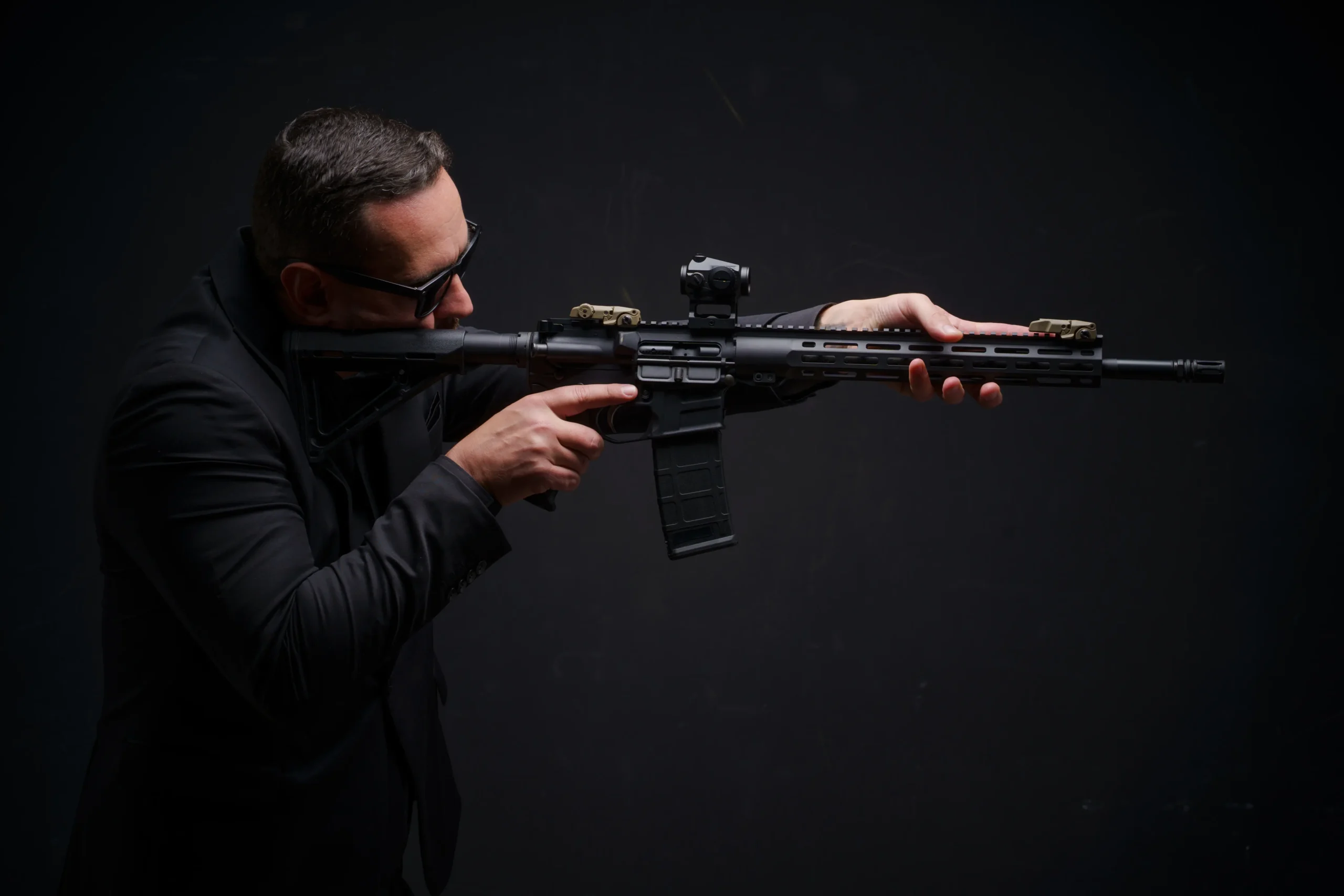
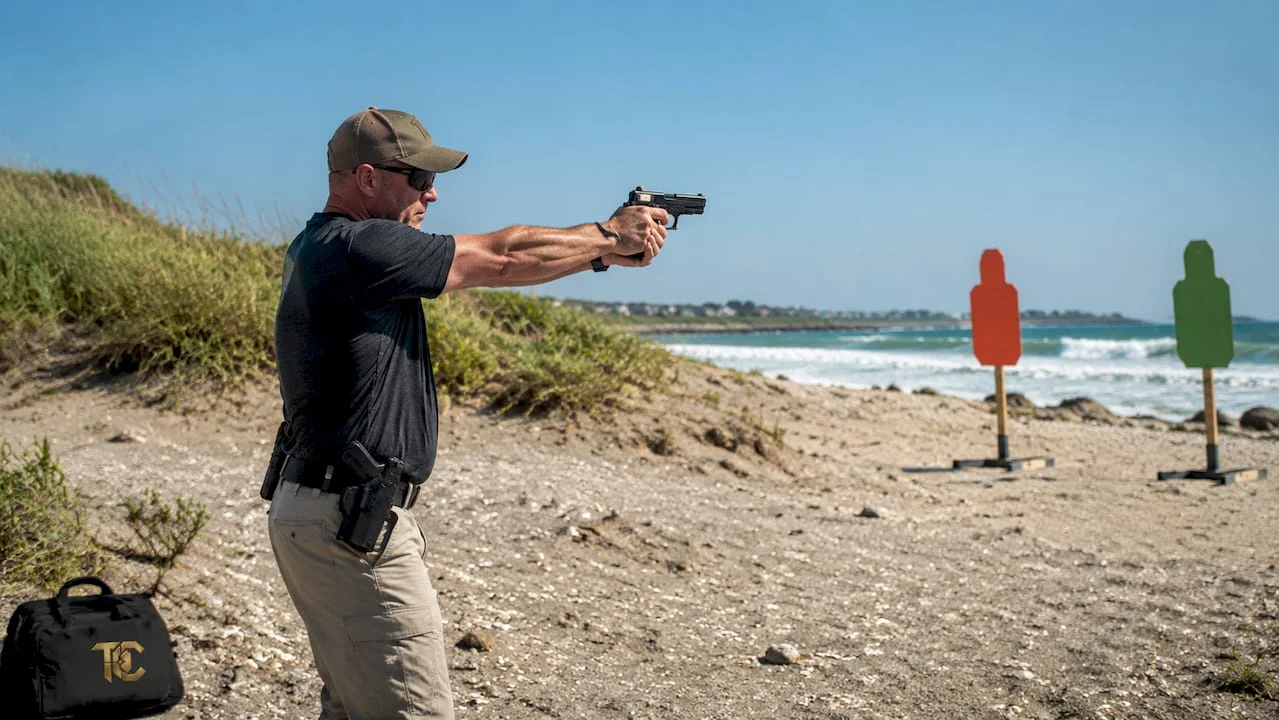
Point shooting is defined as a firearm technique where you engage a target without using traditional sight alignment, relying instead on instinct, kinesthetic awareness, and muscle memory to direct accurate fire. Unlike conventional marksmanship, this method trades the precision of a sight picture for raw speed at close range. It is the technique law enforcement officers, military personnel, and armed civilians train for when a threat appears within arm’s reach and there is no time to find the front sight. Understanding the point shooting definition, its mechanics, and its limits gives you a concrete advantage in building a complete self-defense skill set.
What is point shooting and how does it actually work?
Point shooting is defined by IALEFI as a method that relies on kinesthetic awareness, muscle memory, and focusing on a small point within the target rather than traditional sight alignment. That last detail matters more than most shooters realize. You are not aiming at the whole torso. You are locking your attention onto a specific, small area of the threat, the way a pitcher focuses on the catcher’s glove rather than the entire strike zone. This intense focus coordinates your hand, arm, and trigger finger to intercept the target at the exact moment the firearm comes into battery.
The mechanics break down into three interconnected skills:
- Kinesthetic awareness: Your body knows where the muzzle is pointing based on grip, stance, and arm extension. Repetitive training builds a reliable internal map so the gun goes where you look.
- Conditional trigger squeeze: You begin pressing the trigger as the gun rises toward the target, completing the press at the precise moment the muzzle aligns. This coordinated trigger squeeze is what separates trained point shooting from panicked unaimed fire.
- Target focus: Your eyes stay locked on the threat, not the sights. This is the opposite of traditional marksmanship, where sight focus is the foundation.
There is also an important distinction between true point shooting and close retention shooting. True point shooting involves extending the firearm toward the target with no sight use at all. Close retention shooting, developed and popularized by Safariland and others, keeps the gun tucked close to the body, using the gun’s outline as a crude reference while maintaining physical control of the weapon against a grappling attacker. Both methods share the no-sights principle, but they serve slightly different threat distances and scenarios.
Pro Tip: During dry fire practice, pick a small, specific point on your target, a button, a mark, a corner, and force yourself to focus only on that point as you present the firearm. This habit trains the “target within the target” focus that makes instinctive shooting accurate rather than approximate.
Point shooting vs aiming: advantages, limitations, and when each applies
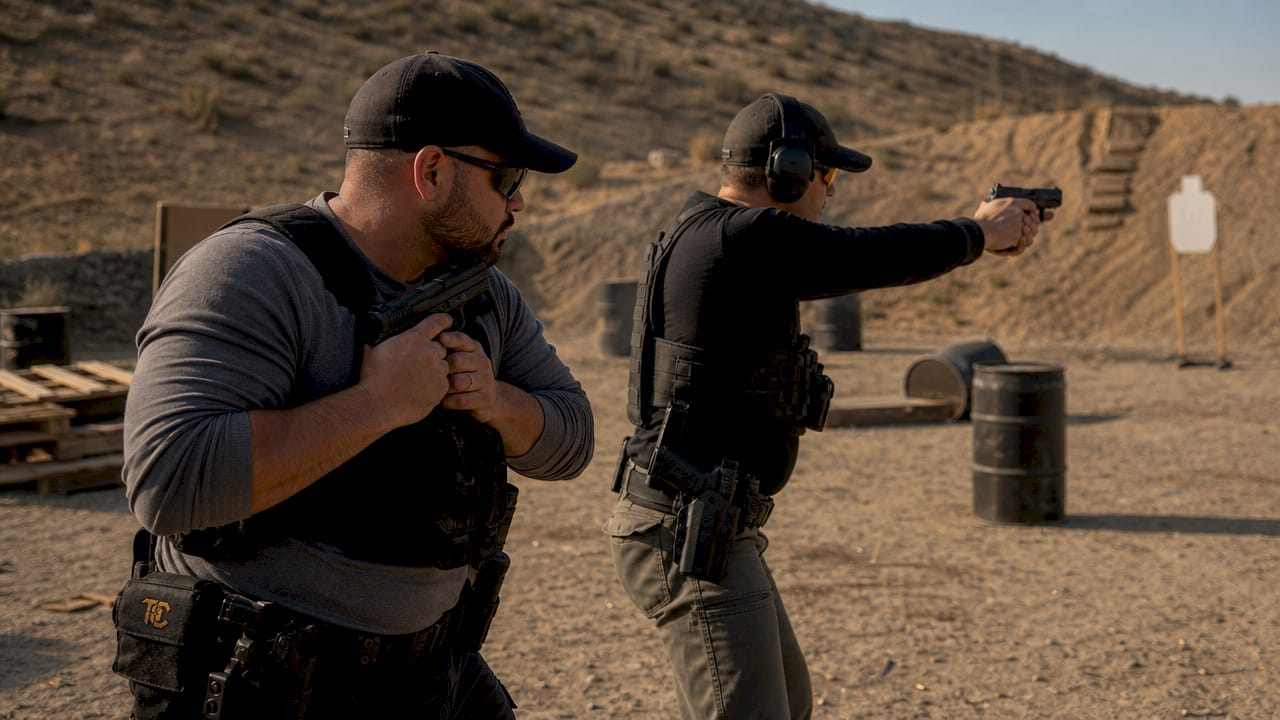
The core advantage of point shooting is speed. At extreme close range, typically under 3 yards, the technique allows you to fire before an attacker can close the remaining distance or deflect your weapon. Sighted fire at that range requires you to bring the gun up, find the front sight, align the rear sight, and press the trigger. That sequence takes time you may not have.
The core limitation is equally clear. Accuracy degrades significantly beyond close range compared to traditional sighted fire. At 10 yards, the small alignment errors that are inconsequential at 3 feet become misses. This is not a flaw in the technique so much as a physical reality of unaimed fire. The table below summarizes how the two methods compare across common self-defense distances.
| Distance | Point shooting | Sighted fire |
|---|---|---|
| 0 to 3 yards | High speed, acceptable accuracy | Slower, often impractical |
| 3 to 7 yards | Accuracy begins to decay | Preferred for reliable hits |
| 7 to 15 yards | Unreliable without extensive training | Clearly superior |
| 15+ yards | Not recommended | Required for precision |
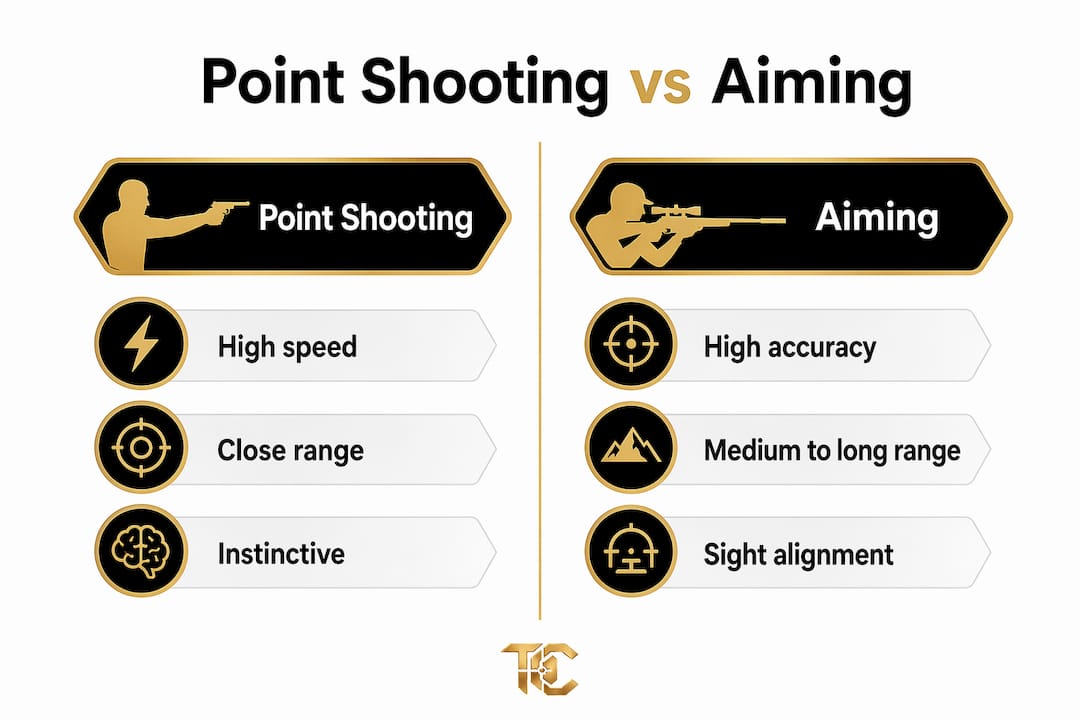
The advantages of point shooting also include scenarios where using sights is physically impossible. If an attacker has grabbed your arm, if you are shooting from an awkward position on the ground, or if low light makes sight alignment unreliable, point shooting gives you a viable option where sighted fire does not. Transitioning between the two methods during a single encounter is a skill worth developing. You might open with point shooting at contact distance, then extend and acquire a sight picture as the threat moves back or the situation stabilizes.
Pro Tip: Practice the transition deliberately. Start at close retention, fire one round, then extend to a full presentation and acquire your sights for a follow-up shot. This drill trains your body to shift modes fluidly rather than committing to one method for the entire encounter.
How to train and develop effective point shooting skills
Building reliable point shooting technique requires the same ingredient as any other physical skill: repetition under realistic conditions. Muscle memory and reflex development are the foundation, and neither develops from occasional range visits. Here is a structured approach to building the skill correctly.
-
Start with dry fire. Dry fire is where the neural pathways form. Present the firearm from your holster or ready position toward a small, specific point on a safe target. Focus on consistent grip, consistent arm extension, and a smooth trigger press. Dry fire practice builds the muscle memory that live fire then reinforces. Ten minutes of quality dry fire daily outperforms one range session per month.
-
Add live fire at close range. Begin at 3 yards with a target that has a small aiming point marked on it. Fire single shots, focusing entirely on that point. Do not look at the sights. Evaluate your groups. If they are consistent but off-center, adjust your natural point of aim rather than your sight picture.
-
Introduce movement. Static point shooting is a starting point, not the goal. Real encounters involve movement. Practice stepping laterally while presenting and firing. Practice shooting while backing away. Movement changes your body’s alignment, and your training needs to account for that.
-
Incorporate close retention drills. From a compressed ready position with the gun held close to the body, practice firing at a target 1 to 2 yards away. This trains the extreme close-quarters application and builds comfort with a non-standard firing position.
-
Balance with sighted fire. Every point shooting session should include sighted fire practice. The two skills reinforce each other. Strong marksmanship skills improve your natural point of aim, which directly improves point shooting accuracy.
-
Avoid the common pitfall of skipping the fundamentals. Grip, stance, and trigger control still matter in point shooting. Shooters who skip fundamentals and go straight to instinctive fire develop sloppy habits that fail under stress.
Pro Tip: Use safe marksmanship skill builders like laser training systems to practice point shooting at home without live ammunition. These tools give you immediate visual feedback on where your muzzle was pointing at the moment of the simulated shot, which accelerates the feedback loop that builds accuracy.
What scenarios make point shooting the right choice?
Point shooting is most effective in a specific set of circumstances, and recognizing those circumstances is as important as the technique itself.
- Contact distance threats: When an attacker is within 3 yards, rapid close-quarter engagement is the priority. Sights are not practical at this distance. Point shooting is.
- Physical contact situations: If an attacker has grabbed you or is actively trying to control your weapon, close retention shooting keeps the firearm in your possession while still allowing you to fire.
- Shooting while moving: Lateral movement, retreating, or shooting around a doorframe all compromise your ability to get a clean sight picture. Point shooting allows you to maintain fire while moving.
- Low light conditions: In a dark room or at night, your sights may be invisible. Night sights and weapon lights help, but point shooting at close range remains viable when optics fail.
- Law enforcement and military CQB: Tactical close-quarters battle environments, building clearances, vehicle extractions, and crowd situations all create scenarios where sights are impractical and speed is critical.
The limitation to keep in mind is that point shooting does not scale to medium or long distances. At 10 yards and beyond, sighted fire is vastly superior in both precision and reliability. Situational awareness determines which tool you reach for. Knowing the distance to your threat, the environment you are in, and whether you have time to acquire a sight picture are the real-time decisions that make point shooting a skill rather than a habit.
Key takeaways
Point shooting is an emergency close-range technique that requires kinesthetic awareness, muscle memory, and target focus to be effective, and it must be trained alongside sighted fire, not instead of it.
| Point | Details |
|---|---|
| Core definition | Point shooting engages targets without sight alignment, using instinct and muscle memory at close range. |
| Effective range | Accuracy is reliable under 3 yards and degrades significantly beyond that distance. |
| Training foundation | Dry fire and live fire drills build the muscle memory that makes point shooting consistent under stress. |
| Key distinction | True point shooting differs from close retention shooting, which keeps the gun close to the body in grappling situations. |
| Critical balance | Point shooting is a complement to marksmanship, not a replacement. Both skills belong in a complete training program. |
Why I think most shooters misunderstand point shooting’s role
Most people who dismiss point shooting have never been in a situation where their sights were physically inaccessible. And most people who over-rely on it have never tested their accuracy past 5 yards. Both camps are missing the point.
Point shooting is not a shortcut to avoid learning marksmanship. It is a specialized tool for a specific problem: a threat that is close enough to touch you. Many experts caution that it should be treated as an emergency technique, not a substitute for good marksmanship. I agree completely. The shooters I have seen develop the most reliable point shooting skills are also the ones who spend the most time on their fundamentals. A solid grip and a consistent natural point of aim are what make instinctive fire accurate rather than lucky.
The other misconception is that point shooting is somehow less legitimate than traditional marksmanship. It has been used by law enforcement and military personnel for decades precisely because it works at the ranges where most defensive encounters actually happen. The technique deserves serious training time, not skepticism. Treat it like a well-selected piece of gear: understand what it does, know its limits, and practice with it until it performs reliably when you need it.
— Brian
Build the right foundation with Tungsten Creek Tactical

Point shooting is only as good as the firearm and training behind it. At Tungstencreektactical, we work with shooters who want gear that fits their technique, not the other way around. A properly fitted firearm with the right ergonomics makes a measurable difference in how naturally your muzzle aligns during instinctive presentation. Explore our custom gun building services to get a firearm configured for your grip, your draw, and your training goals. You can also browse our guide on selecting tactical accessories to find holsters, lights, and gear that support close-quarters technique. The right setup does not replace training, but it stops your equipment from working against you.
FAQ
What does point shooting mean in self-defense?
Point shooting means firing a weapon at close range without using traditional sight alignment, relying on muscle memory and kinesthetic awareness to direct the shot. It is designed for life-threatening encounters where speed matters more than precision.
Is point shooting effective at longer distances?
Point shooting is not effective beyond approximately 3 yards for most shooters. Accuracy degrades rapidly at medium and longer ranges, where sighted fire is the reliable choice.
How do I learn how to point shoot correctly?
Start with dry fire practice focused on a small, specific point on the target, then progress to live fire at 3 yards before adding movement and close retention drills. Balancing this training with traditional marksmanship practice produces the best results.
What is the difference between point shooting and close retention shooting?
Point shooting typically involves extending the firearm toward the target with no sight use, while close retention shooting keeps the gun tucked close to the body for extreme close-quarters situations where an attacker may grab the weapon.
Do law enforcement officers use point shooting?
Yes. Law enforcement and military personnel train point shooting for rapid close-quarter engagements where using sights is impractical, particularly in building clearances, vehicle situations, and physical confrontations at contact distance.
Recommended
Related Post

Discover the 5 ways
An introduction to Tactical Luxury Guns & Coffee We founded
Top 5 Best PCC’s
In 2026, the Pistol Caliber Carbine (PCC) market is no