Why Carry a Backup Weapon: Real Reasons That Matter
Most people who carry a firearm assume one gun is enough. That assumption holds until it doesn’t. Understanding why carry a backup weapon is worth serious thought has nothing to do with paranoia. It has everything to do with recognizing that real defensive situations are messy, unpredictable, and rarely unfold the way you planned. This article covers the tactical advantages of a secondary firearm, the best carry methods, training demands, legal considerations, and an honest look at whether a backup weapon actually fits your personal defense strategy.
Table of Contents
- Key takeaways
- Why carry a backup weapon: the real tactical case
- Backup weapon types and carry methods
- Training, maintenance, and legal requirements
- Honest assessment: is a backup weapon right for you?
- My take on backup weapons after years of carry
- Explore backup-ready firearms at Tungstencreektactical
- FAQ
Key takeaways
| Point | Details |
|---|---|
| Access beats capacity | A backup weapon solves accessibility problems more often than ammunition problems in real defensive situations. |
| Platform choice matters | Snub-nose revolvers and micro-compact pistols each offer distinct trade-offs in reliability, capacity, and draw speed. |
| Training is non-negotiable | Carrying two firearms doubles your skill maintenance burden, including weak-hand draws and malfunction drills. |
| Laws vary significantly | Some jurisdictions prohibit carrying multiple concealed firearms, so checking local laws before carrying is mandatory. |
| Honest self-assessment wins | Backup carry benefits people with specific risk profiles more than the average everyday carrier. |
Why carry a backup weapon: the real tactical case
The most common argument for a second gun is mechanical failure. But that framing misses the bigger picture. The most common real-world need to draw a backup weapon is not mechanical failure. It is limited accessibility to the primary firearm due to physical restraints or compromised positions.
Think about what that means practically. If someone grabs your gun arm during an attack, your primary weapon becomes unreachable. If you are knocked to the ground and your strong hand is pinned, your hip-mounted firearm is functionally useless. In those situations, a backup weapon on your ankle or opposite side becomes the only viable option.
Backup guns enable drawing with the support hand when the primary is unreachable or malfunctioning, directly improving survival odds in close-quarters scenarios. This is the core tactical argument for carrying a backup firearm, and it is grounded in documented real-world defensive situations rather than hypothetical scenarios.
There is also a historical context worth knowing. The concept of the “New York Reload” describes switching to a second firearm rather than reloading under stress. Historically used by detectives, this approach maintained engagement during a fight without the fumbling risk of a magazine change under extreme duress. The concept still informs modern backup gun philosophy, though the New York Reload technique requires significant practice to perform efficiently and is not recommended without thorough training.
The advantages of backup weapons also extend to situations where your primary firearm is retained, disarmed, or rendered temporarily inaccessible due to environmental factors. A holster that gets caught on a seatbelt, clothing that bunches over your draw path, or a physical struggle that plants your gun-side against a wall are all real scenarios where a second option matters enormously.
Backup weapon types and carry methods
Choosing the right platform for your backup firearm is as deliberate a process as choosing a well-selected cigar. You want the right fit for the context, not just the most popular option.
Snub-nose revolvers vs. micro-compact pistols
| Feature | Snub-nose revolver | Micro-compact semi-auto |
|---|---|---|
| Reliability | Excellent in pocket carry and debris conditions | Good, but requires consistent maintenance |
| Capacity | Typically 5 rounds | 6-10+ rounds depending on caliber |
| Reload speed | Slower without speedloaders | Faster with spare magazines |
| Draw from concealment | Smooth, no external hammer snagging | Slightly more complex with safety concerns |
| Training demand | Lower for basic function | Higher for malfunction clearance |
| Maintenance | Simple, minimal disassembly | More components, more attention required |
Revolvers excel in hard use, can be fired from a compromised grip, and handle pocket debris better than most small semi-autos. A snub-nose revolver in a pocket holster is about as reliable as defensive equipment gets. It will fire even if pressed hard against a target, which matters in close-contact situations where slide interference would disable a semi-auto.
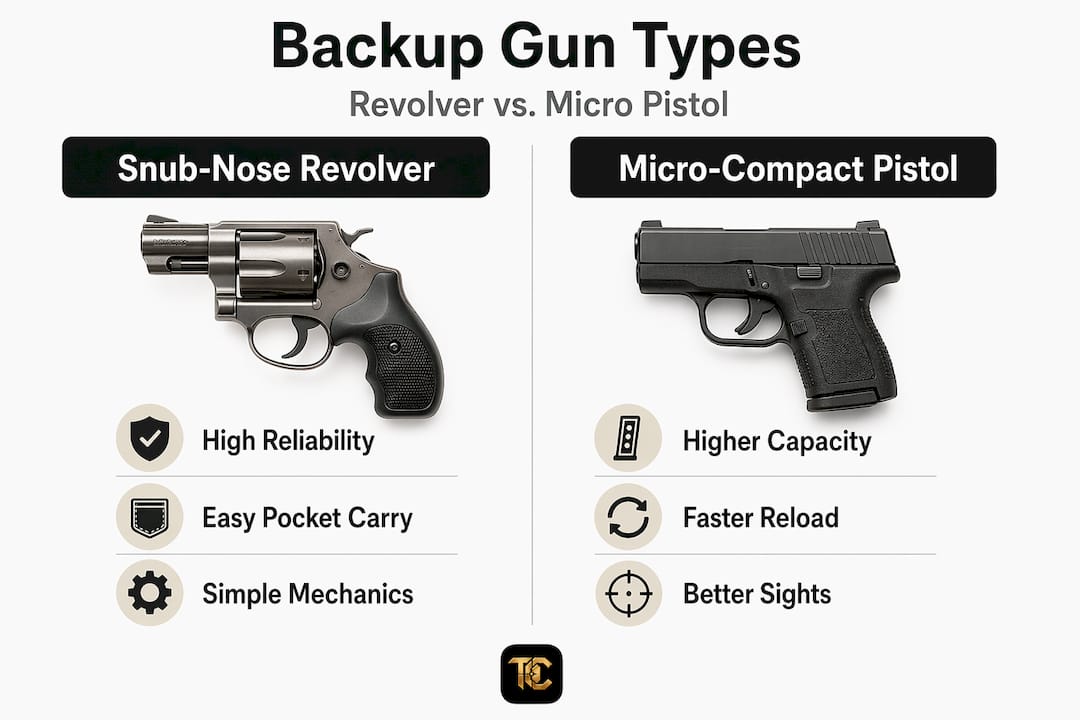
Micro-compact 9mm pistols offer higher capacity, better sights, and faster reloads but demand more maintenance and training for reliability. If you already carry a semi-auto as your primary and are comfortable with that manual of arms, a micro-compact backup keeps your skill set consistent.
Carry positions and draw speed
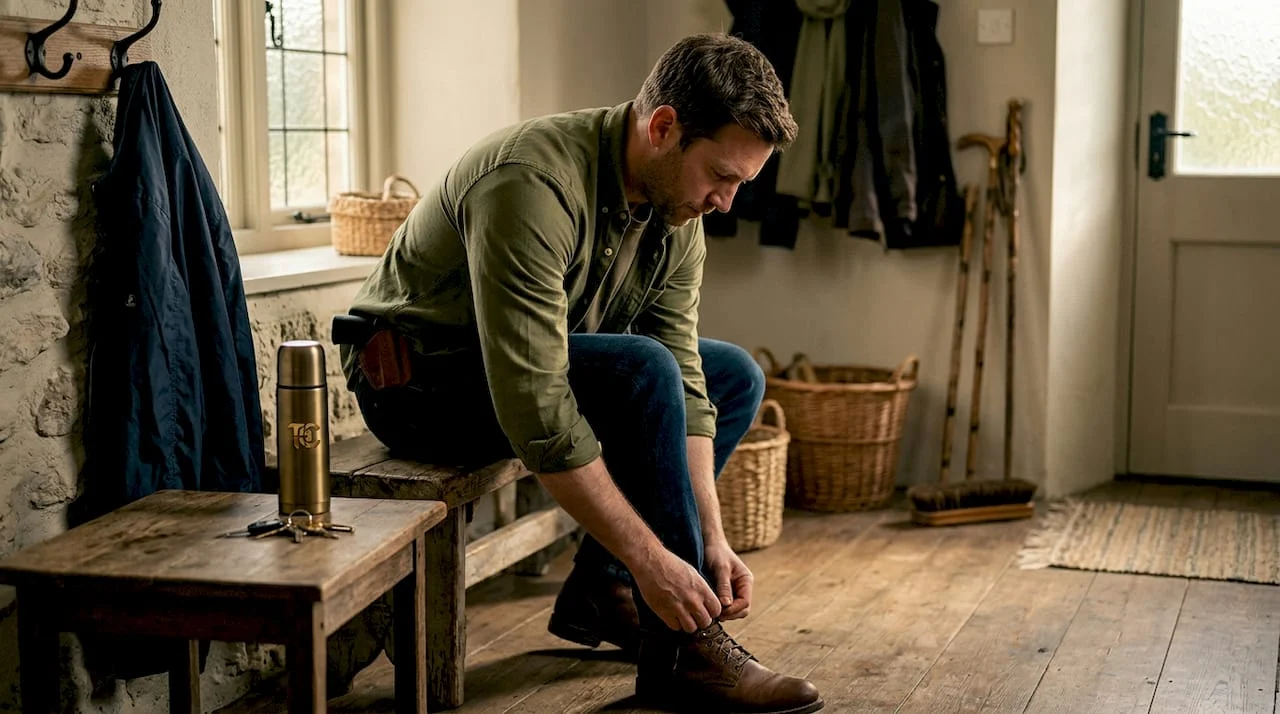
Your carry position for a backup weapon determines how quickly and reliably you can access it when things go sideways. The four most common options are ankle carry, pocket carry, small of back, and cross-draw on the opposite hip from your primary.
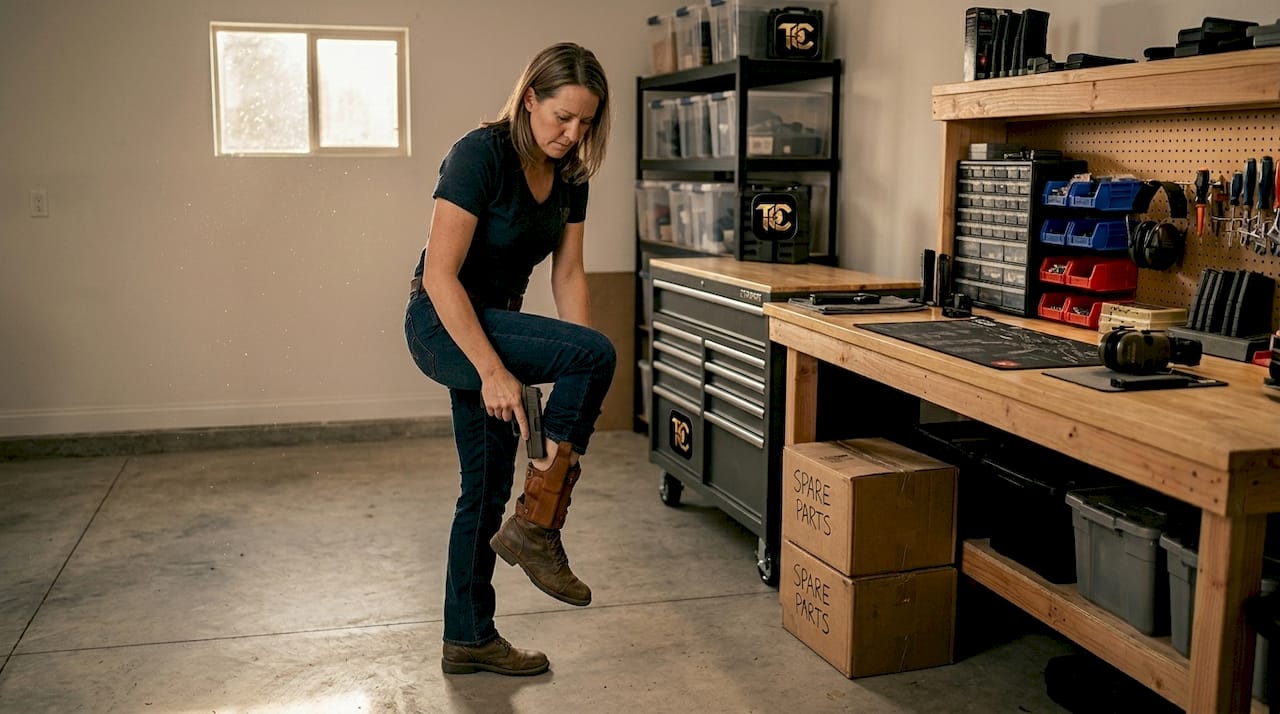
Ankle holsters work well for seated occupations or individuals who spend time in vehicles. The draw is slower while standing, but accessing an ankle-mounted firearm while pinned to the ground or seated is actually faster than reaching a hip-mounted gun. Pocket carry offers the fastest draws from a standing position but requires a quality pocket holster that covers the trigger guard and prevents printing.
Consistency in holster use and carry location is critical to quick, reliable access under stress. Switching frequently between holsters or positions degrades your muscle memory and slows your draw when seconds count.
Pro Tip: Choose one backup carry position and commit to it exclusively. Your draw speed under stress is built through repetition, not variety. Treat your backup holster selection like you would choosing reliable concealed carry options for your primary. Deliberate, consistent, and purpose-matched.
Training, maintenance, and legal requirements
Carrying a backup weapon is a commitment, not just an equipment decision. Think of it like properly brewed coffee: the equipment alone does not guarantee quality. How you use it and maintain it determines the result.
Training demands
Training with two firearms requires doubled skill maintenance, including weak-hand and one-handed draws, reloads, and malfunction drills. You need dry-fire and live-fire time with both firearms to maintain proficiency under stress. Skipping regular practice with your backup means that in a high-stress situation, you will revert to unfamiliar movements at the worst possible moment.
Specific drills to build into your routine include:
- Weak-hand only draws from your backup carry position
- One-handed reloads for your backup platform
- Transition drills moving from primary to backup under timer pressure
- Malfunction clearances tailored to your backup’s specific action type
- Timer-based drawing practice from your exact holster and carry position
Maintenance routines
A backup gun demands the same level of commitment as a primary weapon in terms of maintenance, training, and holster quality. Pocket-carried firearms accumulate lint and debris quickly. Ankle-carried guns take on moisture. Review your firearm maintenance practices on a consistent schedule, not just when you remember.
Ammunition selection matters just as much as mechanical upkeep. Vetting your defensive ammunition choices for a backup firearm is not optional. You need rounds that function reliably from a short barrel at reduced velocities, which eliminates many common duty loads that perform well only from full-length barrels.
Pro Tip: Run at least 200 rounds of your chosen defensive ammunition through your backup firearm before trusting it. Short-barreled guns can be finicky about pressure and bullet profile. Verify function before you carry it, not after.
Legal considerations
This is where many carriers overlook a critical detail. Legal restrictions may prohibit carrying multiple concealed firearms in some jurisdictions. Certain states explicitly forbid carrying a secondary concealed firearm. In those places, a spare magazine may be your only legal alternative for increasing your defensive capacity.
Check your state and local statutes before adding a backup weapon to your carry setup. The consequences of unknowingly violating a weapons law while carrying defensively can be severe. Consult a firearms attorney in your jurisdiction if you have any doubt. No tactical advantage justifies criminal liability.
Honest assessment: is a backup weapon right for you?
Not everyone should carry a backup weapon. That statement might surprise you coming from a firearms-focused publication, but it reflects real-world probability rather than gear culture enthusiasm.
Many civilians will likely never encounter a situation requiring a backup weapon. Police officers face statistically higher likelihoods of needing a secondary firearm during duty. For the average everyday carrier focused on responsible conflict avoidance, improving single-weapon proficiency often delivers more value than adding a second platform.
Consider these honest questions before committing to backup carry:
- Do you already train consistently with your primary firearm?
- Are you willing to double your practice time and equipment budget?
- Does your daily environment or occupation increase your risk profile meaningfully?
- Can you legally carry multiple concealed firearms in your jurisdiction?
- Have you honestly assessed your draw speed and retention skills at your primary carry position?
Deciding to carry a backup weapon should be grounded in realistic risk assessment, training capability, and practical necessity. Carrying a second gun because it feels like the prepared thing to do, without the training to support it, adds complexity without adding safety. A neglected backup that you have never practiced drawing under stress is closer to dead weight than a defensive tool.
The benefits of having a second weapon are real and documented. But those benefits belong to the carrier who has done the work, not just the carrier who has done the shopping.
My take on backup weapons after years of carry
I have seen too many people treat a backup gun the same way they treat an insurance policy they never read. They carry it, they feel better having it, and they never actually prepare to use it.
In my experience, the backup weapon conversation goes wrong the moment someone skips from “should I carry one?” to “which one should I buy?” That gap, between the idea and the execution, is where most backup carry setups fail. I have worked with carriers who drew their ankle gun so slowly during force-on-force drills that the exercise was already over before they cleared the holster. The gun was there. The skill was not.
My own approach has evolved significantly. I do not carry a backup every day. I carry one when my environment, clothing, or activity changes my risk profile enough to justify the additional commitment. That means carrying it when I am traveling through unfamiliar urban areas, when I am working in contexts that limit strong-hand access, or when I am training others and need to demonstrate backup concepts in real time.
What I have learned is this: the importance of a secondary firearm is never about the gun itself. It is about whether you have built the specific skill set that makes it a genuine advantage rather than a false sense of security. If you are not willing to train with it the same way you train with your primary, you are better off investing that energy into mastering what you already carry.
The right backup weapon, paired with consistent practice, is genuinely one of the better personal defense decisions a serious carrier can make. But it earns that status through training, not through purchase.
— Brian
Explore backup-ready firearms at Tungstencreektactical
If you have worked through this decision and are ready to look at platforms built for backup carry, Tungstencreektactical has you covered with options purpose-built for the task.

Whether you are eyeing a compact revolver for ankle carry or a micro-compact semi-auto for pocket or cross-draw carry, the team at Tungstencreektactical can help you find the right fit. The custom firearms options available through Tungstencreektactical go beyond off-the-shelf. You get precision-built firearms matched to your specific carry needs, carry method, and hand ergonomics. Reach out directly at (689) 686-9321 for personalized guidance on backup carry platforms and holster pairings. Good gear and the right conversation go a long way toward making a confident, informed carry decision.
FAQ
What is a backup weapon for self-defense?
A backup weapon is a secondary firearm carried in addition to a primary gun, intended for use when the primary becomes inaccessible, malfunctions, or is otherwise unavailable during a defensive situation.
Why carry a backup weapon instead of extra magazines?
A backup weapon provides immediate access when the primary firearm cannot be reached, particularly in close-quarters or physically compromised scenarios where a reload is not feasible. Extra magazines address capacity; a backup addresses accessibility.
What is the best carry position for a backup firearm?
The best position depends on your daily activity and primary carry setup. Ankle carry works well for seated occupations and ground-level access, while pocket carry offers faster standing draws. Consistency with your chosen position matters more than which position you pick.
Are there legal restrictions on carrying a backup weapon?
Yes. Some jurisdictions, including certain states like New York, prohibit carrying more than one concealed firearm. Always verify your local and state laws before carrying a backup weapon, and consult a firearms attorney if you are unsure.
Should I carry a backup weapon if I am new to concealed carry?
Not immediately. New carriers benefit most from mastering a single firearm before adding a second platform. Consistent training, fundamental firearm safety, and proficiency with your primary weapon should come first.
Recommended
Related Post
Discover the 5 ways
An introduction to Tactical Luxury Guns & Coffee We founded
Top 5 Best PCC’s
In 2026, the Pistol Caliber Carbine (PCC) market is no