How to Choose a Handgun: A Practical Buyer’s Guide
The right handgun for most new shooters is a compact 9mm semi-automatic pistol. That single answer covers the majority of use cases, from home defense to concealed carry to weekend range sessions. Knowing how to choose a handgun comes down to four variables: purpose, caliber, size, and ergonomics. Get those four right, and the brand on the slide becomes secondary. Skip them, and you risk buying a gun that sits in a drawer unused. This guide walks you through each factor with the specificity you need to make a confident, informed purchase.
How to define your purpose before choosing a handgun
Purpose is the first filter in any handgun buying guide. A firearm selected for home defense has different requirements than one chosen for daily concealed carry or casual range shooting. Defining your primary use case before you walk into a gun store prevents you from buying a gun that works adequately for everything but excels at nothing.
Consider these three primary use cases and what each demands:
- Home defense: Size and concealability matter less. A full-size or compact pistol with a longer barrel delivers better accuracy and a more comfortable grip. You can also mount a light or optic without worrying about printing under a shirt. The right gun for your environment depends on your living situation, including apartment layouts versus open floor plans.
- Concealed carry: Weight, thickness, and grip length determine whether you will actually carry the gun every day. A pistol you leave at home because it is uncomfortable defeats its purpose entirely. Compact and subcompact models dominate this category.
- Recreational shooting: Comfort over extended sessions matters most. Full-size pistols with longer sight radii are easier to shoot accurately and cause less fatigue during a two-hour range session.
Your lifestyle shapes the decision as much as your preference. If you live in a rural area and rarely leave home without a vehicle, a full-size pistol may serve you well. If you live in an urban environment and commute on foot, a concealable compact becomes the practical choice. Many buyers eventually own one gun for each purpose, but starting with a compact 9mm covers all three use cases at an acceptable level.
What caliber and action type should beginners choose?
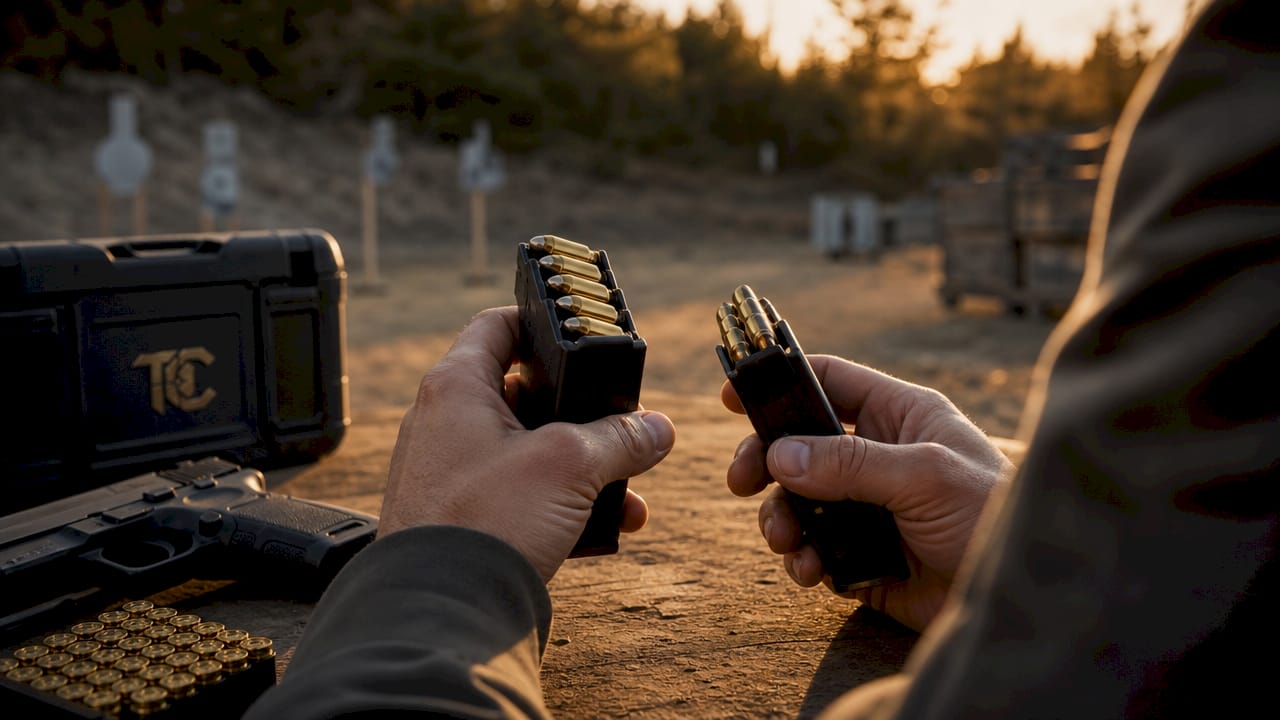
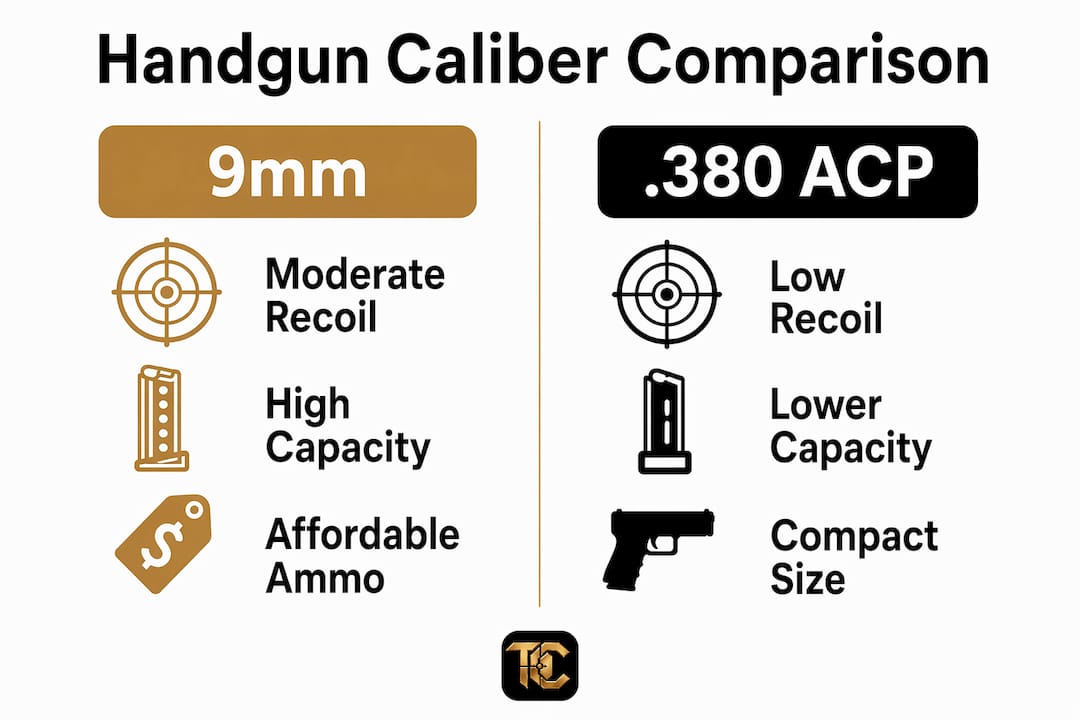
Caliber selection is where new buyers most often get derailed by myths. The best first handgun caliber is 9mm Luger, and the data supports that clearly. Recoil runs approximately 5 foot-pounds, magazine capacity reaches 12 to 15 rounds plus one in the chamber, and practice ammunition costs between $0.17 and $0.25 per round. That affordability matters because proficiency requires volume, and volume requires affordable ammo.
| Caliber | Recoil Level | Typical Capacity | Ammo Cost (per round) | Best For |
|---|---|---|---|---|
| .22 LR | Very low | 10+ | $0.05–$0.10 | Absolute beginners, skill building |
| .380 ACP | Low | 6–10 | $0.25–$0.40 | Recoil-sensitive shooters |
| 9mm | Moderate | 12–17 | $0.17–$0.25 | Most new shooters, all-purpose |
| .40 S&W | High | 10–13 | $0.30–$0.45 | Experienced shooters only |
| .45 ACP | High | 7–10 | $0.35–$0.55 | Experienced shooters only |
The .380 ACP is a legitimate option for shooters who are recoil-sensitive or have limited hand strength. It is smaller, lighter, and softer-shooting than 9mm, though it sacrifices some capacity and terminal performance. The Ruger 10/22 in .22 LR is the gold standard for absolute beginners learning fundamentals before transitioning to a centerfire pistol.
On action type, the choice between a semi-automatic and a revolver is simpler than most people think. Revolvers offer simplicity and mechanical reliability with no manual safety to manage, but they hold only 5 to 7 rounds and reload slowly. Semi-automatics hold 10 to 15 or more rounds, reload faster with a magazine swap, and dominate both the carry and home defense markets. For most new buyers, a striker-fired semi-automatic with no external safety, such as the Glock 19 or Smith & Wesson M&P 2.0 Compact, removes one variable from the manual of arms under stress.
Pro Tip: Sight alignment and trigger control matter more than caliber stopping power. Learning those fundamentals on a low-recoil platform like a 9mm or .22 LR builds the muscle memory that transfers to any firearm you shoot later.
What handgun size is right for you?
Handgun size is a direct tradeoff between shootability and concealability. Understanding the four size categories helps you match the gun to your actual needs rather than what looks appealing in a display case.
Full-size pistols like the Glock 17 or Sig Sauer P320 Full offer the longest barrel, largest grip, and highest capacity. They are the easiest to shoot accurately and absorb recoil well, making them ideal for home defense and range use. Concealing one under everyday clothing requires a cover garment and deliberate effort.
Compact pistols represent the best compromise for most buyers. The Glock 19 and Sig P320 Compact weigh between 23 and 26 ounces loaded, hold 15 rounds plus one, and conceal reasonably well under a light jacket or untucked shirt. They are forgiving to shoot, easy to train with, and capable enough for serious defensive use. This is why the compact category dominates beginner recommendations.
Subcompact and micro-compact pistols like the Sig P365 and Glock 43X are purpose-built for concealment. Their shorter grips and reduced sight radius make them harder for beginners to shoot accurately. Most novices who start with a micro-compact find themselves upgrading to a compact model within a year. If concealed carry is your primary goal, read through the case for micro-compact pistols before committing to the smallest option on the shelf.
- Full-size: Best accuracy and capacity, limited concealability
- Compact: Best all-around choice for new shooters
- Subcompact: Concealable but demands more skill to shoot well
- Micro-compact: Maximum concealability, steepest learning curve
How to test and evaluate handguns before you buy
Buying a handgun without firing it first is like ordering a custom suit without a fitting. The gun may look right, but you will not know until you are behind it. Renting multiple models and firing at least 50 rounds through each is the single most effective way to avoid a costly mistake. Range rental fees typically run $10 to $20 per firearm, which is a fraction of the cost of buying the wrong gun.
Here is a structured process for evaluating any handgun at the range:
- Check grip fit first. Wrap your hand around the grip and confirm your trigger finger reaches the center of the trigger face without shifting your grip. If you have to adjust your hand to reach the trigger, the gun does not fit you.
- Rack the slide. Can you cycle it smoothly with a full overhand grip? Difficulty here often indicates the gun is too large or the recoil spring too stiff for your hand strength.
- Locate the magazine release. Press it with your thumb without breaking your firing grip. If you have to shift your hand, that is a fit issue that will slow you down under stress.
- Fire 20 rounds slowly. Focus on sight alignment and trigger press. Note whether the sights track back to the target naturally after each shot.
- Fire 30 rounds at a faster pace. Evaluate recoil management and whether the gun stays comfortable. Flinching or grip fatigue at this stage signals a mismatch.
- Assess the trigger reset. After each shot, release the trigger only until you feel or hear the reset click, then press again. A clean, short reset builds speed and accuracy.
Ergonomics and fit affect shootability more than brand reputation or caliber. A Glock 19 is an excellent pistol, but it does not fit every hand equally well. The Smith & Wesson M&P 2.0 Compact ships with four interchangeable backstraps specifically because hand size varies. Sig Sauer’s modular P320 platform allows grip module swaps without tools. These are not marketing features. They are practical solutions to a real fit problem.
Pro Tip: Bring a friend with more shooting experience to your rental session. An experienced shooter can watch your grip, stance, and trigger press and identify problems you cannot feel yourself.
Common mistakes to avoid during evaluation include choosing a gun based on aesthetics alone, buying the same model a friend owns without testing it yourself, and dismissing a pistol after a single magazine. Recoil sensitivity and grip fatigue often improve dramatically between the first and third magazine as your technique settles.
What does a handgun actually cost to own responsibly?
The purchase price of a quality compact 9mm runs between $400 and $600 for proven platforms like the Glock 19, Smith & Wesson M&P 2.0 Compact, and Sig Sauer P320 Compact. That number is only the starting point. Responsible ownership costs extend well beyond the firearm itself, and underestimating them leads to gaps in safety and proficiency.
Budget for these additional items before you buy:
- Holster: A quality inside-the-waistband or outside-the-waistband holster from a reputable maker runs $50 to $150. Avoid cheap nylon holsters that collapse when you reholster.
- Safe storage: A quick-access handgun safe costs $100 to $300 and is non-negotiable if children or unauthorized users are present in your home.
- Training course: A basic pistol safety course costs $100 to $200 and covers fundamentals, legal considerations, and safe handling. It is the most valuable investment you will make.
- Practice ammunition: Budget for 200 to 500 rounds of practice ammo per month at $0.17 to $0.25 per round for 9mm. Consistent practice is what builds the skill that makes the gun useful.
- Defensive ammunition: Quality personal defense ammo from Federal, Speer, or Hornady runs $1.00 to $1.50 per round. You need 50 to 100 rounds to verify reliable function in your specific pistol.
A handgun without training is a tool you do not yet know how to use. Think of it the way you would approach a well-selected cigar or a properly brewed cup of coffee. The quality of the product matters, but so does the knowledge to appreciate and use it correctly. Skill development is a long-term investment, and the shooters who commit to it consistently are the ones who feel genuinely confident with their firearm.
Key takeaways
Choosing the right handgun requires matching purpose, caliber, size, and ergonomics to your specific needs before committing to a purchase.
| Point | Details |
|---|---|
| Start with a compact 9mm | The Glock 19, S&W M&P 2.0 Compact, and Sig P320 Compact cover most beginner needs at $400 to $600. |
| Define your purpose first | Home defense, concealed carry, and range use each demand different size and feature priorities. |
| Fit beats brand loyalty | Controls must be reachable without shifting your grip; test trigger reach, slide, and magazine release. |
| Rent before you buy | Fire 50 or more rounds through multiple models to assess recoil, comfort, and control before spending. |
| Budget beyond the gun | Holster, safe storage, training, and ammo are required costs for responsible, effective ownership. |
What I have learned after years of watching buyers choose wrong
The most common mistake I see is buyers walking in with a brand in mind and leaving with a gun that does not fit their hand. The Glock 19 is genuinely one of the best pistols ever made. It is also a pistol that does not fit every shooter equally well, and I have watched people buy it based on reputation alone, struggle with it for six months, and quietly replace it with something that actually fits.
My honest position is this: ergonomics are not a secondary consideration. They are the primary one. A gun you can control confidently under stress is worth more than a gun with a prestigious name that you fight with every time you draw it. The Safariland framework of measuring fit by trigger reach, magazine release access, and slide manipulation is the right approach, and most buyers skip it entirely.
The other thing I will say plainly is that micro-compact pistols are oversold to beginners. They are genuinely excellent carry guns for experienced shooters who have already built their fundamentals on a larger platform. For someone who has never fired a pistol before, starting on a Sig P365 or Glock 43X is like learning to drive on a sports car with a hair-trigger clutch. You can do it, but you will learn slower and develop worse habits. Start on a compact, build your skills, then decide if you want to downsize for carry.
Training changes everything. Shooters who take even a single quality fundamentals course perform measurably better than those who self-teach from YouTube. The accuracy fundamentals that feel abstract on paper become automatic after a few hours with a qualified instructor. Expect your preferences to evolve as your skill grows. The gun that feels right at month one rarely feels the same at month twelve, and that is a sign you are improving.
— Brian
Find your next handgun at Tungsten Creek Tactical
Tungsten Creek Tactical carries a curated selection of handguns, tactical gear, and accessories chosen for quality and real-world performance. Whether you are buying your first compact 9mm or looking for a precision-built option tailored to your grip and carry style, the team at Tungstencreektactical brings the same standard to every recommendation.
For buyers who want something beyond off-the-shelf, explore the custom gun services at Tungsten Creek Tactical, where precision-built firearms are matched to your specific needs. The Tungstencreektactical mobile app lets you scan products, compare pricing, and unlock VIP benefits so you make an informed decision every time. Visit the shop to browse current inventory and gear up with confidence.
FAQ
What is the best handgun for a first-time buyer?
The best first handgun for most buyers is a compact 9mm semi-automatic such as the Glock 19, Smith & Wesson M&P 2.0 Compact, or Sig Sauer P320 Compact. These models balance manageable recoil, sufficient capacity, and affordable practice ammunition at a price point of $400 to $600.
How do I know if a handgun fits my hand correctly?
A handgun fits correctly when your trigger finger reaches the center of the trigger face without shifting your grip, and you can access the magazine release and slide stop without adjusting your hand. Fit directly affects accuracy and safe operation under pressure.
Should I buy a revolver or a semi-automatic pistol?
Semi-automatic pistols are the better choice for most new buyers because they hold 10 to 15 or more rounds and reload faster than revolvers. Revolvers offer mechanical simplicity and reliability but are limited to 5 to 7 rounds, which is a meaningful disadvantage in a defensive scenario.
How much should I budget for a handgun and related gear?
Budget $400 to $600 for a quality compact 9mm, plus an additional $300 to $600 for a holster, quick-access safe, training course, and initial ammunition supply. Ownership costs extend well beyond the purchase price, and skipping these items reduces both safety and effectiveness.
Is a micro-compact pistol a good choice for beginners?
Micro-compact pistols like the Sig P365 and Glock 43X are harder for beginners to shoot accurately due to their shorter grip and reduced sight radius. Most new shooters who start with a micro-compact upgrade to a compact model quickly. Build your fundamentals on a compact first, then evaluate whether a smaller carry gun makes sense for your lifestyle.
Recommended
Related Post
Discover the 5 ways
An introduction to Tactical Luxury Guns & Coffee We founded
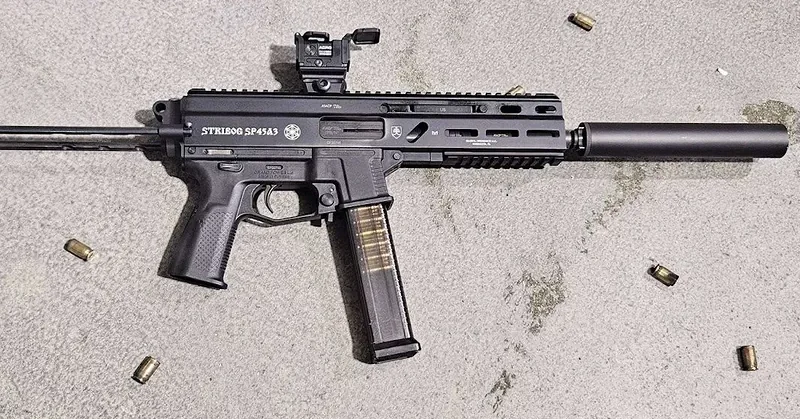
Top 5 Best PCC’s
In 2026, the Pistol Caliber Carbine (PCC) market is no