
Transparency in gun sales: A guide for responsible owners


Most people assume firearm transactions happen in a gray area where paperwork is minimal and oversight is loose. The reality is nearly the opposite. The role of transparency in gun sales is built into federal law at every step, from the moment you fill out paperwork at a dealer counter to the indefinite retention of records that can help law enforcement trace a crime gun years later. This article walks you through how that system works, where it falls short, and what you as a responsible owner can do to make better, safer purchasing decisions.
Table of Contents
- Understanding transparency requirements in federal and state gun sales
- How transparency impacts gun safety and law enforcement tracing
- The nuanced role of gun dealer responsibility and enforcement challenges
- Comparison of state transparency laws and their effect on firearm tracing
- Practical tips for responsible firearm owners to leverage transparency
- Why transparency in gun sales is misunderstood and why it matters more than ever
- Explore trusted custom guns and firearm services with transparency in mind
- Frequently asked questions
Key Takeaways
| Point | Details |
|---|---|
| Transparency ensures safety | Clear background checks and record-keeping reduce illegal gun trafficking and enhance public safety. |
| Dealers are key | Responsible dealers enforce laws and prevent illegal sales, supporting transparency’s effectiveness. |
| State laws vary | Understanding your state’s transparency requirements helps you navigate safer gun ownership. |
| Practical ownership tips | Verify dealer compliance and timing to make informed, responsible firearm purchases. |
| Transparency builds trust | Open practices between owners, dealers, and law enforcement maintain trust and firearm rights. |
Understanding transparency requirements in federal and state gun sales
Federal law creates the foundation for transparency in firearm transactions, and the cornerstone of that system is ATF Form 4473. Every purchase from a licensed dealer triggers this form. It collects your full name, address, date of birth, government ID details, and a set of eligibility questions designed to screen for disqualifying factors like felony convictions or domestic violence history. The ATF Form 4473 requirements as updated in 2026 enforce detailed buyer identification and background checks, enabling traceability of firearms used in crimes with records retained indefinitely by Federal Firearms Licensees (FFLs).
That indefinite records retention is significant. A dealer cannot simply toss paperwork after a few years. If a gun shows up at a crime scene a decade after purchase, law enforcement can trace it back to the original buyer through those dealer records. This is how transparency in firearm transactions serves public safety in a direct, measurable way.
State laws push this baseline further in many cases. Here is what you need to know about the layered legal framework:
- Federal baseline: FFLs must complete Form 4473, run a National Instant Criminal Background Check System (NICS) check, and retain records indefinitely.
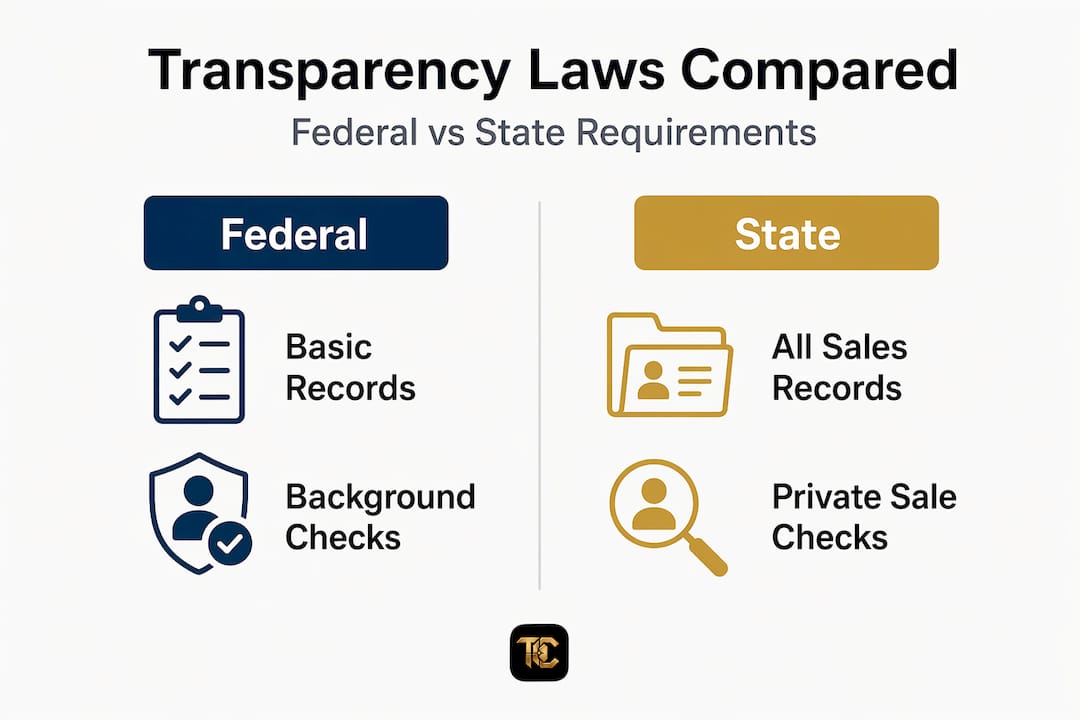
- State additions: Some states require dealers to report all handgun sales to a state agency, not just to NICS.
- Private sale gaps: Federal law does not require background checks for private sales, but several states have closed this gap with universal background check laws.
- Waiting periods: Some states add mandatory waiting periods on top of federal requirements, giving background checks more time to complete.
Understanding legal firearm ownership rules is not just a compliance exercise. It is the foundation of informed purchasing.
How transparency impacts gun safety and law enforcement tracing
With a clear understanding of legal rules, let’s explore how transparency directly supports safety and crime tracing.
Transparent records create a paper trail that law enforcement depends on. When a firearm is recovered at a crime scene, investigators submit a trace request to the ATF, which works backward through manufacturer, distributor, and dealer records to identify the first retail buyer. That chain only holds when every link maintains accurate documentation. Gaps in that chain, whether from missing records, unreported transfers, or private sales without background checks, are exactly where illegal trafficking takes root.
The numbers tell a compelling story. A Delaware analysis found that 66% of crime guns recovered in the state were initially purchased locally, highlighting how transparency gaps contribute to trafficking networks operating close to home rather than through distant sources.
“States requiring handgun sales records aid traces beyond initial sales, supporting law enforcement’s ability to identify illegal transfers.” — RAND analysis of firearm sales
This matters for you as a responsible owner because it reframes what transparency means in practice. You are not just filling out paperwork to satisfy a bureaucrat. You are participating in a system designed to keep guns out of criminal hands and maintain the public trust that makes lawful ownership possible.
Key ways transparency supports safety and tracing:
- Accurate dealer records allow ATF to complete traces that identify trafficking pipelines.
- Background checks stop prohibited buyers at the point of sale, before a transaction completes.
- State-level firearm price transparency and reporting requirements help states build their own tracing capacity independent of federal tools.
- Consistent documentation builds trust in firearms sales between dealers, owners, and the broader community.
The nuanced role of gun dealer responsibility and enforcement challenges
Understanding safety benefits is one side of the picture. The dealer-side hurdles and enforcement realities shape how well transparency actually functions in practice.

Dealers are the human element in a system that otherwise runs on paperwork and database queries. A background check is only as useful as the information that feeds it, and a Form 4473 is only as honest as the buyer completing it. This is where straw purchases, which occur when an eligible buyer acquires a gun on behalf of a prohibited person, represent one of the most persistent failures in the transparency system. Dealers are legally required to recognize and refuse suspicious transactions, but identifying a straw purchase is not always straightforward.
Enforcement data reveals how frequently compliance breaks down. Over 60 Maine gun retailers were cited for violations including failing to flag straw purchasers, underscoring that transparency depends on active, vigilant dealer behavior, not just passive paperwork compliance.
Here is a practical look at how responsible dealers uphold transparency on the ground:
- Verify all buyer documentation against Form 4473 entries before initiating a background check.
- Recognize red flags like a buyer coached on answers, a buyer unfamiliar with the firearm they claim to want, or a third party waiting nearby.
- Refuse suspicious transactions even when background checks technically clear, because a clean NICS result does not rule out a straw purchase.
- Maintain organized records so that any ATF audit or trace request can be answered quickly and completely.
- Train staff consistently so that every employee behind the counter applies the same standard, not just the owner or manager.
Pro Tip: When you visit a gun dealer, the quality of their recordkeeping process tells you something meaningful about how they operate. A dealer who walks you through Form 4473 carefully and explains each step is showing you the same attention to detail they apply to every transaction. That standard matters for the whole firearm buying process.
Comparison of state transparency laws and their effect on firearm tracing
After exploring enforcement, it is important to see how state laws differ and affect the overall transparency landscape.
The federal baseline sets a floor, but states can build significantly above it. Eleven states require records of all handgun sales to aid traces, while federal law requires FFLs to maintain sales records but prohibits the creation of a searchable national registry. That federal prohibition on a national registry is a key distinction. It means that ATF traces must work dealer by dealer rather than querying a centralized database, which is slower and dependent on dealer cooperation.
| State category | Handgun sales records required | State-level tracing capacity | Private sale background checks |
|---|---|---|---|
| High transparency states | Yes | Strong | Required |
| Moderate transparency states | Partial (dealer records only) | Moderate | Varies |
| Federal baseline only states | No beyond federal | Dependent on ATF | Not required |
What this table shows in practical terms: if you live in a high transparency state, your purchase is logged in more places and your chain of ownership is easier to reconstruct. That is not a burden. It is a feature of a system designed to keep illegal transfers traceable.
Key points for responsible buyers navigating state differences:
- Know your state’s reporting requirements before you complete a purchase.
- Understand whether your state mandates background checks for private party transfers, because buying from a private seller without one may be legal in your state but leaves a gap in the paper trail.
- If you move states, research whether your new state requires re-registration of any firearms you already own.
- Learn about serialized firearms and how serial number records underpin the entire tracing system.
Practical tips for responsible firearm owners to leverage transparency
Here is how you can apply transparency knowledge practically to your firearm purchases.
The 2026 ATF reforms made one immediate change that affects every buyer. ATF’s 2026 reforms simplify Form 4473, extending background check validity to two months, which means if your NICS check clears but the transaction does not complete immediately, you have more time to finalize the purchase without starting the process over. That is a practical convenience, but it also reflects how the system is being updated to balance usability with accountability.
Here is how you should approach every transaction with transparency in mind:
- Confirm background check validity timing before you plan a layaway or delayed pickup purchase, so you know exactly when your check expires under the new two-month rule.
- Ask your dealer directly whether they maintain records in compliance with federal and state law, and how they handle ATF trace requests.
- Keep your own records of purchase receipts, serial numbers, and Form 4473 copies where your state allows, so you have independent documentation.
- Report suspicious dealer behavior to the ATF if you encounter a seller who discourages you from completing paperwork or offers to skip the background check entirely.
- Stay current on your state’s laws because requirements for private transfers, waiting periods, and reporting change more frequently than federal law does.
Pro Tip: RAND research suggests that permit-to-purchase and reporting requirements reduce firearm homicides by deterring illegal transfers. If your state has a permit-to-purchase requirement, treat it as a feature, not a hurdle. It is documented evidence that you are a lawful, eligible buyer, which ultimately strengthens your standing in the firearms community.
Understanding firearms ownership social responsibility is inseparable from understanding how building trust in firearms sales protects the rights of every lawful owner.
Why transparency in gun sales is misunderstood and why it matters more than ever
The most common misconception we encounter is that transparency in gun sales is an imposition on lawful owners, a paper-heavy inconvenience designed by people who distrust firearms culture. That framing gets it exactly backward.
Transparency is the reason lawful ownership remains politically viable. Every time a crime gun is traced back to a straw purchase or an unlicensed dealer who kept no records, it generates pressure to restrict legal sales more broadly. The failures are not caused by too much transparency. They are caused by gaps in it. When dealers cut corners or states refuse to close private sale loopholes, they create the very conditions that critics of gun ownership point to as evidence the system cannot self-regulate.
ATF’s 2026 reforms emphasize transparency and accountability to rebuild trust between gun owners, dealers, and law enforcement while prioritizing public safety. That framing is deliberate. The government is not positioning transparency as a restriction. It is positioning it as a bridge, and that distinction matters enormously for how responsible owners should think about compliance.
Here is the uncomfortable truth: owners who resist transparency requirements are not protecting their Second Amendment rights. They are weakening the political foundation those rights rest on. A community that demonstrates consistent, documented accountability is far harder to legislate against than one that treats any recordkeeping as an overreach. The strongest argument for gun rights is a track record of responsible behavior, and trust and transparency in gun sales are what that track record is built from.
Think of it like a well-sourced, properly aged cigar. The provenance matters. You want to know where it came from, how it was handled, and that every step met a standard worth trusting. Firearms are no different. The paper trail is not the enemy of your rights. It is the proof of them.
Explore trusted custom guns and firearm services with transparency in mind
Understanding how transparency protects you and your community is the first step. Choosing a dealer who lives those values is the second.

At Tungsten Creek Tactical, we build every transaction around the same principles this article covers: thorough recordkeeping, complete compliance with federal and state requirements, and a process that treats you as a knowledgeable buyer who deserves honest, clear service. Whether you are exploring our custom guns and services or browsing the full selection available through our online store, you will find a team that takes the importance of transparency in firearms as seriously as you do. A firearm like the FN 502 Tactical 22LR is a great example of a quality product backed by a purchase process you can trust from start to finish.
Frequently asked questions
What is the purpose of ATF Form 4473 in gun sales?
ATF Form 4473 collects buyer identification and eligibility information, enabling required background checks and creating records that support crime gun tracing by law enforcement.
How does transparency in dealer record-keeping help prevent illegal gun trafficking?
Accurate dealer records give law enforcement the chain of custody needed to trace crime guns and identify illegal trafficking patterns that would otherwise go undetected.
Why do some states have stricter transparency laws than the federal government?
States impose additional record-keeping or registration requirements to close gaps in federal law. Eleven states require records of all handgun sales, creating stronger local tracing capacity than federal baseline rules alone provide.
What role do gun dealers play in maintaining transparency and safety?
Dealers must actively verify buyer eligibility, spot suspicious transactions, and maintain complete records. Citations of dealers failing to prevent straw purchases show how much public safety depends on dealer vigilance, not just the law itself.
How can responsible gun owners use transparency to make safer purchasing decisions?
Owners can verify dealer compliance, understand background check timelines under the new two-month validity rule, and stay current on state laws to ensure every purchase is legally sound and fully traceable.
Recommended
Related Post

Discover the 5 ways
An introduction to Tactical Luxury Guns & Coffee We founded

Top 5 Best PCC’s
In 2026, the Pistol Caliber Carbine (PCC) market is no