
Everyday Carry Setup Guide: Build Your Best EDC
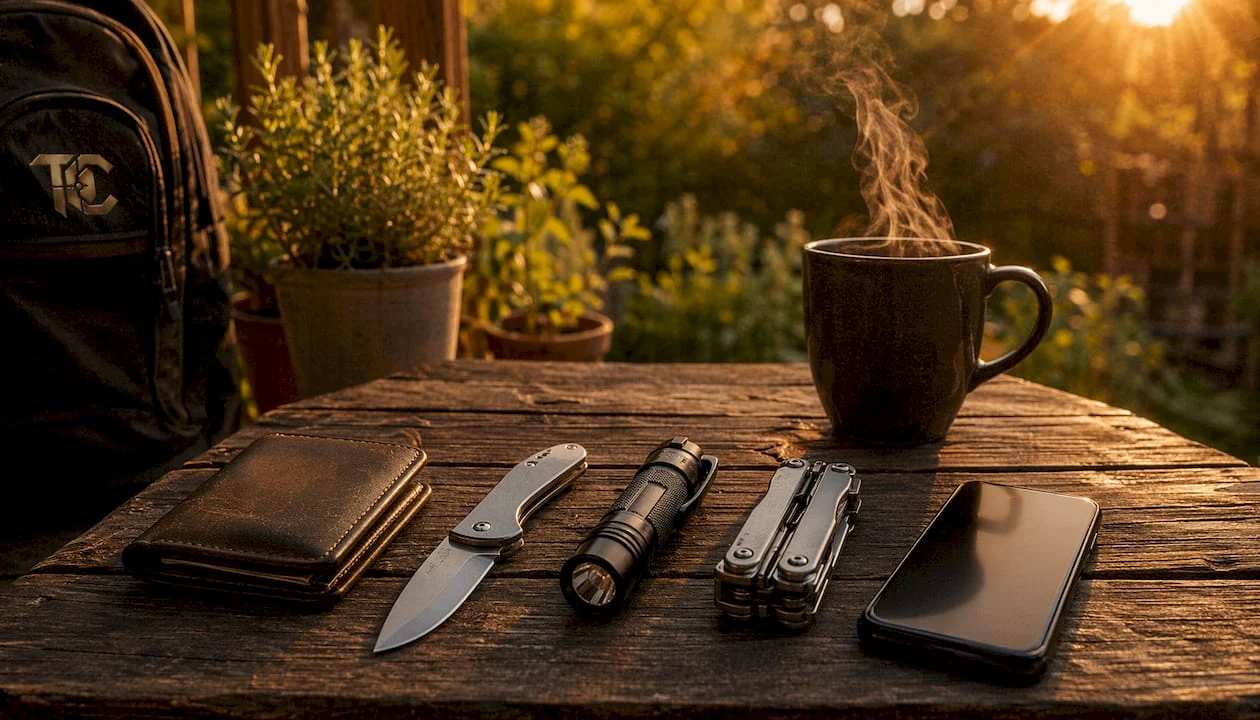
An everyday carry setup is a carefully curated selection of gear designed to solve most daily challenges while minimizing bulk and maximizing readiness. Known in the preparedness community as EDC, this practice spans military professionals, urban commuters, and anyone who values being ready without being weighed down. The right EDC gear checklist is not about carrying everything you might need. It is about carrying exactly what you will use. A well-constructed EDC setup requires only 10–12 carefully chosen items to solve 95% of daily problems. That number is worth sitting with. Most people carry far more and solve far less.
What are the essential everyday carry items?
The core of any EDC gear checklist starts with a short list of high-utility items. These are the tools that handle the widest range of daily situations without adding unnecessary weight or bulk. Think of it like a well-selected cigar: quality over quantity, chosen with intention.
The foundational everyday carry essentials include:
- Wallet with RFID-blocking protection to guard card data in crowded spaces
- Smartphone as your primary communication, navigation, and payment device
- Keys organized on a compact keychain or key organizer to reduce jingle and bulk
- Pocket knife with a durable blade steel like 154CM or S30V for cutting tasks
- Flashlight rated at least 300 lumens for reliable illumination in low-light situations; read more in this tactical flashlight guide
- Multitool covering pliers, screwdrivers, and a secondary blade for fixing tasks
- Pen in a durable metal body for writing on any surface in any condition
- Watch for time management without relying on your phone
- Notebook in a pocket-sized format like Field Notes for quick capture
- Handkerchief for hygiene, first aid, and general utility
Digital gear belongs on this list too. Modern digital essentials include a 10,000mAh power bank, a 65W GaN charger, and a USB-C cable. These items address heavy battery drain during long days and keep your devices ready when you need them most.
Choosing quality materials matters as much as choosing the right items. A wallet made from full-grain leather or aircraft-grade aluminum outlasts a cheap nylon option by years. A knife with a quality steel holds an edge through real use. Prioritize durability and function over aesthetics.

Pro Tip: When evaluating any item for your carry, ask one question: “Did I use this in the last two weeks?” If the answer is no, pull it from the rotation.
How to organize and carry your EDC gear effectively
Carrying gear well is as important as choosing it. Poor distribution creates discomfort, slows access, and damages clothing over time. A structured approach to carrying solves all three problems.
Start by assigning each item a dedicated zone:
- Front left pocket: phone and keys
- Front right pocket: wallet and pen
- Belt or waistband: knife clipped to pocket edge, flashlight on belt loop
- Bag or pack: multitool, power bank, charger, notebook
Structured carry systems use belts and sheaths for tool control, which improves both access speed and retention. Horizontal carry suits people who spend most of their day seated. Vertical carry works better for active or physically demanding routines.
Once you have assigned zones, test the system before committing to it. EDC practitioners use three tests to validate a carry setup: a positioning test while standing, a seated comfort test, and a movement stability test. Failing any one of these means something needs to shift. A knife that digs into your thigh when seated will not stay in your carry for long.
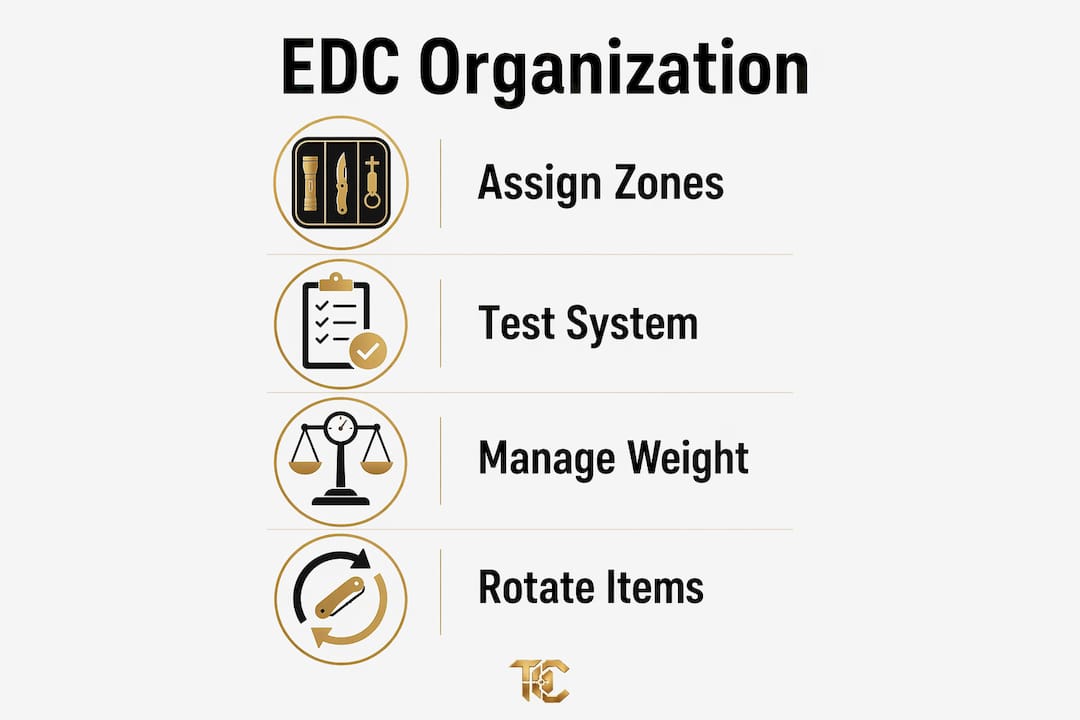
Weight is the most overlooked variable in EDC organization. Loadout weight over 2 lbs can cause pocket damage within months. Sustainable wear targets are under 1.5 lbs for urban carry and under 3 lbs for travel setups. Weigh your current carry on a kitchen scale. The result is usually surprising.
Pro Tip: Lay your full carry on a table and photograph it weekly for one month. You will quickly spot which items never move and which pockets are doing all the work.
A quality bag changes the math entirely. A tactical leather crossbody bag distributes weight off your pockets and onto your shoulder, freeing your carry zones for only the most-accessed items.
Common mistakes to avoid:
- Overloading a single pocket until the seam strains
- Using a belt too thin to support a knife or holster without sagging
- Clipping a flashlight where it catches on car door frames
- Carrying a multitool in a front pocket alongside keys, which causes scratching and wear
How do you build an EDC setup on any budget?
EDC kits can be built at three price points: $100 for entry-level, $250 for intermediate, and $500 for a premium setup. The core jobs each tier must cover stay the same: cutting, illumination, fixing, and carrying cards. Budget changes the quality of execution, not the mission.
| Budget Tier | Core Items | What You Get |
|---|---|---|
| $100 entry-level | Basic folder knife, budget flashlight, slim wallet, keychain tool | Covers daily cutting and lighting; limited durability |
| $250 intermediate | Mid-grade knife, 500-lumen flashlight, RFID wallet, compact multitool | Better ergonomics, stronger materials, longer service life |
| $500 premium | Full-size quality multitool, high-output flashlight, titanium wallet, quality fixed or folder knife | Professional-grade reliability; built to last years of daily use |
The best EDC setups prioritize a reliable knife and flashlight first, then add other tools based on specific daily needs. This approach covers the widest range of daily problems with the fewest items. A quality Leatherman multitool fits naturally into the intermediate and premium tiers, offering pliers, blades, and drivers in a single compact form.
Build your kit incrementally. Start with the knife and flashlight. Add a multitool when you notice you need one. Upgrade your wallet when the current one fails. Frustration points are the most honest signal that a gear upgrade is warranted. Buying everything at once leads to overspending on items you may not actually use.
For those building a carry that includes a firearm, the budget calculus shifts. A quality holster, a reliable carry pistol, and the right belt become the foundation. The concealed carry guide from Tungstencreektactical walks through that selection process in detail.
How to personalize and maintain your EDC for the long term
Personalization beats perfection in EDC. Your kit should reflect your actual daily rhythm, not someone else’s ideal loadout. A field technician needs different tools than a remote worker. A parent running school pickups carries differently than a solo commuter.
Practical personalization steps:
- Log your daily use for two weeks. Note which items you reach for and which stay untouched.
- Trim ruthlessly. Any item unused in 14 days earns a review. Most will not survive it.
- Adjust for seasons. A jacket adds pocket space in winter. Summer carry demands tighter curation.
- Build context-specific kits. Your office carry differs from your weekend carry. Keep a small range bag packed separately, as outlined in this range packing guide.
- Watch for bulk creep. EDC kits tend to grow over time. A quarterly audit keeps weight and bulk in check.
Maintenance keeps gear reliable when you need it most. Clean your knife blade monthly with a dry cloth and a drop of oil on the pivot. Lubricate your multitool’s joints with a light machine oil every few months. Refresh flashlight batteries on a schedule, not after they die. Check your power bank’s charge level weekly.
Gear that is not maintained fails at the worst moment. A sticky multitool pivot or a dead flashlight battery is not a crisis, but it is a failure of preparation. Treat your EDC like a professional tool, not a collection.
Experienced EDC users rotate between 8–15 items daily. Beginners often start with 25 or more, many of which go unused. The path from beginner to experienced carry is mostly subtraction, not addition.
Key Takeaways
A well-built EDC setup covers cutting, illumination, fixing, and carrying with 10–12 quality items, tested for comfort and kept under 1.5 lbs for sustainable daily wear.
| Point | Details |
|---|---|
| Start with 10–12 items | A focused EDC solves 95% of daily problems without unnecessary bulk. |
| Prioritize knife and flashlight | These two tools cover the widest range of daily needs across all budget tiers. |
| Test before committing | Use positioning, seated, and movement tests to confirm comfort and stability. |
| Keep weight under 1.5 lbs | Exceeding 2 lbs causes pocket damage and discomfort over time. |
| Audit quarterly | Regular reviews prevent bulk creep and keep your carry aligned with real daily needs. |
What I’ve learned from years of refining an EDC
Most people approach EDC like a shopping list. They read a “best of” article, buy everything on it, and wonder why their pockets feel like a tool bag. The real work is not acquisition. It is subtraction.
The single biggest mistake I see is treating EDC as a status signal rather than a functional system. Carrying a premium titanium pen alongside a $400 knife looks impressive on a flat lay photo. But if you never write by hand and your daily cutting task is opening Amazon boxes, you have optimized for appearance, not utility.
Start with the cheapest version of each core item. Use it hard for 60 days. The failure points will tell you exactly what to upgrade and why. That process produces a carry that fits your life, not a carry that fits a forum thread.
The other underrated factor is comfort testing. I have seen people abandon otherwise excellent gear because they never sat down in it before committing. A knife clipped at the 3 o’clock position feels fine standing. Seated in a car for 45 minutes, it becomes a distraction. Test everything in the conditions you actually live in.
Trends in EDC are worth watching but not chasing. Titanium hardware, modular pouches, and app-connected gear all have genuine utility in the right context. But the foundational carry, a reliable knife, a bright flashlight, a quality wallet, and a multitool, has not changed in decades. Build that foundation first. Upgrade from there when your use demands it.
— Brian
Tungstencreektactical and the tactical carry lifestyle
Tungstencreektactical is built for people who take their carry seriously, whether that means a quality multitool or a precision-built firearm. The same principles that define a great EDC, reliability, craftsmanship, and honest performance, define every product and service at Tungstencreektactical.
If your carry includes a firearm, the foundation matters more than any accessory. Tungstencreektactical’s custom firearms service delivers precision-built options tailored to your carry needs, not off-the-shelf compromises. For those still choosing the right platform, the firearms comparison guide cuts through the noise with clear, practical criteria. Tungstencreektactical also carries a full range of tactical accessories to complete your setup from belt to barrel.
FAQ
What is an everyday carry setup?
An everyday carry setup is a curated collection of 10–12 tools and essentials carried daily to handle common tasks and unexpected situations. The goal is maximum utility with minimum bulk.
How many items should be in an EDC kit?
Experienced EDC users carry 8–15 items daily. Beginners often start with more, but most carry fewer items as they identify what they actually use.
What should I prioritize first in my EDC?
Start with a reliable knife and flashlight. These two items cover the widest range of daily problems and form the foundation of any effective carry at any budget.
How do I know if my EDC setup is working?
Use three tests: a standing positioning test, a seated comfort test, and a movement stability test. If any item causes discomfort or shifts during normal activity, adjust its position or remove it.
How often should I review my EDC kit?
A quarterly audit keeps your kit aligned with your actual needs. Log daily use for two weeks before each audit to identify items that have stopped earning their place in your carry.
Recommended
Related Post
Discover the 5 ways
An introduction to Tactical Luxury Guns & Coffee We founded
Top 5 Best PCC’s
In 2026, the Pistol Caliber Carbine (PCC) market is no