
Tactical Organization Explained: Strategy to Action


Tactical organization is the temporary grouping of forces or resources to accomplish a specific mission, with clearly defined command and support relationships built around that mission alone. In business terms, tactical planning is the process of breaking long-term strategic goals into specific, actionable short-term tasks that bridge the gap between where leadership wants to go and what teams do every day. Think of it like loading a magazine before a range session: the strategic goal is accurate fire downrange, but the tactical work is making sure the right rounds are seated, the kit is staged, and every team member knows their role before the first shot.
What is tactical organization and tactical planning?
Tactical organization, as defined by the Department of Defense, is a temporary grouping of forces designed to accomplish a particular mission through the allocation of available assets to subordinate commanders and the establishment of their command and support relationships. It is not a permanent hierarchy. Every new mission calls for a fresh analysis of how resources should be arranged. In a business context, the same logic applies: you reorganize teams, budgets, and reporting lines around a specific project or objective, then reassess when conditions change.
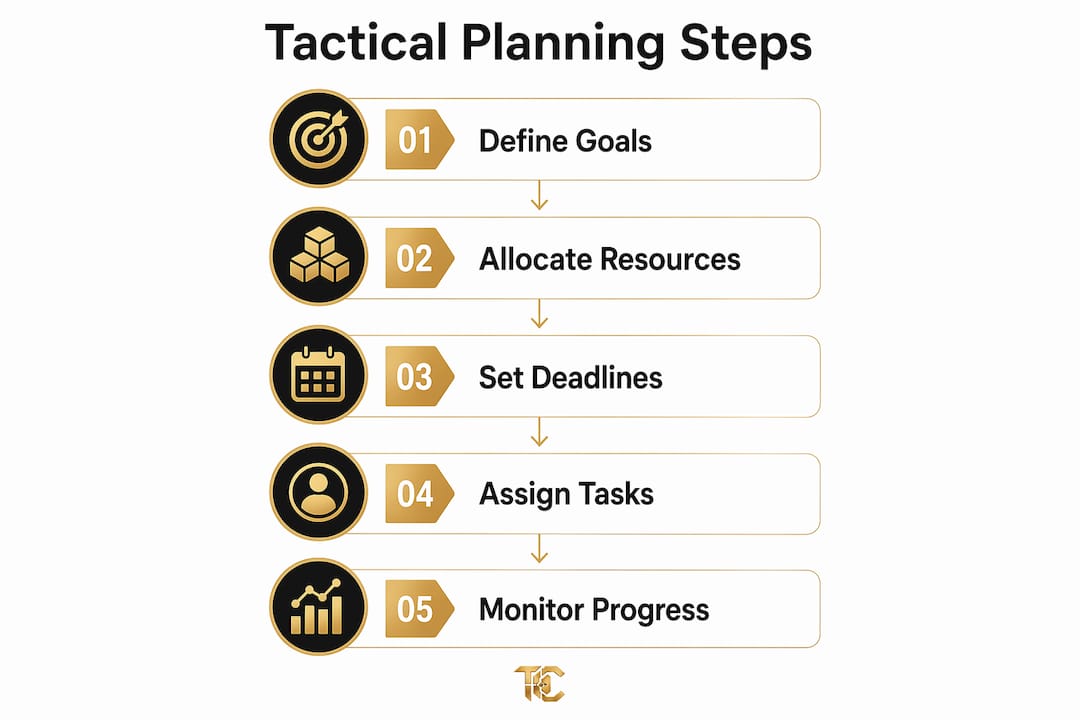
Tactical planning is the step-by-step process of outlining specific actions a team will take to solve a problem or reach a goal. These plans are measurable, time-bound, and directly tied to the strategic objective above them.
Key components of tactical organization and planning include:
- Command relationships: Who reports to whom for this specific mission or project.
- Support relationships: Which units or departments provide resources, logistics, or expertise to others.
- Resource allocation: Assigning personnel, budget, and equipment to subordinate teams.
- Measurable outcomes: Specific, time-bound targets that indicate whether the tactical plan is succeeding.
- Flexibility mechanisms: Built-in reassessment points that allow the plan to adapt as conditions shift.
- Task assignments: Clear delineation of who does what, by when, and to what standard.
How strategic, tactical, and operational planning differ
The three planning levels work together, but each has a distinct scope and time horizon. Confusing them is one of the most common reasons organizations fail to execute well.
Strategic planning operates at the organizational or national level, setting broad, long-term goals. A company’s decision to expand into a new market region is strategic. It defines the destination but not the route.
Tactical planning sits in the middle. It links strategy to action by defining how resources will be allocated and how command relationships will be structured to realize strategic intent. A regional sales manager building a 90-day plan to capture market share in a new territory is doing tactical work.

Operational planning handles the day-to-day. It manages task execution, schedules, and processes that keep the organization running. The sales rep following a daily call cadence is working at the operational level.
A quick summary of the distinctions:
- Scope: Strategic is organization-wide; tactical is department or project-level; operational is individual task or process-level.
- Time horizon: Strategic spans years; tactical spans weeks to months; operational covers days to weeks.
- Flexibility: Strategic goals rarely change; tactical plans adjust frequently; operational procedures shift daily.
- Ownership: Executives own strategy; middle managers own tactics; frontline teams own operations.
- Example: A military example makes this concrete. The decision to liberate a city is strategic. The plan to seize a key bridge with a task force is tactical. The squad-level movement to contact is operational.
What goes into an effective tactical plan?
A well-built tactical plan has structure, not just intention. The components below are what separate a plan that executes from one that sits in a slide deck.
- Specific, measurable goals: Each tactical objective must trace directly back to a strategic goal. Vague targets produce vague results.
- Defined command and support structure: Every team member needs to know who they report to and who supports them for this particular effort.
- Resource allocation: Budget, personnel, and equipment are assigned explicitly, not assumed.
- Clear timelines: Milestones and deadlines create accountability and allow progress tracking.
- Actionable steps: Tasks are broken down to the point where a team member can execute without further interpretation.
- Performance metrics: Quantifiable indicators tell you whether the plan is working before the deadline arrives.
- Reassessment checkpoints: Scheduled reviews allow the plan to adapt when conditions change, which they always do.
Good tactical plans reflect management priorities, use the organization’s actual strengths, and maintain a clear logical link to the strategic goal above them. A plan that optimizes for the wrong objective, no matter how well executed, is still a failure.
Pro Tip: Write each tactical objective as a statement that answers three questions: What will be accomplished? By when? How will you know it succeeded? If any answer is missing, the objective is not ready to execute.
Why tactical planning matters for your organization
Tactical planning is what turns a strategy from a vision into a result. Without it, strategic goals remain aspirational. With it, they become schedules, assignments, and deliverables.
The practical benefits are direct:
- Execution clarity: Teams know exactly what they are responsible for and how their work connects to the larger goal.
- Cross-department coordination: Tactical plans force different departments to understand each other’s timelines and dependencies, reducing friction.
- Agility: Because tactical plans are short-term and flexible, organizations can adjust course without abandoning the strategy.
- Resource efficiency: Explicit allocation prevents duplication of effort and ensures critical resources go where they are needed most.
- Accountability: Measurable outcomes create a clear record of performance, making it easier to identify what worked and what did not.
- Communication: A written tactical plan gives everyone a shared reference point, reducing misalignment across teams.
Tactical management is the essential link synchronizing resources to ensure strategic goals become realized outcomes. Organizations that skip this layer often find that their strategies are well-designed but poorly executed, not because the strategy was wrong, but because no one translated it into work.
Real-world examples of tactical planning in action
Tactical planning looks different across industries, but the underlying structure is consistent: a strategic goal, broken into specific actions, assigned to specific people, with defined timelines and metrics.
- Retail expansion: A national retailer sets a strategic goal of gaining 10% market share in a new region. The regional manager’s tactical plan includes hiring timelines, store layout decisions, local marketing campaigns, and weekly sales targets for each location.
- Military task force: A battalion commander receives a strategic objective to secure a supply corridor. The tactical plan assigns specific companies to specific terrain, defines support relationships with artillery and logistics units, and sets phase lines with time-based triggers for reassessment.
- Healthcare system: A hospital network’s strategic goal is to reduce patient readmission rates. The tactical plan assigns a care coordination team to high-risk patients, sets a 30-day follow-up protocol, and tracks readmission rates by unit weekly.
- Law enforcement: A police department’s strategic priority is reducing response times in a high-call district. The tactical plan reallocates patrol units, adjusts shift schedules, and sets a target response time with weekly reporting to the precinct commander. A police department organizational assessment often reveals exactly where these tactical gaps exist.
- Product launch: A technology company’s strategic goal is to capture a new customer segment. The product team’s tactical plan covers feature prioritization, launch date milestones, marketing channel assignments, and a 60-day post-launch review.
The common thread across all of these is alignment. Every tactical action connects to the strategic goal, and every team member understands how their specific work contributes.
Who prepares and performs tactical planning in an organization?
Middle managers and team leaders are the primary practitioners of tactical planning. They receive strategic direction from senior leadership and translate it into specific, measurable plans their teams can execute. This is not a passive role. It requires judgment about resource allocation, timeline feasibility, and cross-functional dependencies.
Typical roles and their functions in tactical planning:
- Middle managers: Create tactical plans, assign tasks, set milestones, and monitor progress against strategic objectives.
- Team leaders: Communicate the plan to frontline staff, manage day-to-day execution, and escalate obstacles.
- Department heads: Coordinate across functions to align tactical plans and prevent conflicting priorities.
- Project managers: Build and maintain detailed project plans that operationalize tactical objectives.
- Frontline staff: Execute assigned tasks and provide feedback on what is working and what is not.
- Senior leadership: Set strategic direction, approve resource allocation, and review tactical progress at defined intervals.
Every employee can contribute to tactical planning. When a strategic goal is communicated clearly, individuals at every level can set their own tactical objectives that support it. The key is that those individual plans maintain a clear, logical link to the strategic goal above them.
How tactical planning differs from operational planning
Tactical and operational planning are often confused, but they serve different purposes and operate at different levels of specificity.
Tactical planning is medium-term and goal-oriented. It focuses on allocating resources and setting flexible steps to achieve strategic objectives. It answers the question: what do we need to do, and how do we organize ourselves to do it?
Operational planning is short-term and task-focused. It manages the daily activities and processes that keep the organization functioning. It answers the question: what does each person do today, and in what sequence?
Key distinctions:
- Time horizon: Tactical plans span weeks to months; operational plans cover days to weeks.
- Scope: Tactical plans address how to achieve a goal; operational plans address how to execute a specific task.
- Flexibility: Tactical plans are designed to adapt; operational plans are often standardized procedures.
- Output: A tactical plan produces a roadmap with milestones; an operational plan produces schedules, checklists, and procedures.
- Ownership: Tactical plans belong to managers; operational plans belong to frontline teams and supervisors.
Tactical plans inform operational activities, but they do not replace them. A tactical plan tells the sales team to run a 60-day outreach campaign. The operational plan tells each rep how many calls to make per day, which scripts to use, and how to log results.
Where tactical organization fits in business and project management
Tactical organization sits at the center of any well-run project management structure. It is the layer that connects the executive vision to the work that actually gets done. Without it, project teams often work hard in the wrong direction.
In project management frameworks like the Project Management Institute’s PMBOK Guide, the planning phase explicitly requires defining work breakdown structures, assigning responsibilities, and establishing reporting relationships. That is tactical organization by another name. The temporary nature of project teams mirrors the military definition precisely: resources are grouped for a specific mission, command relationships are defined, and the structure dissolves or reorganizes when the mission ends.
In business units, tactical organization shows up in how departments are structured around quarterly priorities. A company might temporarily assign engineers from three different teams to a single product initiative, with a designated lead and defined support relationships. When the initiative closes, those engineers return to their home teams. This flexibility is what allows organizations to respond to market conditions without permanently restructuring.
The critical insight from U.S. Army doctrine applies directly here: failing to define command and support relationships creates operational friction that compromises success. The same is true in any organization. When team members are unclear about who has authority over a decision, work stalls.
How tactical planning connects strategic goals to daily work
The connection between strategy and daily operations does not happen automatically. Tactical planning is the mechanism that makes it work.
A strategic goal like “increase customer retention by 15% this year” is not executable on its own. A tactical plan breaks it into specific actions: launch a loyalty program by a set date, assign a customer success team to high-value accounts, set up monthly check-in calls, and track churn weekly. Each of those actions is assignable, measurable, and time-bound.
Flexibility and mission-specific reassessment are core to making this connection durable. Conditions change. A competitor launches a new product. A key team member leaves. A supply chain disruption shifts priorities. Tactical plans that build in reassessment checkpoints can absorb these changes without losing the thread back to the strategic goal.
The discipline required here is similar to maintaining a firearm: the system only performs reliably when every component is checked, maintained, and ready. A tactical plan that is written once and never reviewed is like a weapon that has not been cleaned. It may work, or it may not, and you will not know until the moment it matters most.
Common challenges in tactical organization and how to address them
Tactical organization fails in predictable ways. Recognizing these patterns early saves significant time and resources.
Misalignment with strategy. The most common failure is tactical plans that do not connect to the strategic goal. This happens when managers set their own priorities without clear strategic direction from above. The fix is requiring every tactical objective to explicitly reference the strategic goal it supports.
Unclear command relationships. When team members do not know who has authority over a decision, work stalls or gets duplicated. Clear articulation of command and support relationships is not optional. It must be documented and communicated before execution begins.
Rigid plans in dynamic environments. A tactical plan written in January may be obsolete by March. Organizations that treat tactical plans as fixed documents rather than living frameworks lose the ability to respond to change. Build reassessment checkpoints into every plan from the start.
Resource conflicts. When multiple tactical plans compete for the same people or budget, execution suffers. Department heads need visibility into each other’s plans to identify conflicts before they become crises.
Inadequate knowledge of unit capabilities. Successful tactical organization requires detailed knowledge of unit strengths and limitations. Assigning tasks without understanding what a team can realistically deliver sets the plan up for failure.
Poor communication downward. A plan that exists only in a manager’s head or a shared drive no one reads is not a plan. Tactical plans must be communicated clearly to every person responsible for executing them.
Tools and methodologies for tactical planning
The right tools make tactical planning faster to build and easier to maintain. The methodology matters as much as the software.
OKRs (Objectives and Key Results) are one of the most widely used frameworks for connecting strategic goals to tactical execution. The objective is the strategic direction; the key results are the tactical metrics that indicate progress.
Gantt charts provide a visual timeline of tactical tasks, dependencies, and milestones. Tools like Microsoft Project, Smartsheet, and Asana all support Gantt-style planning and are widely used in U.S. organizations.
SWOT analysis helps teams assess strengths, weaknesses, opportunities, and threats before building a tactical plan, ensuring the plan is grounded in reality rather than assumption.
Work breakdown structures (WBS) decompose a tactical objective into its component tasks, making it easier to assign responsibilities and estimate timelines.
Kanban boards support operational execution of tactical plans by visualizing work in progress. Tools like Trello and Monday.com are common choices.
After-action reviews (AARs) are a military-derived methodology for evaluating what worked and what did not after a tactical plan is executed. They feed directly into the reassessment process for the next plan.
For teams managing tactical accessories and gear alongside organizational planning, the same discipline applies: every item has a designated place, a maintenance schedule, and a readiness standard.
Case studies: tactical organization working across industries
U.S. Army task force operations. The Army’s doctrine of task organization is the clearest real-world model. For Operation Desert Storm, VII Corps organized its forces tactically around specific battle objectives, assigning armor, artillery, and logistics units to subordinate commanders based on mission requirements. The temporary nature of those assignments allowed the Corps to adapt as the operational picture evolved. The three levels of warfare — strategic, operational, and tactical — were explicitly linked throughout the campaign.
Fire department incident command. When a fire department responds to a structure fire, the incident commander immediately establishes a tactical organization: an attack team, a search and rescue team, a water supply group, and a safety officer. Each has defined responsibilities and reports to the incident commander. The structure dissolves when the incident is resolved. Fire department operational excellence depends on this kind of rapid, mission-specific organization being second nature to every member.
Technology product launch. A software company launching a new product assigns a cross-functional team with a designated product lead, a marketing owner, an engineering lead, and a customer success representative. Each has tactical objectives tied to the launch date. Weekly standups serve as reassessment checkpoints. When a key integration partner delayed their API, the team’s built-in flexibility allowed them to adjust the launch scope without missing the date.
Retail chain expansion. A regional grocery chain entering a new market assigned a dedicated expansion team with authority over site selection, hiring, and local vendor contracts. The team reported directly to the VP of Operations for the duration of the expansion, then reintegrated into their home departments. The temporary command structure gave the team the authority to move quickly without waiting for approval at every step.
How tactical organization sharpens mental performance and readiness
Tactical organization does more than improve efficiency on paper. It directly affects how people perform under pressure.
An organized environment reduces cognitive load by eliminating the mental friction of searching for information, equipment, or clarity about roles. When a team member knows exactly what they are responsible for, where their resources are, and who to escalate to, they can focus entirely on execution. That focus is the difference between a confident response and a hesitant one.
In high-stakes fields like law enforcement and military operations, this principle is applied to physical gear with the same rigor as organizational planning. Treating equipment storage as a tactical task improves readiness, reduces stress, and extends the lifespan of critical equipment. The “grab-and-go” capability that comes from disciplined gear organization is a direct product of applying tactical planning principles to physical preparation.
The psychological benefit extends to business environments. Teams that operate with clear tactical plans report higher confidence, faster decision-making, and lower stress during high-pressure periods. The plan itself becomes a cognitive anchor.
Key expert observations on mental performance and tactical organization:
- Clarity in roles and responsibilities eliminates the hesitation that costs time in critical moments.
- Reassessment checkpoints prevent plan rigidity, which is itself a source of stress when conditions change.
- Documented command relationships reduce the cognitive burden of figuring out who to ask when a decision needs to be made.
- Physical gear organized by the “Rule of Accessibility” (most critical items easiest to reach) mirrors the mental model of prioritizing the most important tasks in a tactical plan.
- Discipline in maintaining organizational systems, whether gear or project plans, reflects and reinforces a disciplined mind.
Pro Tip: Treat your tactical plan with the same maintenance discipline as a primary weapon system. Review it on a fixed schedule, update it when conditions change, and never let it sit unchecked for longer than the shortest milestone it contains.
Tungstencreektactical is built on the same principles that make tactical organization work: clarity, preparation, and the right gear for the mission. Whether you are building a custom precision firearm or organizing a cross-functional team around a critical objective, the standard is the same. Know your assets, define your relationships, and stay ready.

Key Takeaways
Tactical organization is the temporary, mission-specific structure that connects strategic goals to the work teams actually execute, and it only succeeds when command relationships, resource allocation, and reassessment checkpoints are explicitly defined.
| Point | Details |
|---|---|
| Tactical organization is temporary | It is restructured for each mission or project, not locked into a permanent hierarchy. |
| Middle managers own tactical planning | They translate strategic direction into measurable, time-bound plans their teams can execute. |
| Three planning levels are distinct | Strategic sets goals, tactical allocates resources, and operational manages daily task execution. |
| Clear command relationships prevent friction | Undefined authority creates delays and duplication; every tactical plan must document who decides what. |
| Reassessment is built in, not added later | Tactical plans must include scheduled review points to adapt when conditions change. |
Recommended
Related Post

Discover the 5 ways
An introduction to Tactical Luxury Guns & Coffee We founded
Top 5 Best PCC’s
In 2026, the Pistol Caliber Carbine (PCC) market is no