How to Choose the Right Scope: A 2026 Buyer’s Guide
A rifle scope is defined as a magnifying optical sighting device mounted on a firearm to improve target acquisition and accuracy at distance. Knowing how to choose the right scope means matching its magnification, reticle, objective lens, and build quality to your specific shooting environment and realistic distances. Get that match wrong and even a premium optic will work against you. Get it right and your confidence at the range or in the field improves immediately. This guide delivers the 2026 industry standards and practical criteria you need to make a confident, fit-for-purpose decision.
How to choose the right scope for your shooting environment
Your shooting environment is the single most important factor in scope selection. A scope that excels on open plains will frustrate you in dense timber, and vice versa.
Different terrain types demand different optical setups:
- Open plains and long-range fields: Shots often exceed 300 yards. You need higher magnification, typically 6–18x, and a larger objective lens to gather enough light at distance.
- Dense bush and woodland: Shots rarely exceed 100 yards. A low-power variable optic in the 1–6x range gives you a wide field of view for fast target acquisition.
- Low-light hunting (dawn and dusk): Light transmission matters more than magnification. A quality 40mm or 44mm objective with fully multi-coated lenses handles these conditions without requiring an oversized tube.
- Mixed terrain: A 3–9x40mm covers most North American hunting scenarios from 50 to 300 yards without locking you into one extreme.
- Target shooting and competition: Consistent bench shooting at fixed distances allows you to use higher magnification without the field-of-view penalty that hurts hunters.
Understanding your terrain also shapes your durability requirements. Wet, cold, or high-humidity environments demand nitrogen-purged, waterproof construction. A scope rated for those conditions costs more upfront but holds zero reliably across seasons.
Pro Tip: Before you shop, write down your three most common shooting scenarios and the typical distance of each. That list should drive every feature decision you make.
What magnification range do you actually need?
Magnification is expressed as a ratio. A 3–9x scope magnifies the target 3 to 9 times. The first number is the minimum power, the second is the maximum, and the number after the “x” is the objective lens diameter in millimeters.
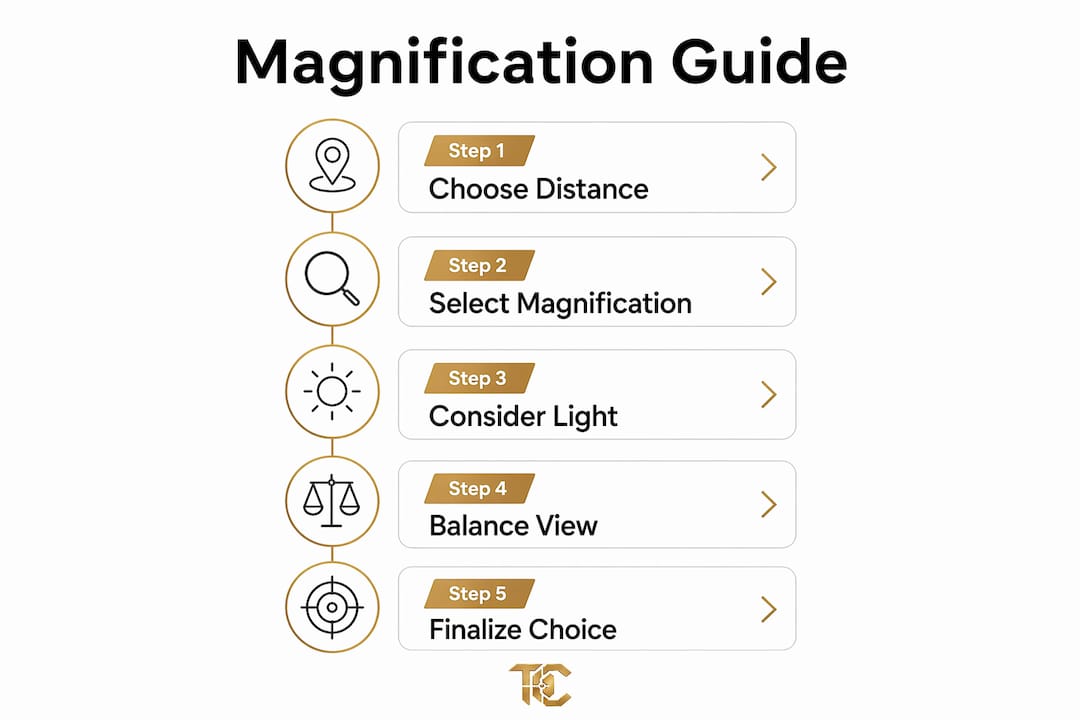
The right magnification range follows a simple rule: match power to distance. Here is how that breaks down in practice:
- Under 100 yards, fast shooting: A 1–6x variable gives you a near-zero magnification for close targets and enough zoom for moderate distances. Ideal for brush hunting and home defense carbines.
- 100–300 yards, general hunting: The 3–9x range covers this bracket completely. It is the most recommended configuration for beginners in 2026 because it handles the vast majority of real-world shots without adding unnecessary weight.
- 300–600 yards, precision hunting or target work: A 4–16x or 6–18x variable gives you the resolution to read wind and place shots accurately at extended ranges.
- Beyond 600 yards, long-range precision: Magnification of 10x and above becomes necessary, but so does a quality reticle with accurate holdover marks and a stable shooting platform.
The critical trade-off is this: higher magnification reduces field of view and light transmission. A 20x scope on a deer rifle in thick woods is a liability, not an asset. Beginners consistently make the mistake of buying the highest magnification they can afford, then struggling to find targets in the narrow field of view.
The 3-9x40mm configuration remains the most recommended versatile setup for new shooters. It handles shots out to 300 yards, keeps weight manageable, and does not require advanced technique to use effectively. Think of it like a well-balanced cup of coffee: not the most extreme option on the menu, but the one that delivers consistent results every single time.
Which reticle type fits your shooting style?
A reticle is the aiming pattern you see when you look through the scope. Choosing the wrong one adds confusion under pressure.
The two main reticle categories are:
- Simple duplex reticles: Thick outer posts taper to a fine center crosshair. They are fast, uncluttered, and ideal for hunting. Most beginners should start here.
- Ballistic reticles (BDC): Include holdover marks calibrated for bullet drop at specific distances. Useful for hunters who shoot at varying ranges without adjusting turrets.
- Mil-dot and MRAD reticles: Grid-based systems used for range estimation and precise holdovers. Standard in precision rifle shooting and tactical applications.
- Illuminated reticles: Add a lit center dot or crosshair for low-light target acquisition. Genuinely useful at dawn and dusk; unnecessary in full daylight.
Beyond reticle design, you need to choose between first focal plane (FFP) and second focal plane (SFP) scopes. FFP scopes scale the reticle with magnification, so holdover marks stay accurate at any power setting. SFP scopes keep the reticle size constant, which means holdover marks are only accurate at one specific magnification, usually maximum power.
FFP is the better choice for long-range precision shooting where you dial magnification frequently. SFP suits hunters who set their scope to a fixed power and leave it there. For most beginners, an SFP scope with a duplex or BDC reticle is the most practical starting point.
Pro Tip: Match your turret units to your reticle units. If your reticle is calibrated in MOA, your turrets should click in MOA. Mixing MOA reticles with MRAD turrets creates calculation errors under field conditions.
Does objective lens size actually matter?
The objective lens is the large front lens that gathers light. A bigger lens sounds better, but the practical benefit has a ceiling.
Modern fully multi-coated optics transmit over 90% of available light, which means a well-coated 40mm lens often outperforms a poorly coated 56mm lens in real conditions. The coating quality matters more than raw diameter for most shooters.
| Objective size | Best use case | Trade-off |
|---|---|---|
| 32–40mm | General hunting, target shooting | Lighter, lower mounting height |
| 44–50mm | Low-light hunting, mixed terrain | Moderate weight increase |
| 56mm+ | Extreme low-light, long-range precision | Heavy, requires high rings |
Exit pupils larger than 5mm provide no practical benefit to the human eye in low light. That fact alone deflates most marketing claims about oversized objectives. Your eye cannot use the extra light the lens gathers.
Mounting height and weight increase with larger objective lenses. A 50mm objective often requires high or extra-high rings, which raises the scope above the bore and forces you to lift your cheek off the stock. That breaks your cheek weld and hurts consistency. Measure your rifle’s geometry before selecting a scope, and choose the smallest objective that meets your actual light requirements.
How do durability, warranty, and budget fit together?
Durability is non-negotiable. A scope that loses zero after three shots of heavy recoil is worthless regardless of its optical quality.
Key durability and value factors to prioritize:
- Zero retention: The scope must hold its point of impact after repeated shots and after being removed and remounted. Test this before trusting a scope in the field.
- Recoil rating: Confirm the scope is rated for your rifle’s recoil impulse. A scope built for a .223 may fail on a .300 Win Mag.
- Waterproof and fog-proof construction: Nitrogen or argon purging prevents internal fogging. This is standard on quality scopes and non-negotiable for field use.
- Lifetime warranty: Most quality scopes now carry lifetime warranties. A manufacturer that stands behind its product with a no-fault warranty signals confidence in its own build quality.
- Capped turrets: Protect adjustment dials from accidental movement in the field. Beginners benefit from this more than exposed tactical turrets.
- Parallax adjustment: Useful for precision shooting beyond 200 yards. Less critical for general hunting scopes set at a fixed parallax of 100 yards.
The 80/20 rule applies directly to scope features: you will use 20% of your scope’s features 80% of the time. A 3–9x40mm with a duplex reticle, capped turrets, and a solid warranty outperforms a complex tactical scope with features you never use. Spend your budget on glass quality and mechanical reliability, not on feature lists that look impressive in a catalog.
Key Takeaways
Choosing the right rifle scope requires matching magnification, reticle type, and objective lens size to your actual shooting distances and environment, not to theoretical maximums.
| Point | Details |
|---|---|
| Match magnification to distance | Use 1–6x under 100 yards, 3–9x for general hunting, and 10x+ only for deliberate long-range work. |
| Prioritize lens coatings over size | Fully multi-coated 40mm lenses outperform large, poorly coated objectives in most real conditions. |
| Choose reticle by use case | Duplex or BDC for hunting; FFP mil-dot for precision long-range; SFP for fixed-power simplicity. |
| Demand zero retention and a warranty | Mechanical reliability and a lifetime warranty matter more than advanced features for most shooters. |
| Start with a 3-9x40mm | This setup covers the widest range of beginner shooting scenarios without adding weight or complexity. |
What I’ve learned from watching beginners buy the wrong scope
The most common mistake I see is magnification inflation. A shooter buys a 6–24x scope for a deer rifle because the number sounds impressive, then struggles to find a deer at 80 yards in the woods because the field of view is the size of a dinner plate. Beginners consistently overestimate the magnification they need and underestimate how much that hurts them in real conditions.
My honest recommendation for any first-time buyer: start with a 3-9x40mm optic and learn it completely before upgrading. That setup will handle 90% of what you actually do at the range or in the field. You can read your reticle, adjust your turrets, and build the muscle memory that makes a scope feel like an extension of the rifle rather than a separate piece of equipment to manage.
I also want to push back on the idea that expensive tactical scopes are automatically better. Value lies in consistency and durability, and mid-range optics from reputable manufacturers often deliver both without the price premium attached to a tactical label. A scope that holds zero, transmits light cleanly, and fits your rifle’s geometry is a better scope than one with 34 reticle options you will never use.
One more thing: get your eye relief right before you finalize any scope choice. Eye relief of roughly 3.2 to 3.5 inches is the standard for hard-recoiling rifles. Too little and the scope comes back and cuts your brow. Too much and you lose the full field of view. Mount the scope, shoulder the rifle naturally, and confirm the full image appears without any shadow before you tighten a single ring screw.
— Brian
Tungstencreektactical can help you get the fit right
Selecting a scope is only half the equation. Mounting it correctly on the right rifle, with the right rings and the right eye relief, is where the real accuracy gains happen.
Tungstencreektactical offers custom gun services that include expert consultation on matching optics to your specific rifle and shooting style. The team works with you to identify the right scope for your caliber, your terrain, and your budget, then ensures it is mounted and zeroed correctly. You can also browse the full tactical accessories selection to find rings, mounts, and complementary gear. Every product comes backed by the transparency and quality assurance that Tungstencreektactical is built on.
FAQ
What is the best scope magnification for beginners?
The 3–9x40mm configuration is the most recommended setup for beginners in 2026. It covers shots out to 300 yards and keeps weight and complexity manageable.
What is the difference between FFP and SFP scopes?
FFP scopes scale the reticle with magnification, keeping holdover marks accurate at any power. SFP scopes hold the reticle at a fixed size, with accurate holdovers only at maximum magnification.
How do I know if my objective lens is large enough?
Modern fully multi-coated lenses transmit over 90% of available light, so a 40mm objective is sufficient for most conditions. Exit pupils larger than 5mm provide no additional low-light benefit to the human eye.
How do I select a rifle scope for hunting in low light?
Choose a scope with fully multi-coated lenses and a 40–50mm objective. Lens coating quality matters more than objective diameter for practical low-light performance.
What eye relief should I look for on a hard-recoiling rifle?
Eye relief of 3.2 to 3.5 inches is the standard for hard-recoiling rifles. This distance provides a full field of view and protects you from scope contact during recoil.
Recommended
Related Post
Discover the 5 ways
An introduction to Tactical Luxury Guns & Coffee We founded
Top 5 Best PCC’s
In 2026, the Pistol Caliber Carbine (PCC) market is no