
Legal Firearm Ownership: Clear Rules, Rights, Responsibilities

Legal firearm ownership in the United States sounds straightforward until you actually try to navigate it. Federal law sets the foundation, but state laws layer on top, court rulings shift the boundaries, and the rules for buying, building, or carrying can vary dramatically depending on where you live or travel. Even experienced gun owners get tripped up by these overlapping requirements. This guide walks you through who qualifies to own a firearm, how legal purchases work, what special regulations apply to certain items, how court decisions shape your rights, and what you need to know when crossing state lines.
Table of Contents
- Who is eligible to legally own a firearm?
- The basics of legal gun purchase and transfer
- Special rules: NFA items and regulated firearms
- How federal, state, and Supreme Court decisions shape your rights
- State-by-state differences and traveling with firearms
- The uncomfortable truth: Most errors are avoidable if you know the steps
- Your next steps: Explore custom solutions and stay prepared
- Frequently asked questions
Key Takeaways
| Point | Details |
|---|---|
| Eligibility is critical | Federal and state laws set who can and cannot own firearms, with felonies and court orders being the main disqualifiers. |
| Purchasing rules vary | Buying through dealers requires background checks, and some private sales also require checks depending on state law. |
| NFA items require more | Special firearms like suppressors or short-barreled rifles require ATF registration, tax stamps, and state approval. |
| State laws are different | You must obey the rules of every state where you buy, own, or travel with firearms to avoid unintentional violations. |
| Stay updated | Supreme Court decisions and state laws change the boundaries of legal ownership, so keep yourself informed. |
Who is eligible to legally own a firearm?
Eligibility is the cornerstone of every other legal question around firearm ownership. If you don’t meet federal eligibility requirements, nothing else in this guide applies until that status changes.
Federal law under 18 USC 922(g) defines a clear list of “prohibited persons” who cannot legally possess or purchase firearms. That list includes:
- Felons convicted of any crime punishable by more than one year of imprisonment
- Fugitives from justice
- Unlawful users of or addicts to any controlled substance
- Individuals adjudicated as mentally defective or committed to a mental institution
- Illegal aliens and most nonimmigrant visa holders
- Individuals dishonorably discharged from the military
- Anyone convicted of a domestic violence misdemeanor
- Persons subject to certain restraining or protective orders
The most common reason people fall into prohibited status is a prior felony conviction. In fact, 90.4% of 922(g) convictions in fiscal year 2024 involved prior felony records. That statistic matters because it illustrates how seriously federal enforcement treats this category. Domestic violence misdemeanors and active restraining orders are frequently overlooked disqualifiers that catch people off guard.
Age restrictions also apply. Under federal law, licensed dealers cannot sell handguns to anyone under 21 or long guns to anyone under 18. For unlicensed (private) transfers, the floor is 18 for handguns. Some states raise these thresholds further, so always check your local rules before assuming the federal minimums apply.
Edge cases create additional complexity. An expunged felony conviction may restore your eligibility in some states, but this is not automatic or universal. A single domestic violence misdemeanor involving a dating partner from more than five years ago might not prohibit you under certain interpretations of federal law. These situations are genuinely murky, and the stakes are high.
Pro Tip: If your legal status has changed due to expungement, a court order being lifted, or a dismissed charge, consult a firearms attorney before purchasing. Don’t assume a change in paperwork automatically restores your rights.
Before you go further in the firearm buying process for first-timers, confirming your eligibility is the one step you cannot skip.
| Category | Federal minimum age | Notes |
|---|---|---|
| Handgun from FFL | 21 | Some states higher |
| Long gun from FFL | 18 | Some states higher |
| Handgun private sale | 18 | No background check required in most states |
| Long gun private sale | 18 | Varies by state law |
The basics of legal gun purchase and transfer
Once you know you’re eligible, the next step is understanding how to lawfully acquire a firearm, whether buying from a dealer, private seller, or building for yourself.
Every purchase through a federally licensed firearms dealer (FFL) requires a National Instant Criminal Background Check System (NICS) check. This is non-negotiable at the federal level. The process is consistent whether you’re buying a pistol, a rifle, or a shotgun. The dealer submits your information, the FBI runs the check, and you either get a proceed, delay, or deny response.
Here’s how a standard FFL purchase works:
- Present valid government-issued ID to the dealer
- Complete ATF Form 4473 (the Firearms Transaction Record)
- Dealer submits your information for a NICS background check
- Receive a proceed response (or wait through a delay)
- Complete the transfer and take possession of the firearm
Private sales are where things get more nuanced. Many states now require universal background checks that extend to private transactions, meaning you’d still need to run the transfer through an FFL even if you’re buying from a neighbor. States like California, Colorado, and New York require this. Others, like Texas and Florida, do not. Some states also impose waiting periods between purchase approval and actual transfer, typically ranging from three to fourteen days.
A few additional state-level restrictions to be aware of:
- Magazine capacity limits: Several states restrict magazines to ten rounds or fewer
- Permit to purchase: Some states require a purchase permit or firearm owner ID card before any acquisition
- Assault weapon definitions: Certain states have broad definitions that restrict features like pistol grips or folding stocks
- Waiting periods: These apply regardless of whether you already own firearms
What about building your own firearm? Private individuals can manufacture firearms for personal use without a license, provided they are not in the business of selling them and the item is not an NFA-regulated item. However, federal law now requires serialization on personally made firearms. Understanding the serialized firearms requirements before you start a build is essential to staying legal. If you plan to sell or transfer a personally made firearm, different rules apply and an FFL may be required.
Reviewing the complete firearm buying process steps will save you time and help you avoid paperwork mistakes that could delay or derail your purchase.
Special rules: NFA items and regulated firearms
Legal ownership gets trickier with certain regulated firearms, so let’s examine the unique process and requirements for NFA items.
The National Firearms Act creates a separate regulatory tier for specific categories of firearms and accessories. These items are legal to own in most states, but they require a more involved federal approval process. The NFA categories and what they require are summarized below.
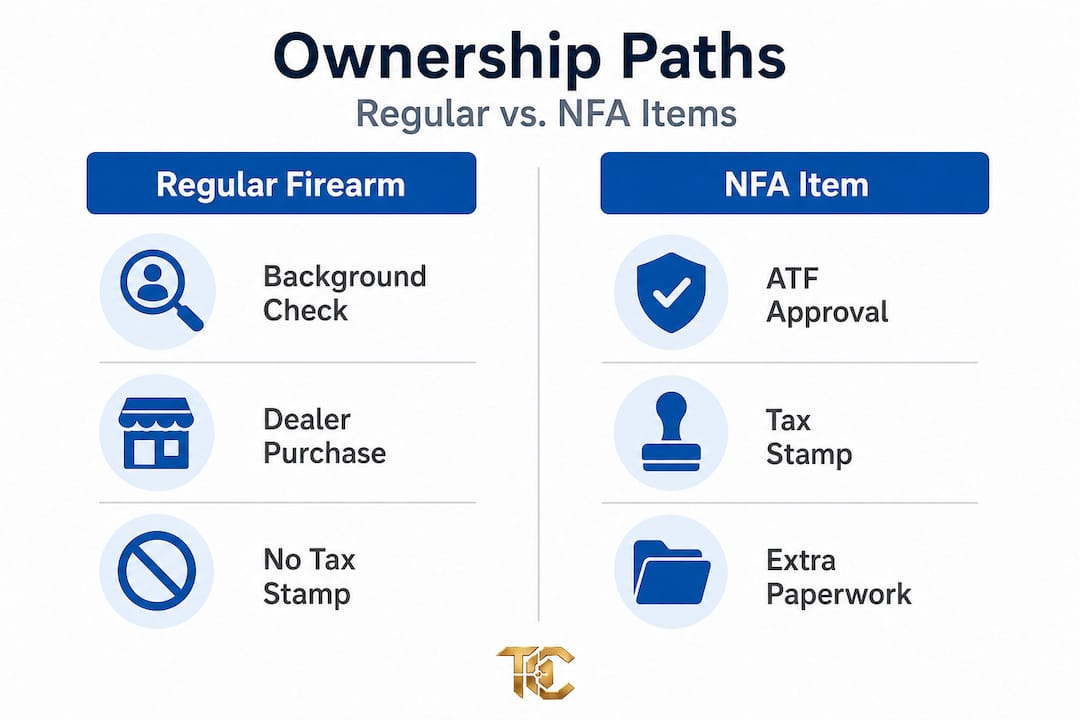
| NFA item | Tax stamp | ATF form | Key restriction |
|---|---|---|---|
| Short-barreled rifle (SBR) | $200 | Form 1 (make) or Form 4 (transfer) | Barrel under 16 inches |
| Short-barreled shotgun (SBS) | $200 | Form 1 or Form 4 | Barrel under 18 inches |
| Suppressor | $200 | Form 1 or Form 4 | Federally legal; state restrictions vary |
| Destructive device | $200 | Form 4 | Grenades, explosive devices, large-bore weapons |
| Any Other Weapon (AOW) | $5 transfer / $200 make | Form 1 or Form 4 | Pen guns, disguised firearms |
| Machine gun (pre-1986) | $200 | Form 4 | Civilian ownership frozen at 1986 registry |
Post-1986 machine guns cannot be transferred to civilians. Period. Only pre-1986 registered machine guns can be owned by private citizens, and prices for those reflect the closed registry, often running $10,000 to $50,000 or more for common models.
For all NFA items, the process involves submitting the appropriate ATF form along with fingerprints, passport-style photos for all responsible persons, a $200 tax stamp payment (in most cases), and CLEO (Chief Law Enforcement Officer) notification. Some states prohibit NFA ownership altogether, including suppressors in states like California, New York, and Illinois.
Pro Tip: NFA approval wait times currently range from several months to over a year depending on the item and application type. Before starting the process, verify that your state allows the specific NFA item you want. Starting an application for something that’s banned in your state is a costly mistake.
Practicing good habits around firearms and social responsibility becomes even more important when you own regulated items, because the consequences of missteps are more severe. Review NFA ownership safety tips before taking possession of any NFA item.

How federal, state, and Supreme Court decisions shape your rights
The law isn’t static, so it’s crucial to follow how recent court decisions and ongoing debates continue to redefine the boundaries of legal firearm ownership.
Three Supreme Court decisions in particular have shaped the modern landscape of gun rights in America. Understanding them helps you grasp why certain laws are being challenged and what may change in the coming years.
District of Columbia v. Heller (2008) established that the Second Amendment protects an individual’s right to possess a firearm for traditionally lawful purposes, including self-defense in the home. This overturned D.C.’s handgun ban and rejected the interpretation that the right only applies to militia service. McDonald v. City of Chicago (2010) extended Heller to the states through the Fourteenth Amendment, meaning state and local governments cannot ignore Second Amendment protections either.
Then came New York State Rifle & Pistol Association v. Bruen (2022), which significantly altered how courts evaluate firearm regulations. The ruling held that public carry is protected under the Second Amendment and that any firearm regulation must be consistent with the nation’s historical tradition of firearms regulation. This “historical analogue” test replaced the previous two-step interest balancing approach used by many lower courts.
The practical effects are still unfolding. Post-Bruen challenges are currently targeting:
- “Sensitive places” restrictions that prohibit carry in locations like Times Square, government buildings, and houses of worship
- Bans on so-called assault weapons in states like Illinois and Maryland
- NFA constitutionality challenges, particularly around suppressor regulations
- Restrictions on firearm ownership for individuals under active indictment
Businesses also face evolving exposure. For example, open carry and business liability are intersecting more frequently as more states loosen carry restrictions, creating new considerations for both owners and establishments.
The takeaway is simple: rights that existed last year may be expanded by a new ruling, and restrictions you’ve grown accustomed to may face legal challenge at any time. Staying informed is not optional for the responsible gun owner.
State-by-state differences and traveling with firearms
Now that we’ve addressed federal law and court decisions, it’s just as important to know how state rules and travel can further affect your rights and responsibilities.
Gun laws vary significantly across all 50 states. What’s perfectly legal in New Hampshire or West Virginia may result in criminal charges in California or New York. The core federal framework applies everywhere, but states layer their own requirements on top, and those differences are substantial.
Key variables that differ by state include:
- Waiting periods: From zero days in some states to up to 14 days in others
- Magazine capacity limits: Ten-round limits are common in restrictive states
- Registration requirements: Some states require all handguns to be registered
- Assault weapon definitions: Broad definitions in some states can make common rifles illegal
- Suppressor legality: Not permitted in approximately 8 states
- Permitless carry: Currently allowed in about 28 states; others require permits
Concealed carry reciprocity is one of the most practically important topics for traveling gun owners. Your home state permit may be recognized in some states and not others. There is no federal reciprocity law, so this must be researched individually before every trip across state lines.
Before traveling with a firearm, verify the following for each state you’ll pass through:
- Whether your carry permit is recognized there
- Whether your firearm’s features are legal (magazine capacity, stock type, etc.)
- Local storage and transport requirements
- Whether you’re required to declare the firearm if stopped by law enforcement
The ATF’s state law compendium is a useful starting point, but it’s always worth cross-referencing with current state statutes because laws change and publications can lag behind legislative updates.
The uncomfortable truth: Most errors are avoidable if you know the steps
After reviewing all the legal frameworks, let’s talk candidly about why the vast majority of firearm law trouble is preventable with good habits.
Most firearm law violations by otherwise law-abiding gun owners don’t happen because of malicious intent. They happen because someone assumed their home state rules applied everywhere, or because they didn’t check whether a new court ruling or legislative session changed the legal landscape since they last looked. That’s the uncomfortable reality we see repeated over and over.
A gun owner moves from Arizona to New Jersey and brings their high-capacity magazines without realizing possession is now a criminal offense. Someone drives through Maryland with an unserialized build in the trunk, not knowing Maryland’s transport laws. These situations aren’t rare, and “I didn’t know” is not a legal defense.
The fix is surprisingly simple. Check for firearms social responsibility insights and develop the habit of verifying rules before any purchase, transfer, or trip. Bookmark the ATF’s official resources. Sign up for state-level legislative updates. Make it a point to review your owned items annually in light of any law changes in your state.
Equally important is the culture you build around you. If you’re the knowledgeable person in your group, share what you know. Friends and family who own firearms but don’t stay current on legal changes represent a liability, not just to themselves but to everyone they’re associated with. Responsible ownership is both personal and communal.
Pro Tip: Bookmark the ATF’s official firearms FAQ and your state attorney general’s website. Check both at least once a year and always before making a new purchase, building a firearm, or planning interstate travel with firearms.
Your next steps: Explore custom solutions and stay prepared
For those looking to apply what you’ve learned or explore compliant upgrades, having a trusted resource makes all the difference. At Tungsten Creek Tactical, we’ve built our entire operation around the principle that informed ownership is the foundation of responsible ownership.

Whether you’re considering a custom firearms build that meets your state’s specific legal requirements or looking for components like an adjustable stock that keeps your AR-15 platform compliant and versatile, we stock what responsible owners actually need. Our team understands both the gear and the regulatory framework. Visit the Tungsten Creek Tactical homepage to browse our full selection, use our mobile app to compare products and pricing, and connect with experts who know how to help you build a setup that’s as legally sound as it is effective.
Frequently asked questions
Can you legally own a gun if you were convicted of a felony but your record was expunged?
If your felony conviction is expunged and your rights are restored under state law, you may regain eligibility, but this is not automatic. Expunged convictions may restore rights under certain circumstances, so consult a firearms attorney or contact the ATF directly to confirm your specific situation.
What are the most common reasons people are prohibited from owning firearms?
The most common reason is a prior felony conviction. In fact, 90.4% of 922(g) convictions in FY2024 involved prior felony records, followed by domestic violence misdemeanors and active restraining orders.
Do I need a background check for a private gun sale?
It depends entirely on your state. Many states extend background checks to private sales through universal background check laws, while others follow only the federal baseline, which does not require a check for unlicensed transfers.
What kinds of guns or accessories require extra paperwork or a tax stamp?
Short-barreled rifles and shotguns, suppressors, pre-1986 machine guns, destructive devices, and Any Other Weapons all fall under NFA registration rules requiring a $200 tax stamp (in most cases), ATF forms, and approval before transfer or manufacture.
Do gun laws change when traveling between states?
Yes, and significantly. You must comply with every state’s laws as you travel through them, including carry permit reciprocity, magazine limits, and transport requirements. Always research the rules for each state before departing.
Recommended
Related Post

Discover the 5 ways
An introduction to Tactical Luxury Guns & Coffee We founded
Top 5 Best PCC’s
In 2026, the Pistol Caliber Carbine (PCC) market is no