
What Is a Gun Trust? Your 2026 Legal Guide


A gun trust is a specialized revocable living trust that holds legal title to firearms regulated under the National Firearms Act, allowing multiple people to legally possess and use those firearms under one legal structure. Also called an NFA trust or firearms trust, this legal tool covers items like suppressors, short-barreled rifles (SBRs), and short-barreled shotguns (SBS). If you own or plan to acquire any of these regulated items, understanding what a gun trust does versus individual ownership could save you from serious federal compliance mistakes. In 2026, setup costs typically range from $200 to $800, and the compliance workflow has been updated with ATF eForms.
What is a gun trust and how does it work?
A gun trust functions by holding legal title to NFA-regulated firearms, with the trust itself acting as the registered owner rather than any individual. The three key roles inside the trust are the grantor, the trustees, and the beneficiaries. The grantor creates the trust and typically serves as the primary trustee. Trustees are the authorized possessors who can legally handle and transport the trust’s firearms. Beneficiaries are the heirs who inherit the trust’s assets when the grantor passes.
The trust acts as legal owner of each NFA item, which means every acquisition goes through the ATF using the trust as the applicant. The core forms involved are ATF Form 1 (for manufacturing an NFA item), ATF Form 4 (for transferring a registered NFA item to the trust), and ATF Form 23 (the responsible persons questionnaire). Every person named as a responsible person on the trust must submit Form 23 with fingerprints, photos, and CLEO (Chief Law Enforcement Officer) notification for each new acquisition.

The concept of “responsible persons” is one of the most misunderstood parts of the process. A responsible person is any trustee or co-trustee who has the power to direct the management of the trust. Beneficiaries who hold no possession authority are treated differently and do not require the same vetting. Naming multiple responsible persons broadens your authorized user pool but increases the paperwork and background check requirements for each new item acquired.
As of 2026, ATF eForms have made the submission process faster, but practitioners consistently warn that correct form downloads and CLEO certification must be followed precisely to avoid rejections. Approval wait times vary, but electronic submissions generally process faster than paper filings. Plan for several months from submission to approval for most Form 4 transfers.
Pro Tip: Add only the trustees you genuinely trust and who meet federal eligibility requirements. Every responsible person triggers a full background check and paperwork cycle, so quality matters more than quantity here.
What are the real benefits of a gun trust?
The single most practical advantage of a gun trust is that named trustees can possess and transport the trust’s firearms independently, without the primary registrant present. Under individual NFA ownership, only the registered owner can legally possess the item. A trust removes that restriction entirely for all named trustees, which matters enormously if you want a spouse, adult child, or trusted friend to have legal access.
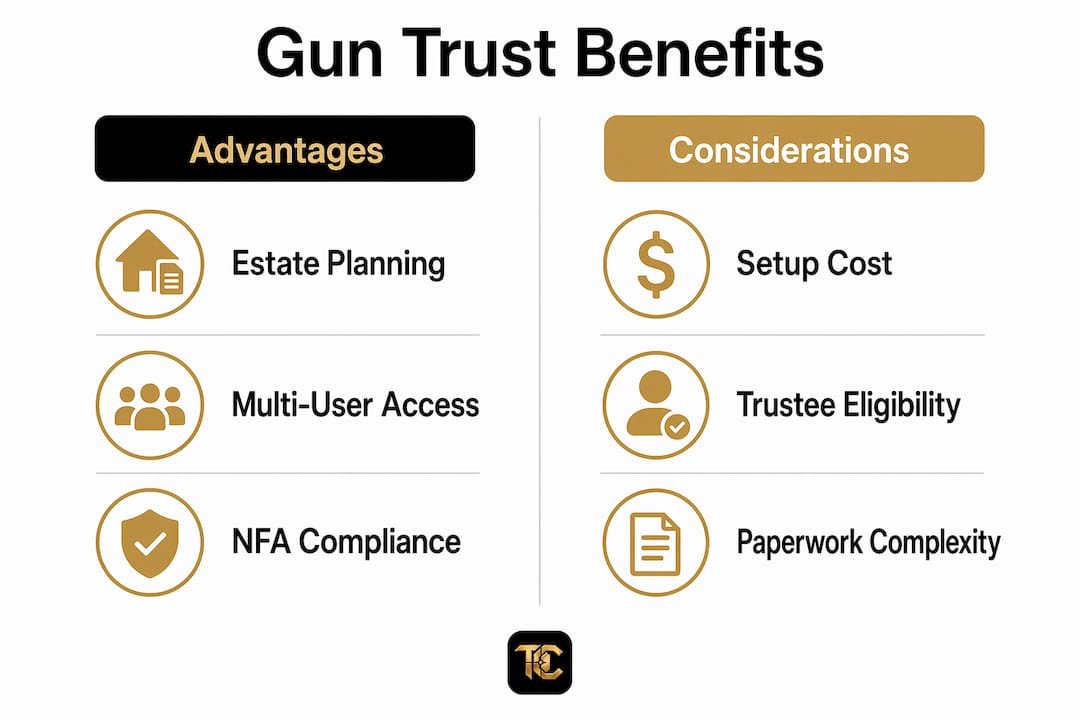
Here is a clear breakdown of the core advantages:
- Multi-user possession. Multiple trustees can legally handle, transport, and use trust firearms without the grantor being present. This is the defining practical benefit over individual registration.
- Estate planning without probate. Successor trustees step into the grantor’s role upon death, and NFA items transfer to heirs without the delays and costs of probate court. This avoids the Form 5 transfer process that individual owners’ estates must navigate.
- Privacy. The trust holds title, so your name is not the primary identifier on every NFA registration. This is a modest but real privacy benefit depending on your state’s public records laws.
- Simplified compliance for multiple firearms. One trust can hold an unlimited number of NFA items. You do not need a separate legal structure for each suppressor or SBR you acquire.
- Continuity of possession. Successor trustees assume control without costly probate delays, protecting your heirs from accidental unlawful possession of NFA items during estate settlement.
The cost to establish a trust ranges from $200 to $800 depending on complexity and jurisdiction, based on 2026 attorney reports. That is a one-time investment that covers potentially dozens of NFA items over a lifetime. Compare that to the legal exposure of a single compliance mistake on an individually owned suppressor, and the math becomes straightforward.
Pro Tip: Work with an estate planning attorney who has specific NFA experience. A generic revocable living trust template will not include the NFA-specific language required for compliance, and the consequences of a poorly drafted document can include felony liability.
Gun trust vs LLC: which structure fits your needs?
Both a gun trust and an LLC can legally own NFA-regulated firearms, but they serve different purposes and carry different compliance burdens. Understanding the distinction helps you choose the right structure rather than defaulting to whichever one you heard about first.
| Factor | Gun trust | LLC |
|---|---|---|
| Primary purpose | Hold and transfer NFA firearms | Business entity with broader legal uses |
| Authorized users | Named trustees (responsible persons) | Members or officers designated as responsible persons |
| Estate planning | Built-in succession via successor trustees | Requires separate operating agreement provisions |
| Compliance complexity | Moderate, NFA-specific forms | Higher, involves business entity filings plus NFA forms |
| Ongoing costs | Legal maintenance, trust amendments | State filing fees, registered agent, annual reports |
| Privacy | Trust name on ATF records | LLC name on ATF records |
| Tax implications | Pass-through, no separate tax entity | Depends on LLC structure and state law |
Gun trusts offer estate-planning benefits and multi-user possession flexibility that LLCs do not replicate as cleanly. An LLC introduces business entity issues, state annual fees, and separate legal considerations that add complexity without adding meaningful NFA compliance advantages for most individual owners. That said, an LLC may make sense if you are operating a firearms-related business and want liability separation for commercial reasons.
The practical reality is that most individual firearm owners aged 25 to 55 who want to share NFA items with family members or plan for inheritance are better served by a gun trust. An LLC is a business tool. A firearms trust is a personal ownership and estate planning tool. They are not interchangeable, and conflating them leads to compliance gaps.
How to create and maintain a gun trust responsibly
Creating a gun trust is not a DIY project. The document must include NFA-specific compliance language to avoid federal liability for trustees and responsible persons. A standard revocable living trust from a general estate planning attorney will not meet this standard. You need an attorney who has drafted NFA trusts specifically and understands the ATF’s current requirements.
Here is what the creation and maintenance process looks like in practice:
- Hire a qualified attorney. Seek out a firearms attorney or an estate planning attorney with documented NFA trust experience. Budget $200 to $800 for the initial draft depending on your state and the complexity of your situation.
- Identify your trustees and beneficiaries. Name only individuals who are federally eligible to possess firearms. Each responsible person will undergo a background check for every NFA item acquired.
- Complete ATF paperwork for each acquisition. Form 1 covers manufacturing, Form 4 covers transfers. Every responsible person submits ATF Form 23 with fingerprints, photos, and CLEO notification for each new item.
- Follow state-specific formalities. Some states require notarization or witnesses for trust execution. Others have additional registration requirements for NFA items. Your attorney should address these.
- Update the trust when trustees change. Adding or removing a trustee requires a legal amendment to the trust document and updated ATF filings. Changing responsible persons triggers Form 23 filings to avoid unlawful possession risks. This is not optional maintenance.
The most common mistake is treating the trust as a one-time setup rather than a living document. Life changes. Trustees move, relationships change, and eligibility can shift. Ongoing trust maintenance requires active legal oversight to stay compliant. Think of it the way you would a well-maintained firearm: regular attention prevents failures at the worst possible moment.
Pro Tip: Keep a dedicated folder, physical or digital, with your trust document, all ATF approval letters, and Form 23 records for every responsible person. If you are ever questioned about possession, having clean documentation on hand resolves the situation immediately.
Key takeaways
A gun trust is the most practical legal structure for responsible multi-user NFA firearm ownership, combining compliance, estate planning, and possession flexibility that individual registration cannot match.
| Point | Details |
|---|---|
| Core definition | A gun trust is a revocable living trust that holds legal title to NFA-regulated firearms. |
| Multi-user access | Named trustees can legally possess trust firearms independently, without the grantor present. |
| Estate planning | Successor trustees inherit control without probate, protecting heirs from accidental unlawful possession. |
| Gun trust vs LLC | Trusts serve personal ownership and estate planning; LLCs are business tools with higher ongoing costs. |
| Ongoing maintenance | Trustee changes require legal amendments and updated ATF Form 23 filings to stay compliant. |
Why I think most gun owners underestimate what a trust actually protects
I have seen firearm owners spend thousands on suppressors and SBRs, then register them individually because the trust setup felt like extra work. That decision creates a quiet legal time bomb. The moment that owner is incapacitated or dies, every family member who touches those items is potentially committing a federal felony, even with the best intentions.
The estate planning angle is where a properly drafted firearms trust earns its cost many times over. It is not just about who can shoot with you today. It is about what happens to those items when you cannot be there to authorize possession. Successor trustees step in cleanly. Heirs do not face probate delays on regulated items. That continuity is genuinely difficult to replicate through any other structure.
The misconception I hear most often is that a gun trust is only for collectors with large NFA inventories. One suppressor is enough reason to set one up correctly. The compliance exposure on a single improperly transferred item is severe, and the cost of a properly drafted trust is modest by comparison.
My advice: treat the trust document the way you treat your firearm. Buy quality, maintain it regularly, and do not cut corners on the fundamentals. The legal framework for responsible ownership exists to protect you. Use it properly.
— Brian
Build your collection the right way with Tungstencreektactical
Understanding the legal framework is step one. Step two is acquiring firearms worth protecting.

Tungstencreektactical specializes in precision-built firearms for owners who take both quality and compliance seriously. Whether you are adding a custom build to your trust or starting your NFA collection from scratch, the team at Tungsten Creek Tactical can help you identify the right firearm for your purpose and budget. Every purchase decision deserves the same care you put into your legal structure. Explore the custom firearms catalog to see precision builds designed for responsible owners who expect both performance and integrity from their gear.
FAQ
What does a gun trust actually do?
A gun trust holds legal title to NFA-regulated firearms, allowing multiple named trustees to legally possess and use those items without the original registrant present. It also transfers firearms to heirs outside of probate upon the grantor’s death.
Can a gun trust own any type of firearm?
A gun trust can hold any legally owned firearm, but its primary advantage applies to NFA-regulated items such as suppressors, short-barreled rifles, short-barreled shotguns, and machine guns registered before 1986.
How much does it cost to set up a gun trust in 2026?
Attorney fees to draft a gun trust typically range from $200 to $800 depending on complexity and jurisdiction. This does not include the $200 NFA tax stamp required for each regulated item transferred into the trust.
What is the difference between a gun trust and an LLC for firearm ownership?
A gun trust is designed specifically for personal NFA firearm ownership and estate planning, while an LLC is a business entity with broader legal and tax implications. For most individual owners, a trust offers simpler compliance and cleaner succession planning than an LLC.
Do all trustees need to complete ATF paperwork?
Yes. Every responsible person named in the trust must submit ATF Form 23 with fingerprints, photos, and CLEO notification for each new NFA item the trust acquires. Beneficiaries without possession authority follow a different process.
Recommended
Related Post

Discover the 5 ways
An introduction to Tactical Luxury Guns & Coffee We founded
Top 5 Best PCC’s
In 2026, the Pistol Caliber Carbine (PCC) market is no