
What Is Match-Grade Ammunition? A Shooter’s Guide


Match-grade ammunition is factory-produced ammo built to tighter manufacturing tolerances than standard commercial rounds, delivering the consistency required for precision and competitive shooting. The term “match-grade” refers to intended use rather than a certified standard. No governing body or regulatory agency certifies the label, meaning manufacturers self-apply it. What separates true match-grade ammo from marketing language is measurable: velocity standard deviation under 15 fps, compared to 25–40 fps for standard ammo. Brands like Federal Premium, Hornady, and Nosler produce widely respected match-grade lines in calibers such as .223 Remington, 6.5 Creedmoor, and .308 Winchester.
What is match-grade ammunition, and how is it defined by specs?
Match-grade ammo earns its name through specific, measurable manufacturing criteria. The three most important are bullet weight variance, powder charge consistency, and bullet concentricity. Each one directly affects where your round lands downrange.
Bullet weight variance in true match-grade ammo is held to ±0.3 grains or tighter. Powder charge variance runs ±0.1–0.3 grains. Bullet run-out, also called concentricity, is controlled to ±0.002 inches or less. These tolerances are not arbitrary. They exist because any inconsistency in weight or alignment translates directly into point-of-impact variation at distance.
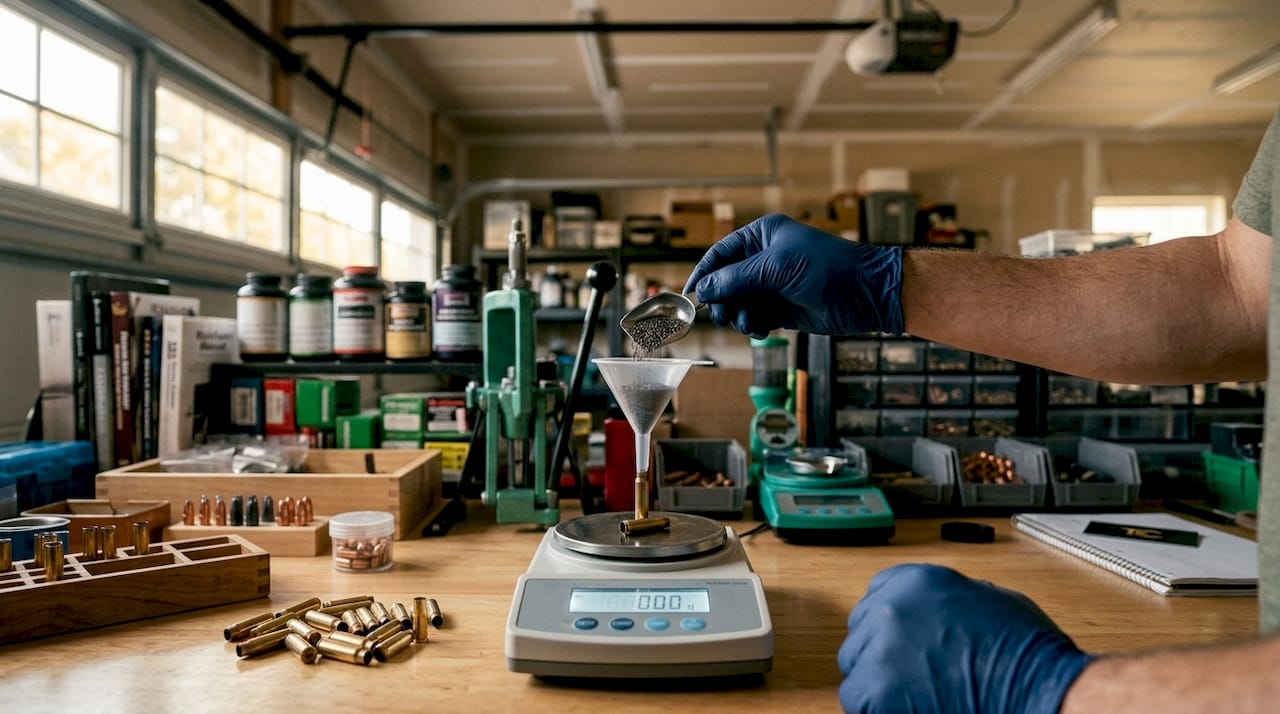
Brass case quality is equally critical. Match-grade brass features uniform primer pocket depth, consistent neck-wall thickness, and tight dimensional control. These factors affect how consistently the primer ignites the powder charge, which feeds directly into velocity uniformity.
| Specification | Match-Grade | Standard Commercial |
|---|---|---|
| Velocity SD | Under 15 fps | 25–40 fps |
| Bullet weight variance | ±0.3 gr or less | ±1.0 gr or more |
| Powder charge variance | ±0.1–0.3 gr | ±0.5 gr or more |
| Bullet run-out | ±0.002" or less | ±0.005" or more |
| Brass consistency | High uniformity | Variable |
Pro Tip: When evaluating match-grade ammo, ask the manufacturer for published velocity SD data. If they cannot provide it, the “match-grade” label may be more marketing than engineering.
How does match-grade ammo performance compare to standard ammo?
The performance gap between match-grade and standard ammo is not constant. It grows with distance. Accuracy gains are largely invisible at 100 yards, meaningful at 300 yards, and decisive at 600 yards and beyond. At close range, your trigger pull and sight picture matter far more than velocity consistency.
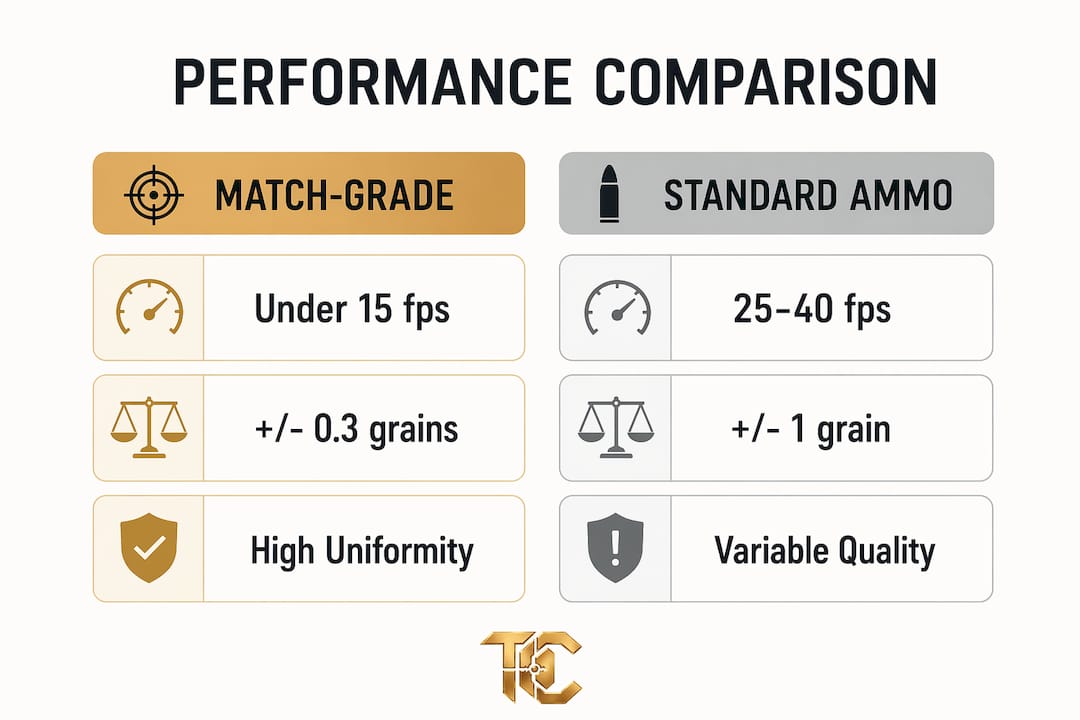
At 600 yards, a velocity SD of 25–40 fps produces noticeably wider vertical dispersion than a load running under 15 fps. Tighter velocity consistency can produce roughly twice the vertical precision at that distance. That difference can mean the gap between a first-place finish and a miss in precision rifle competition.
One factor shooters often overlook: poor rifle mechanical accuracy cannot be fixed by match-grade ammo. A rifle that groups at 3 MOA will not suddenly shoot 1 MOA because you switched ammunition. Match-grade ammo delivers its full benefit only in a rifle capable of sub-MOA precision.
Scenarios where match-grade ammo delivers clear value:
- Precision rifle competitions such as PRS (Precision Rifle Series) events
- Long-range target shooting at 300 yards and beyond
- Benchrest shooting where group size is the primary metric
- Hunting applications requiring first-shot accuracy at extended range
Scenarios where standard ammo is sufficient:
- Defensive training drills at 25 yards or less
- General plinking and recreational shooting
- New shooters still developing fundamentals
- Rifles with mechanical accuracy above 2 MOA
| Factor | Match-Grade | Standard Commercial |
|---|---|---|
| Velocity SD | Under 15 fps | 25–40 fps |
| Accuracy benefit at 100 yds | Minimal | Equivalent |
| Accuracy benefit at 600 yds | Significant | Degraded |
| Cost per round | Higher | Lower |
| Best use case | Competition, long-range | Training, defense, plinking |
What practical considerations should shooters know before buying match-grade ammo?
Match-grade ammo is a tool, and like any tool, it works best when the rest of your setup is ready for it. New shooters often spend money on match ammo before establishing solid fundamentals and rifle precision. That investment rarely pays off. A shooter who flinches at the trigger will not see the benefit of a 10 fps velocity SD.
Rifle compatibility matters more than most shooters realize. Match-grade ammo is loaded to tight dimensional specs, and your chamber needs to complement those specs. A rifle with a generous “mil-spec” chamber may not fully realize the accuracy potential of tightly loaded match ammunition. Matching ammo to your barrel’s twist rate and harmonics is equally important. A 77-grain .223 bullet needs a 1:8 or faster twist to stabilize properly.
Key practical considerations before committing to match-grade ammo:
- Confirm your rifle groups under 2 MOA with quality factory ammo before upgrading
- Zero your rifle with the specific match load you plan to use, since point of impact shifts between loads. Learn rifle zeroing fundamentals before switching ammo types
- Store match-grade ammo in a cool, dry environment to preserve primer and powder integrity
- Rotate stored ammo annually if possible, especially in humid climates
- Test multiple match loads in your specific rifle before buying in bulk
Pro Tip: Buy at least three different match loads and shoot five-shot groups at 100 yards with each. The load that groups tightest in your specific rifle is your match load, regardless of brand reputation.
Handloading is the next step beyond factory match-grade for shooters who want ultimate precision. By controlling seating depth, powder charge, and component selection for their exact chamber, competitive shooters can exceed what any factory load delivers. Many top Precision Rifle Series competitors handload exclusively for this reason.
What calibers and bullet types are available in match-grade ammo?
Match-grade ammunition is available across a focused set of calibers that have proven track records in precision shooting. The three most common are .223 Remington, 6.5 Creedmoor, and .308 Winchester. Each serves a distinct role based on distance, recoil, and ballistic performance.
Match-grade bullets use premium components including precise brass, consistent primers, and high ballistic coefficient projectiles. The most common design is the hollow point boat-tail, or HPBT. The boat-tail base reduces drag at the rear of the bullet, while the hollow point nose improves concentricity during manufacturing. Together, they produce a more consistent flight path and better wind resistance at long range. You can see this design in loads like the Nosler Accubond Long Range line, which applies high-BC projectile design to precision rifle applications.
| Caliber | Common Bullet Weight | Typical Muzzle Velocity | Primary Use |
|---|---|---|---|
| .223 Remington | 69–77 gr | 2,750–2,950 fps | Mid-range competition, training |
| 6.5 Creedmoor | 120–143 gr | 2,650–2,850 fps | Long-range competition, hunting |
| .308 Winchester | 168–175 gr | 2,550–2,700 fps | Long-range target, military-style matches |
Federal Premium’s Gold Medal line, Hornady’s ELD Match series, and Nosler’s Custom Competition loads are among the most respected factory match-grade options. Each brand publishes velocity and SD data, which is the standard you should hold any match-grade product to before buying.
Key Takeaways
Match-grade ammunition delivers its full accuracy advantage only when paired with a sub-MOA rifle and a shooter who has mastered the fundamentals.
| Point | Details |
|---|---|
| Tight tolerances define match-grade | Velocity SD under 15 fps, bullet weight ±0.3 gr, and run-out ±0.002" separate true match-grade from standard ammo. |
| Distance determines value | Accuracy gains are negligible at 100 yards but decisive at 600 yards and beyond. |
| Rifle quality is a prerequisite | A rifle that cannot group under 2 MOA will not benefit from match-grade ammo. |
| No regulated standard exists | Manufacturers self-apply the match-grade label, so always verify published velocity SD data. |
| Handloading surpasses factory match | Competitive shooters who handload can optimize seating depth and powder charge for their exact chamber. |
Why I think most shooters buy match-grade ammo too early
Shooters treat match-grade ammo the way some people treat premium coffee equipment. They buy the best gear before they have developed the technique to taste the difference. I have watched shooters spend significantly more per round on Federal Gold Medal or Hornady ELD Match while their trigger control and follow-through were still inconsistent. The ammo could not fix what the shooter had not yet built.
The honest reality is that match-grade ammo is a precision multiplier, not a precision creator. It takes what your rifle and your skill can already do and makes it more repeatable. If your rifle groups at 1.5 MOA with quality hunting ammo, a true match load might bring that to 0.8 MOA. That is a real and meaningful gain. But if your rifle groups at 3 MOA, match ammo will give you a tighter 3 MOA cluster at best.
My advice is to maintain firearm accuracy first. Clean your barrel, check your bedding, and shoot enough rounds to understand your own trigger habits. Once your groups are consistent and your rifle is mechanically sound, match-grade ammo will give you a clear, measurable return on the investment.
— Brian
Tungstencreektactical: precision firearms and ammo, in one place
Knowing what match-grade ammo does is one thing. Having the right rifle to run it is another.

Tungstencreektactical builds and stocks precision firearms designed to get the most from quality ammunition. Whether you are looking for a custom-built precision rifle chambered for 6.5 Creedmoor or .308 Winchester, or you need expert guidance on pairing the right load to your existing setup, the team at Tungstencreektactical is equipped to help. The Tungstencreektactical mobile app also lets you scan products, compare pricing, and access VIP deals on ammunition and gear. Precision shooting rewards preparation. Start with the right platform.
FAQ
What is match-grade ammo in simple terms?
Match-grade ammo is factory ammunition built to tighter tolerances than standard commercial rounds, producing more consistent velocity and better accuracy at long range. The term refers to intended use in competitive or precision shooting.
Is match-grade ammo worth the extra cost?
Match-grade ammo is worth the cost for shooters with sub-MOA rifles engaging targets at 300 yards or beyond. At shorter distances or with less accurate rifles, the performance difference over quality standard ammo is minimal.
Does match-grade ammo have a regulated definition?
No regulated or certified standard defines match-grade ammunition. Manufacturers self-apply the label, so shooters should verify published velocity SD data rather than relying on the label alone.
What is the best match-grade ammo for long-range shooting?
Federal Premium Gold Medal, Hornady ELD Match, and Nosler Custom Competition are consistently regarded as top factory match-grade options. The best choice for your rifle depends on caliber, twist rate, and how each load groups in your specific barrel.
Can I use match-grade ammo for self-defense?
Match-grade ammo is designed for accuracy, not terminal performance. For self-defense, purpose-built defensive loads with controlled expansion are the better choice. Match-grade hollow point boat-tail bullets are not optimized for reliable expansion on soft tissue.
Recommended
Related Post

Discover the 5 ways
An introduction to Tactical Luxury Guns & Coffee We founded
Top 5 Best PCC’s
In 2026, the Pistol Caliber Carbine (PCC) market is no