How to select tactical accessories for firearm owners
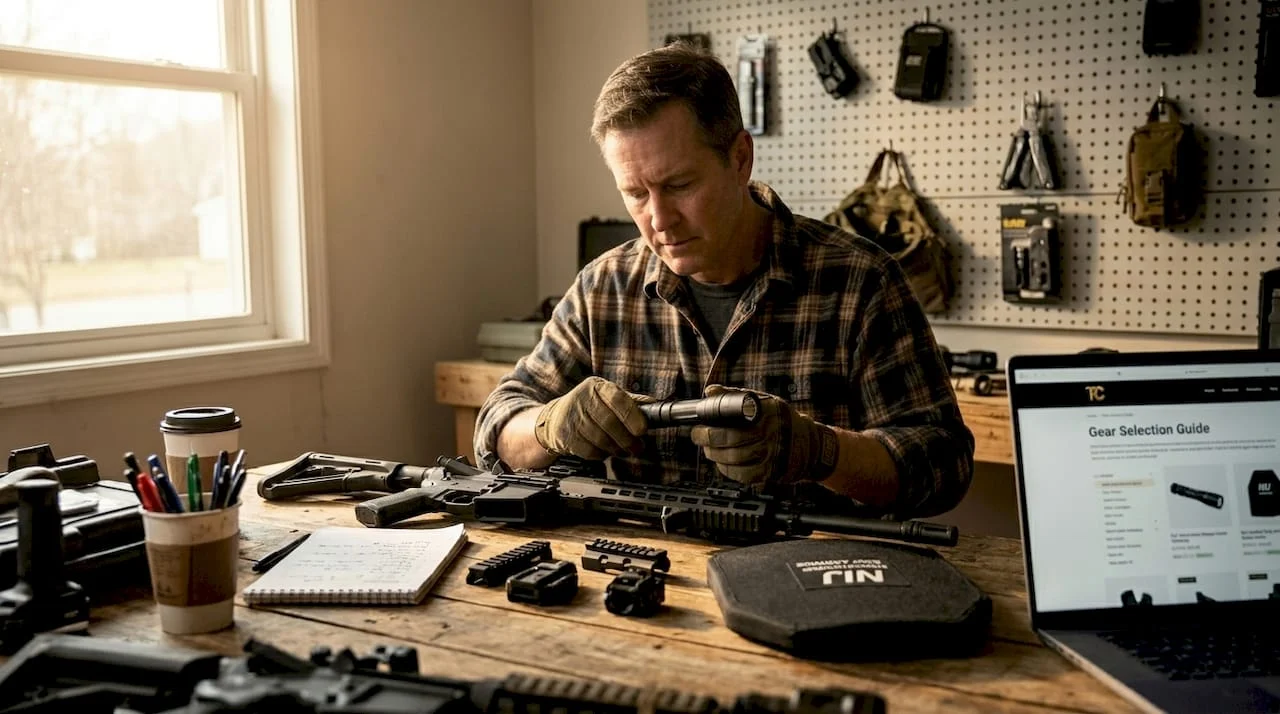
Knowing how to select tactical accessories is one of the most practical skills a responsible firearm owner can develop, yet most people get it wrong in the same ways: buying for looks, chasing the highest specs, or copying loadouts from social media. The result is gear that looks impressive on a shelf but fails in the field. This guide cuts through the noise. We cover the four pillars of smart gear selection: threat assessment, body armor, weapon lighting, and loadout assembly. Every recommendation here is grounded in real operational standards, not marketing copy.
Table of Contents
- How to select tactical accessories: Start with mission and threat
- Selecting body armor for protection and mobility
- Choosing weapon lights to enhance tactical visibility
- Assembling and scaling your tactical loadout efficiently
- Common mistakes and tips for tactical accessory selection
- Why realistic threat assessment beats gear hype every time
- Explore premium tactical gear and custom firearms at Tungsten Creek Tactical
- Frequently asked questions
Key Takeaways
| Point | Details |
|---|---|
| Match gear to mission | Select tactical accessories based on realistic threat and mission duration for optimal balance and performance. |
| Balance protection and mobility | Choose body armor NIJ levels carefully to ensure adequate protection without excessive weight. |
| Choose weapon lights wisely | Focus on brightness and beam intensity that suit your operational environment, not just lumens. |
| Avoid gear overload | Test full loadouts to prevent mobility loss and fatigue from excess accessories or poorly fitted gear. |
| Verify certifications | Always confirm NIJ certification and lab reports to guarantee the quality and reliability of ballistic armor. |
How to select tactical accessories: Start with mission and threat
Before you touch a product page, you need a clear picture of what you’re actually preparing for. Tactical gear selection starts with mission timeframe and threat assessment, not gear browsing. That single discipline separates prepared owners from those carrying $2,000 worth of kit that doesn’t fit their actual life.
Start by defining your mission duration. A 24-hour scenario, such as a home defense situation or a one-day range event, requires a much lighter kit than a 48-plus-hour wilderness patrol or search-and-rescue support role. Scale everything to that timeframe. Then assess your realistic threat environment. An urban home defender faces different risks than someone patrolling a rural property at night or traveling through remote terrain.
Ask yourself these grounding questions before purchasing anything:
- What is the most likely threat I will face: handgun, rifle, or environmental?
- How long will I carry this gear continuously?
- Will I be stationary or moving significant distances?
- What is the climate and terrain of my operating environment?
- Do I need to conceal my gear or can it be overt?
Honest answers to these questions will eliminate 80% of the gear you were about to buy and focus your budget where it matters.
Pro Tip: Write down your three most realistic threat scenarios before shopping. If a piece of gear doesn’t address at least one of them directly, leave it on the shelf.
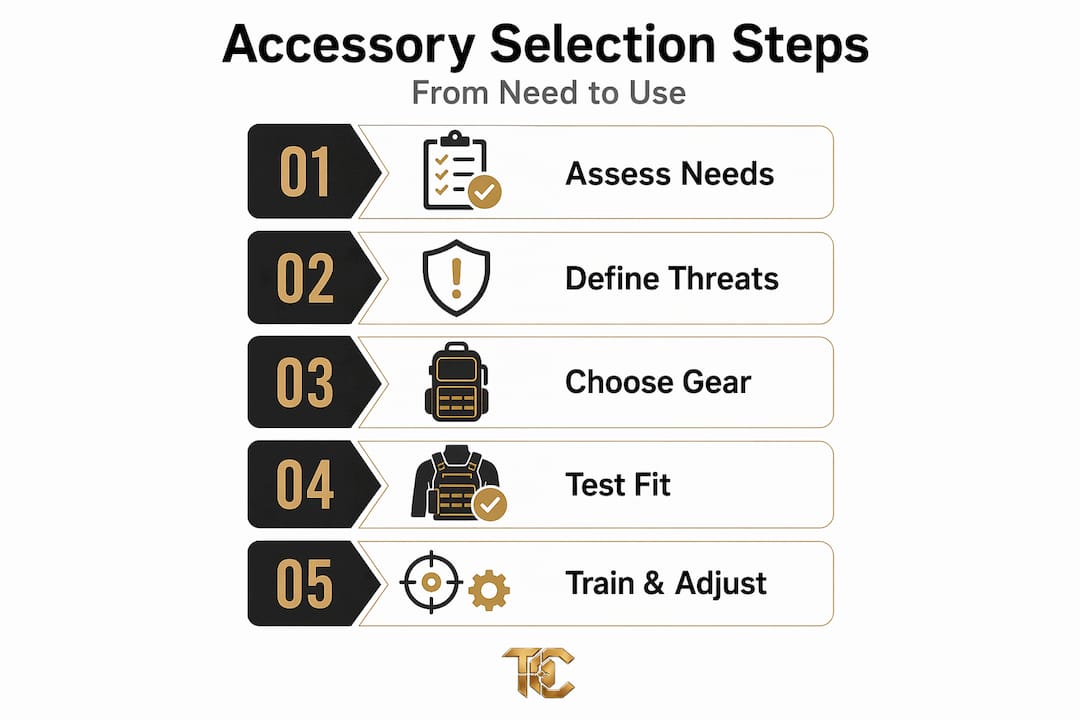
Good firearm accessory choices follow the same logic. Every addition to your platform should serve a defined purpose tied to your mission, not your wish list.
Selecting body armor for protection and mobility
Once your mission parameters are clear, body armor selection becomes a logical decision rather than an emotional one. The National Institute of Justice (NIJ) sets the testing and certification standards used across law enforcement and civilian markets. Understanding those levels is non-negotiable.
Here is a practical comparison to help you match threat level to armor type:
| NIJ Level | Armor Type | Threats Stopped | Avg. Weight Per Plate | Best Use Case |
|---|---|---|---|---|
| IIIA | Soft armor | High-velocity handgun rounds (.357 SIG, .44 Mag) | 1–2 lbs | Everyday carry, urban defense |
| III | Hard plate | Rifle rounds including 7.62×51 NATO | 4–6 lbs | Active duty, patrol operations |
| IV | Hard plate | Armor-piercing rifle rounds (.30 caliber AP) | 5–8 lbs | High-threat military/LE environments |
NIJ Level IIIA soft armor stops high-velocity handgun rounds and suits most civilian needs without the weight penalty of hard plates. For the overwhelming majority of responsible firearm owners, this is the right starting point. Level IIIA provides everyday handgun threat protection without sacrificing the mobility you need to respond effectively.
Weight is a factor people consistently underestimate. Each hard plate adds 2 to 6 pounds, and that load compounds fast when combined with a carrier, magazines, and other kit. A heavier setup that slows your movement or causes you to leave gear at home is objectively less protective than a lighter, properly fitted setup you actually wear.
Fit matters as much as rating. Your plate carrier should hold plates flush against your torso, covering your vital organs from the collarbone to the bottom of your sternum. A carrier that rides high, shifts laterally, or gaps at the sides defeats the purpose of the armor inside it.
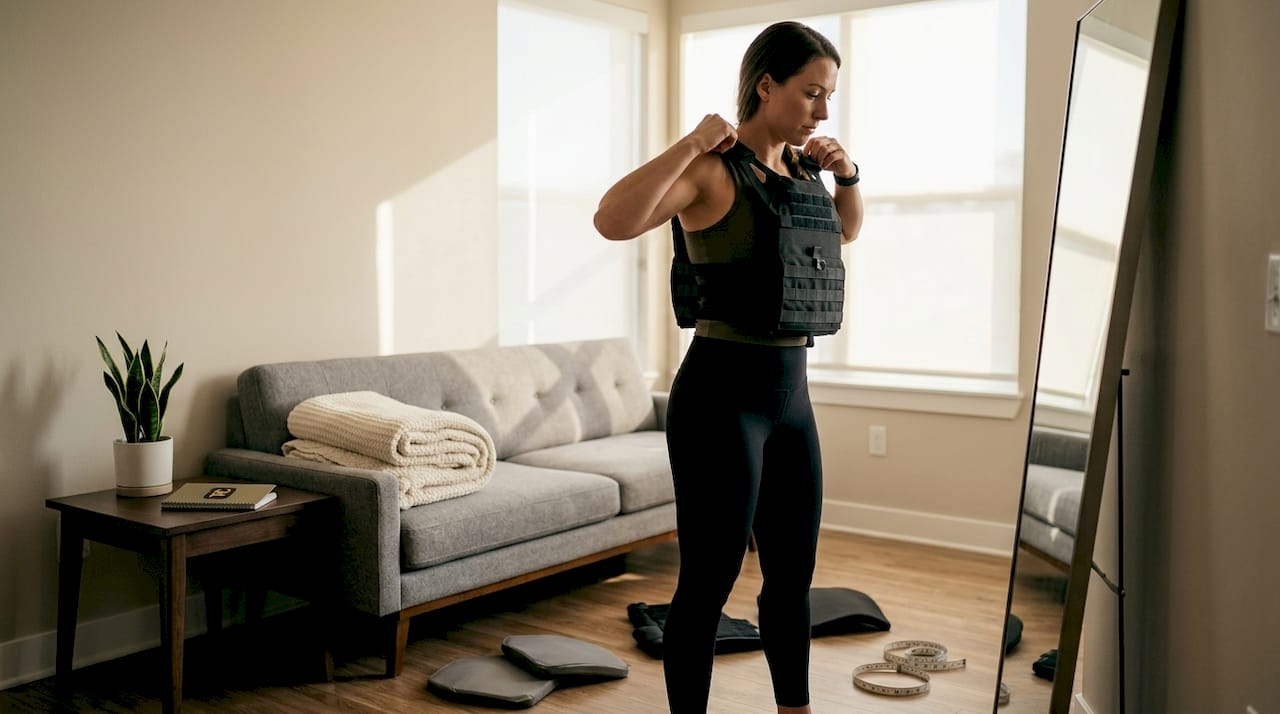
Pro Tip: When sizing a plate carrier, wear the clothing you would realistically wear during operations. Sizing over a t-shirt when you always wear a base layer will leave you with a carrier that fits poorly when it counts.
Choosing weapon lights to enhance tactical visibility
A firearm without a reliable light is an incomplete defensive tool. Most critical incidents happen in low light or no light, which makes your weapon light selection one of the most operationally important decisions you will make.
Two measurements define a weapon light’s performance: lumens and candela. Lumens measure total light output, the overall brightness flooding an area. Candela measures beam intensity, the focused power of light at a specific point. A light with high lumens but low candela floods a room with soft light but won’t reach a threat at 50 yards. A high-candela light throws a sharp, tight beam that identifies targets at distance.
For home defense weapon lights, the minimum threshold is 500 lumens with 20,000 to 50,000 candela, paired with durable dual-mode switches. Both measurements matter. Lumens measure total output, candela measures beam intensity, and matching those specs to your environment determines how effective the light actually is.
Key factors to evaluate when selecting a weapon light:
- Lumens and candela: Minimum 500 lumens for home defense; match candela to your typical engagement distance
- Battery type: CR123A batteries offer longer shelf life; rechargeable options reduce long-term cost
- Runtime: Look for a minimum of 90 minutes at full output before significant degradation
- Mounting system: Confirm compatibility with your firearm’s rail (Picatinny or M-Lok)
- Activation control: Tailcap switches offer simple on/off; remote pressure pads work well for rifles and reduce grip distortion
- Durability rating: Look for IPX7 water resistance and a verified drop rating
One commonly overlooked detail: a light that works perfectly on a pistol may be completely wrong on a carbine. Rail length, mounting position, and switch ergonomics all change between platforms. Test your light on the actual firearm before committing.
Pro Tip: Run your weapon light during dry-fire practice. Knowing how your grip changes when activating the light, and whether the beam centers correctly, reveals issues you won’t find at the range.
Assembling and scaling your tactical loadout efficiently
With armor and lights addressed, the next challenge is assembling a loadout that actually holds together under operational conditions. Think of your loadout like a properly brewed cup of coffee: every element serves a purpose, and anything extra just dilutes the result.
Recommended loadout structure by mission duration:
- 1 to 12 hours (short response/home defense): Handgun, 2 spare magazines, weapon light, tourniquet, phone
- 12 to 24 hours (day operation/range patrol): Add 3 to 4 rifle magazines, first aid kit, water, multitool, comms device
- 24 to 48 hours (extended patrol/wilderness): Full plate carrier, additional medical kit, hydration system, navigation, spare batteries, shelter layer
- 48-plus hours: Full sustainment kit including food, redundant communications, expanded medical, and climate-appropriate clothing layers
For 24-hour operations, a chest rig with 3 to 4 magazines plus essential items is the right configuration. Beyond that, you need more pouches and supplies scaled to duration. The trap most people fall into is building a 48-hour rig for every scenario and then wondering why they’re exhausted after two hours.
Overloading MOLLE systems causes rapid fatigue and reduces mobility, often within the first few hours of sustained activity. MOLLE (Modular Lightweight Load-carrying Equipment) is an attachment system on carriers and vests that lets you add pouches. The flexibility is valuable, but most people treat every loop as an obligation to fill it.
Modular systems give you the ability to customize for the task at hand. A carrier that runs heavy on a training day can be stripped down for a vehicle response scenario. That loadout flexibility is the real value of modular firearm setups.
Pro Tip: Lay your complete loadout on the floor and physically wear it for 30 minutes before any real deployment. Pay attention to where it rubs, how it shifts when you draw, and whether you can take a knee comfortably. Problems found in your living room cost you nothing. Problems found in the field cost you everything.
Common mistakes and tips for tactical accessory selection
Even experienced owners make predictable errors. Most of them come down to skipping verification steps that feel tedious until something fails.
- Mistaking “NIJ-tested” for “NIJ-certified”: These are not the same. Misinterpreting “NIJ-tested” as certified leads to a false sense of security. Always verify that armor appears on the NIJ Compliant Products List (CPL) with accompanying lab reports.
- Ignoring carrier fit: Armor that doesn’t fit securely or that fails carrier compatibility compromises protection even when the plate itself is rated correctly.
- Chasing lumens alone: A 2,000-lumen light with low candela may perform worse in your environment than a 600-lumen light with tightly focused beam intensity.
- Over-speccing for threats you won’t face: Level IV armor is the right call in specific high-threat environments. For most responsible civilian owners, it is unnecessary weight that degrades your performance.
- Never testing under realistic conditions: Gear that feels fine in a store or warehouse environment behaves differently when you’re sweating, moving fast, or wearing it over winter clothing.
“The best tactical gear you own is the gear you have actually trained with, properly fitted, and honestly matched to your threat environment.”
Pro Tip: Before finalizing any gear purchase, find the manufacturer’s NIJ CPL listing online. If you can’t locate it in under two minutes, treat that as a yellow flag worth investigating before you buy.
Why realistic threat assessment beats gear hype every time
Here is an observation earned from watching a lot of good people make expensive mistakes: the most dangerous thing in tactical gear selection is not buying cheap armor or a dim weapon light. It is buying gear for the wrong mission entirely.
The tactical gear market is saturated with products built to look impressive on Instagram or in a YouTube thumbnail. When you avoid video game and social media influences and choose gear for actual operational needs, your loadout shrinks, your performance improves, and your confidence becomes grounded in something real.
Experienced operators share a consistent trait: they carry less than you’d expect. A seasoned defensive shooter with a Level IIIA vest, a reliable weapon light, three magazines, a tourniquet, and a charged phone is better prepared than someone wearing $3,000 worth of Level IV plates and six pouches they’ve never trained with. The discipline behind good gear choices is not about minimalism for its own sake. It is about purposeful selection that you can actually execute under stress.
Understanding NIJ ratings, lumen-to-candela ratios, and MOLLE load limits is not just technical homework. It grounds your purchases in verifiable performance standards rather than manufacturer confidence claims. That knowledge is what separates a prepared owner from someone who is simply well-equipped in appearance. One is ready. The other just looks ready.
Explore premium tactical gear and custom firearms at Tungsten Creek Tactical
You have the framework. Now you need a source that backs it up with quality products, honest guidance, and real expertise.
At Tungsten Creek Tactical, we stock tactical accessories aligned with the standards covered in this guide, from certified protective gear to weapon lighting built for real operational conditions. Our team can help you match every piece to your specific mission, not just your budget. If you’re ready to build a custom platform from the ground up, explore our custom gun builds to get a firearm tailored to your loadout and defensive needs. When you’re ready to outfit the rest of your kit, browse our tactical gear shop for hand-selected products that meet the same standards we’ve outlined here.
Frequently asked questions
What is the optimal NIJ armor level for most civilian tactical uses?
NIJ Level IIIA soft armor is ideal for most civilian and responsible firearm owners, protecting against high-velocity handgun rounds while maintaining manageable weight and mobility. It covers the most common threat types without the performance cost of heavier hard plates.
How many magazines should I carry for a 24-hour tactical mission?
For missions up to 24 hours, carry 3 to 4 magazines with 20 to 40 rounds each in a lightweight chest rig, along with communications, water, and a first aid kit as mission essentials.
What brightness should a weapon light have for home defense use?
A minimum of 500 lumens with 20,000 to 50,000 candela beam intensity is recommended for home defense weapon lights, ensuring adequate illumination and reliable target identification in low-light environments.
Why is verifying NIJ certification important when buying body armor?
Always verify NIJ CPL listing and associated lab reports before purchasing armor, because “NIJ-tested” claims are not equivalent to full certification and may not guarantee the protection level advertised.
How can I avoid fatigue caused by tactical gear during extended use?
Avoid overloading your MOLLE system and test your full loadout for at least 30 minutes before any real deployment, as unchecked gear weight turns a capable kit into a fatigue source within a few hours of sustained activity.
Recommended
Related Post
Discover the 5 ways
An introduction to Tactical Luxury Guns & Coffee We founded
Top 5 Best PCC’s
In 2026, the Pistol Caliber Carbine (PCC) market is no