
Why Gun Laws Matter for Safety and Ownership


Gun laws sit at the center of one of the most debated topics in America, yet the conversation rarely starts with the actual evidence. Understanding why gun laws matter goes beyond political preference. Research published in 2026 links specific legislation directly to measurable reductions in firearm suicides and violent crime. This article cuts through the noise and gives you a clear, evidence-based picture of what the data actually shows, how different laws work in practice, and what all of this means for you as a responsible firearm owner or concerned citizen.
Table of Contents
- Key takeaways
- Why gun laws matter: the numbers behind the debate
- How policy effectiveness varies by state
- The broader societal impact of gun laws
- Responsible ownership and enforcing gun laws
- My take on what the evidence actually tells us
- Quality gear for responsible owners
- FAQ
Key takeaways
| Point | Details |
|---|---|
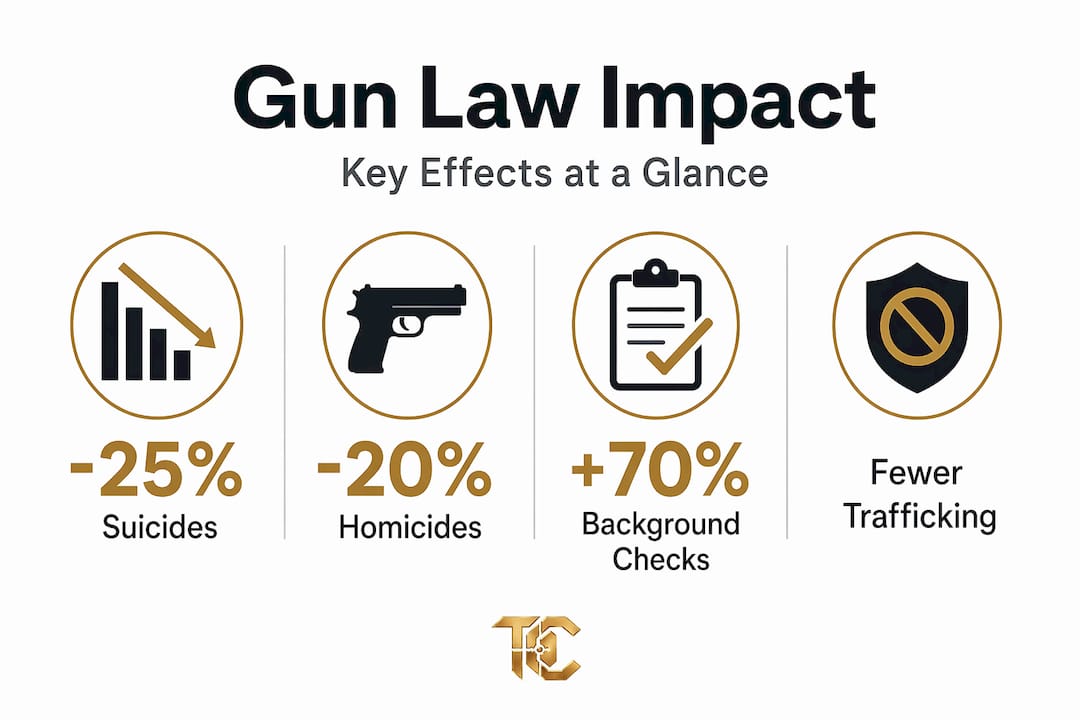
| Specific laws reduce firearm suicides | Permit requirements, waiting periods, and concealed carry licensing can reduce firearm suicide rates by over 25%. |
| ERPOs prevent deaths in crisis windows | Extreme Risk Protection Orders prevented an estimated 675 firearm suicides across four studied states. |
| Cross-state trafficking is a real problem | Nearly three-quarters of crime guns crossing state lines come from states with weak background check laws. |
| Implementation determines outcomes | How a law is written and enforced matters as much as whether it exists at all. |
| Responsible owners benefit from good laws | Clear regulations around storage, licensing, and background checks support a culture of safe, lawful ownership. |
Why gun laws matter: the numbers behind the debate
The most important thing to understand about gun laws is that they are not monolithic. Not every law works the same way, and not every law targets the same problem. But several specific types of legislation have demonstrated real, measurable effects on firearm deaths.
A large-scale longitudinal study found that permit, waiting, and concealed carry laws together correlate with a reduction in firearm suicide rates exceeding 25%. That is not a projection. That is observed data across states over time. What makes this finding particularly significant is that these reductions are firearm-specific. Rates of nonfirearm suicides do not rise in response. People do not simply switch methods when access is temporarily restricted during a crisis moment. The law creates a window, and that window saves lives.
Extreme Risk Protection Orders, commonly called ERPOs, operate on the same principle. These laws allow courts to temporarily remove firearms from individuals who are at high risk of harming themselves or others. Research in JAMA Health Forum found that ERPOs reduced firearm suicides by a mean of 3.79 per 100,000 population within one year, with no corresponding increase in nonfirearm suicides. Across four studied states, an estimated 675 firearm suicides were prevented. The context matters too: firearm suicides reached 57% of all U.S. suicides in 2024, representing 6,000 more deaths than a decade earlier. Laws that interrupt access during acute risk windows are not theoretical. They are one of the few tools with a proven track record against that trend.
Here is a quick look at how these key laws compare in their primary purpose and documented effect:
| Law type | Primary target | Documented effect |
|---|---|---|
| Handgun permit requirements | Restricts access at point of purchase | Reduces firearm suicide rates |
| Waiting periods | Delays access during crisis window | Reduces impulsive firearm suicide |
| Concealed carry licensing | Adds accountability for carriers | Associated with lower suicide and homicide rates |
| ERPOs | Temporarily removes access from at-risk individuals | Prevented an estimated 675 suicides across four states |
| Background checks | Screens for disqualifying history | Reduces crime guns in circulation |
Pro Tip: If you want to track how your state stacks up on specific gun safety policies and what laws are currently active or pending, tools like state legislation tracking can give you a clear view across all 50 states.
How policy effectiveness varies by state
Knowing that a law exists is not the same as knowing it works. This is where the conversation gets more nuanced, and frankly, more useful for anyone trying to understand the real-world impact of gun control laws.
ERPO outcomes vary significantly from state to state, and enactment details and enforcement capacity are the primary reasons. A state that passes an ERPO law with minimal funding for law enforcement training, inadequate court infrastructure, or unclear petition criteria will not see the same reductions as a state that invests in the full implementation process. The law on paper and the law in practice are two different things.
Several factors drive this gap:
- Clarity of the statute. Vague language around who can petition for an ERPO and what evidence qualifies creates inconsistency in how courts and officers apply it.
- Law enforcement training. Officers who are not trained to initiate ERPOs are far less likely to use them, even in qualifying situations.
- Community awareness. If at-risk individuals and their families do not know the law exists, it cannot help them.
- Cross-jurisdictional coordination. In states with mixed urban and rural enforcement, implementation gaps appear in less-resourced areas.
Some states with relatively strong gun laws still show higher rates of firearm violence. This often comes down to firearm ownership density, historical access patterns, and the flow of guns across state lines from neighboring states with weaker regulations. You cannot fully evaluate the importance of gun regulations in one state without accounting for its neighbors.
Pro Tip: When evaluating a state’s gun safety record, look at both the laws on the books and independent assessments of enforcement. The gap between the two often tells you more than either piece alone.
The broader societal impact of gun laws
Firearm legislation does not operate in a vacuum. Its effects ripple outward into communities, across state lines, and into the daily lives of people who may never personally own a gun.

One of the clearest examples is gun trafficking. The “iron pipeline” refers to the well-documented pattern of firearms moving from states with permissive purchase laws into states with stricter ones. Nearly three-quarters of crime guns that cross state lines originate in states without strong background check requirements. That means a state can invest heavily in its own regulations while still absorbing the consequences of another state’s weaker framework. This is one of the strongest arguments for why enforce gun laws consistently at a federal level and why state-only solutions have inherent limits.
Background checks and purchase permitting play a central role in disrupting this flow. The Gun Control Act of 1968 established the federal baseline, prohibiting sales to felons and regulating interstate commerce. But the gap between federally licensed dealers and private sales remains a meaningful one, and states that close that gap see corresponding reductions in crime guns.
Gun laws also provide protection for vulnerable populations in ways that are easy to overlook. Domestic violence victims, for example, are at significantly elevated risk when an abusive partner has firearm access. Laws that prohibit firearm possession by individuals subject to domestic violence restraining orders reduce intimate partner homicides. States with foundational gun laws in place consistently rank at the top in overall gun safety outcomes. States that have repealed or weakened those laws have seen measurable increases in risk.
Responsible ownership and enforcing gun laws
Here is the part of this conversation that often gets lost: responsible gun owners have a direct stake in good gun laws. The gun law benefits most relevant to you are not restrictions. They are guardrails that help you stay on the right side of the law, protect your family, and maintain the legal standing to keep owning firearms.
Consider what responsible compliance actually looks like in practice:
- Background checks. Completing a background check for every transfer is not just a legal requirement in many states. It is the baseline for ensuring your transaction cannot be traced back to a future crime.
- Secure storage. Laws and best practices around secure firearm storage reduce unauthorized access by children and prevent theft, which feeds the trafficking problem described above.
- Licensing and training. Concealed carry licensing requirements, where they exist, create accountability and promote the kind of training that keeps you and those around you safer.
- ERPO compliance. If a family member is in crisis, supporting or initiating an ERPO is not a betrayal of Second Amendment values. It is the kind of responsible action that can prevent a tragedy and preserve the broader culture of lawful ownership.
- Staying informed. Laws change. Knowing the current rules and responsibilities in your state is not optional for a responsible owner. Ignorance of the law is not a defense.
Understanding the social responsibility side of gun ownership matters as much as knowing how to operate a firearm safely. These two things reinforce each other.
My take on what the evidence actually tells us
I have spent years watching the gun law debate generate more heat than light. My honest assessment is that most of the confusion comes from treating this as an all-or-nothing argument. Either every law is an overreach, or no law is enough. Neither position survives contact with the data.
What I have seen consistently is that specific, targeted laws produce specific, measurable results. ERPOs work when they are properly implemented. Waiting periods work by creating time between impulse and access. Background checks work when they are applied to all transfers, not just those that happen to go through a licensed dealer. The mechanism is always the same. Access during a high-risk window is interrupted, and lives are saved.
What I have also seen is that bad implementation can make a good law look ineffective. States that pass laws without funding enforcement, training officers, or building public awareness are setting those laws up to fail. That is not evidence the law does not work. It is evidence that laws require follow-through.
The part that resonates most with me is how this connects to responsible ownership. Laws that support secure storage, proper licensing, and background checks are not working against you as a gun owner. They are protecting the culture of lawful, considered ownership that most serious gun owners actually want to be part of. A good gun law, like a well-built firearm, does exactly what it is designed to do. Nothing more, nothing less.
— Brian
Quality gear for responsible owners
If you take ownership seriously, Tungstencreektactical is built for exactly that kind of person. Whether you are looking for precision-built custom firearms designed to perform reliably, premium accessories that support safe and responsible use, or honest guidance on what you actually need, you will find it here. Tungstencreektactical combines real product expertise with a commitment to transparency that aligns with the values serious owners hold. Check out the full range of firearm safety tips and browse the catalog to find gear built for people who treat ownership as a responsibility.

Responsible ownership starts with the right information and continues with the right equipment. Tungstencreektactical makes both accessible.
FAQ
Do gun laws actually reduce violence?
Yes. Research shows that specific laws reduce firearm suicides by over 25% when permit requirements, waiting periods, and concealed carry licensing are combined, with no corresponding rise in other suicide methods.
What are ERPOs and do they work?
Extreme Risk Protection Orders allow courts to temporarily remove firearms from individuals at high risk of harm. Studies found ERPOs prevented an estimated 675 suicides across four states in a single year.
Why do weak gun laws in one state affect other states?
Firearms purchased in states with permissive laws frequently move to states with stricter regulations through illegal trafficking. Nearly three-quarters of trafficked crime guns crossing state lines come from states without strong background check requirements.
How do gun laws affect responsible owners?
Laws promoting secure storage, licensing, and background checks support lawful ownership by reducing theft, preventing unauthorized access, and maintaining the legal standing that responsible owners depend on. More detail is available in this transparency in gun sales guide.
Why does implementation matter so much for gun law outcomes?
A well-written law still requires funding, training, and public awareness to produce results. ERPO effectiveness varies widely by state precisely because enactment details and enforcement capacity differ significantly across jurisdictions.
Recommended
Related Post

Discover the 5 ways
An introduction to Tactical Luxury Guns & Coffee We founded
Top 5 Best PCC’s
In 2026, the Pistol Caliber Carbine (PCC) market is no