Why Dry Fire Practice Matters for Every Shooter
Most shooters assume the only real training happens at the range. That assumption costs them more than ammo money. Understanding why dry fire practice matters is the first step toward developing skills that actually hold up under pressure. Dry fire isolates the mechanics that live fire often masks: trigger control, sight alignment, grip consistency, and draw timing. Whether you are a beginner still building muscle memory or an experienced shooter trying to sharpen your edge, dry fire gives you a training tool that is affordable, flexible, and available any time you pick up your firearm.
Table of Contents
- Key takeaways
- Why dry fire practice matters for your fundamentals
- What dry fire cannot do on its own
- Safety protocols for at-home dry fire sessions
- How to structure a productive dry fire session
- Practical benefits: cost, access, and volume
- My honest take on dry fire after years at the range
- Gear up your training at Tungstencreektactical
- FAQ
Key takeaways
| Point | Details |
|---|---|
| Dry fire trains core mechanics | Trigger control, sight alignment, and grip are best developed through repetition without recoil distraction. |
| Live fire remains necessary | Recoil management and flinch correction require periodic live fire sessions to validate dry fire progress. |
| Safety protocols are non-negotiable | Remove all live ammo from the practice space and perform multiple chamber checks before every session. |
| Structure beats mindless reps | Planned sessions with defined drills produce measurable improvement; unstructured practice reinforces bad habits. |
| Dry fire is highly cost-effective | Fifteen minutes can produce 100+ trigger presses at zero ammo cost compared to roughly 30 live reps at $20 or more. |
Why dry fire practice matters for your fundamentals
The shot itself lasts a fraction of a second. Everything that determines where it goes happens before that. Dry fire trains fundamentals like trigger control, sight alignment, and grip consistency by isolating the mechanics without recoil or noise getting in the way.
Trigger control is the single most transferable skill from dry fire to live fire. When there is no recoil to manage and no blast to flinch from, you can watch your sights with complete clarity. You will see exactly when and why they move. That kind of immediate feedback is nearly impossible to get in a live fire session because the shot interrupts your ability to observe your own press.
Sight alignment benefits in a similar way. Dry fire removes recoil distraction, which allows you to diagnose mechanical flaws in your press that live fire would simply mask with noise and movement. You stop guessing and start seeing the problem.
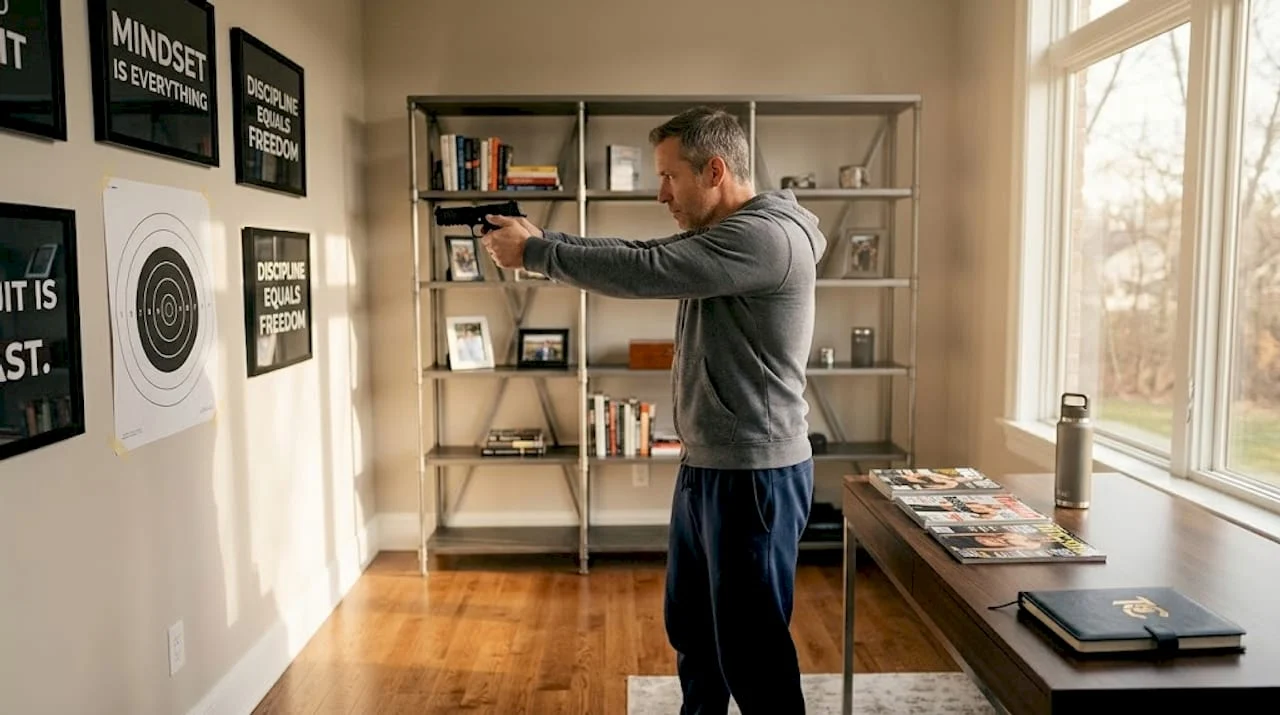
Grip and presentation consistency also improve through repetition. Drawing from a holster, establishing your grip, and presenting to a target are all motor skills that require volume to engrain. The range limits how many reps you can run in a session. Your living room does not.
- Trigger press: Watch the front sight through the entire press. Any movement tells you exactly what your finger is doing wrong.
- Sight alignment: Confirm your natural point of aim before every rep by closing your eyes, gripping normally, then opening to see where the sights settle.
- Grip consistency: Use a full-length mirror or a training partner to verify your grip looks identical on every draw.
- Draw and presentation: Practice your draw stroke from concealment to confirm you are building a repeatable, efficient motion every time.
Pro Tip: Treat every dry fire rep as if the gun is loaded and a live round is in the chamber. Sloppy habits formed in dry fire will show up in live fire at the worst possible time.
What dry fire cannot do on its own
Dry fire is a powerful tool, but it does not cover everything. Being honest about its limitations keeps your training grounded and prevents a false sense of preparedness.
Recoil management is the clearest gap. Dry fire cannot replicate rapid-fire recoil management, and that skill requires live fire to develop and maintain. Learning to manage muzzle rise, recover your sights between shots, and maintain a firing grip under repeated impulse loading simply cannot be simulated without a live round.
Flinch is another issue that only surfaces in live fire. Flinch and anticipation are neurological responses your body builds because it knows a loud, forceful event is coming. You can press a trigger perfectly in dry fire and still flinch badly when a round actually fires. That pattern only shows itself, and only gets corrected, when the gun goes bang.
| Training element | Dry fire | Live fire |
|---|---|---|
| Trigger control | Excellent | Good with feedback |
| Sight alignment | Excellent | Partially masked by recoil |
| Grip consistency | Good | Validated under pressure |
| Recoil management | Not applicable | Required |
| Flinch correction | Not applicable | Required |
| Draw stroke timing | Excellent | Good with timer |
| Shot confirmation | Not applicable | Required |
Monthly live fire check-ins are the standard recommendation to bridge this gap. Use those sessions to confirm your dry fire work is translating correctly, identify any flinch patterns that crept in, and recalibrate your mechanics against real-world feedback.
Safety protocols for at-home dry fire sessions
Safety in dry fire is not a formality. A negligent discharge during what you assumed was a cleared firearm is one of the most preventable and most serious accidents in firearm ownership. Every session starts with the same non-negotiable checklist.
- Remove the magazine before doing anything else.
- Lock the slide back and perform a visual inspection of the chamber.
- Physically inspect the chamber with your finger to confirm it is empty.
- Repeat that inspection a second time. Yes, twice.
- Remove all live ammunition from the room entirely. Leaving live ammo nearby while dry firing is the single most common way a training session turns dangerous.
- Set your target on a safe backstop that would stop a round if the unthinkable happens.
- Declare the session to anyone else in the home so they know not to hand you a loaded magazine or interrupt unexpectedly.
The same mindset that governs live fire governs dry fire. Point the firearm only at your designated target. Keep your finger off the trigger until your sights are where you want them. Treat every press as if a round is in the chamber. This is not paranoia. It is responsible firearm handling applied consistently.
Pro Tip: Put your ammo in a different room or a closed case before you begin. Physical separation between your live rounds and your practice firearm eliminates one of the most common dry fire safety failures.
How to structure a productive dry fire session
Think of a dry fire session the way you would a strength training workout. Walking into the gym and randomly picking up weights produces far less improvement than following a program. The same logic applies here. Structured dry fire sessions with defined drills, rep counts, and standards produce measurable improvement. Unstructured sessions are where bad habits get reinforced.
A well-built session looks like this:
- Warm-up (3 to 5 minutes): Slow, deliberate trigger presses with full attention on the front sight. No speed. No distractions. This primes the mechanics before you add complexity.
- Primary drills (10 minutes): Your main focus for the session. This might be draw-to-first-shot timing, trigger reset work, or presentation from the low ready. Pick one or two skills and work them with purpose.
- Challenge drills (5 minutes): Introduce a timer or a target transition to stress the skill under mild pressure. This is where dry fire starts to feel closer to real performance demands.
- Cooldown (2 to 3 minutes): Return to slow, deliberate presses. End the session with clean mechanics, not fatigued, rushed ones.
Short, frequent sessions of 10 to 15 minutes three to five times per week consistently outperform longer, infrequent sessions. Motor learning research supports distributed practice as the superior model for skill acquisition. Shorter sessions keep your focus sharp and prevent the mental drift that turns practice into hollow repetition.
Pro Tip: A trigger reset device or a snap cap can dramatically increase your rep count per minute by eliminating the need to rack the slide between every press. Trigger reset devices maximize reps and training quality in the same session window.
A shot timer is worth every penny for dry fire. Even without live fire, tracking your draw-to-presentation splits builds an honest record of improvement. You stop guessing whether you are getting better and start seeing it in the data.
Practical benefits: cost, access, and volume
The case for dry fire is not just about skill development. It is also about pure practicality. Getting to a range requires time, money, and a clear schedule. Weather matters. Range hours matter. Ammo prices matter. Dry fire removes every one of those barriers.
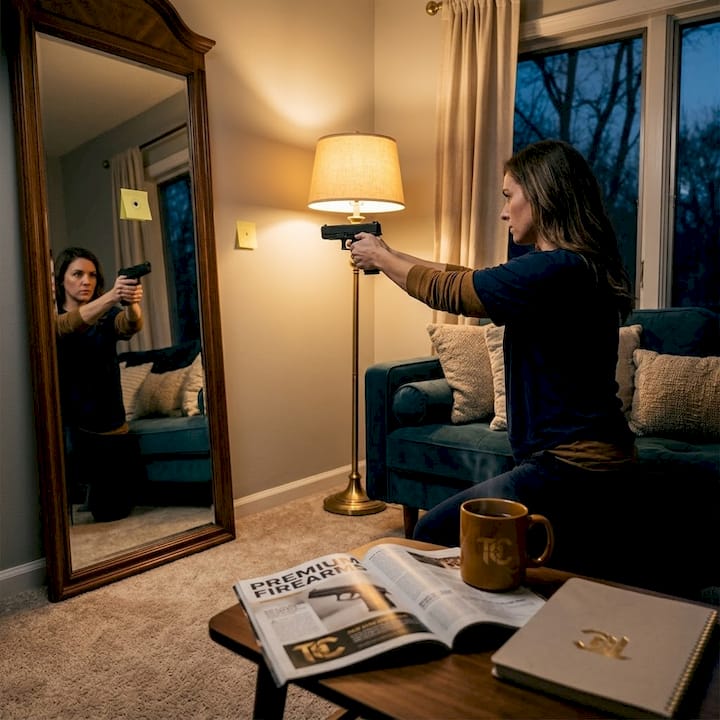
In 15 minutes of dry fire, you can complete 100 or more trigger presses at zero ammo cost. The equivalent live fire volume runs approximately 30 rounds plus range fees, totaling $20 to $30 or more per session depending on your caliber. Over the course of a month, the rep economy difference is staggering.
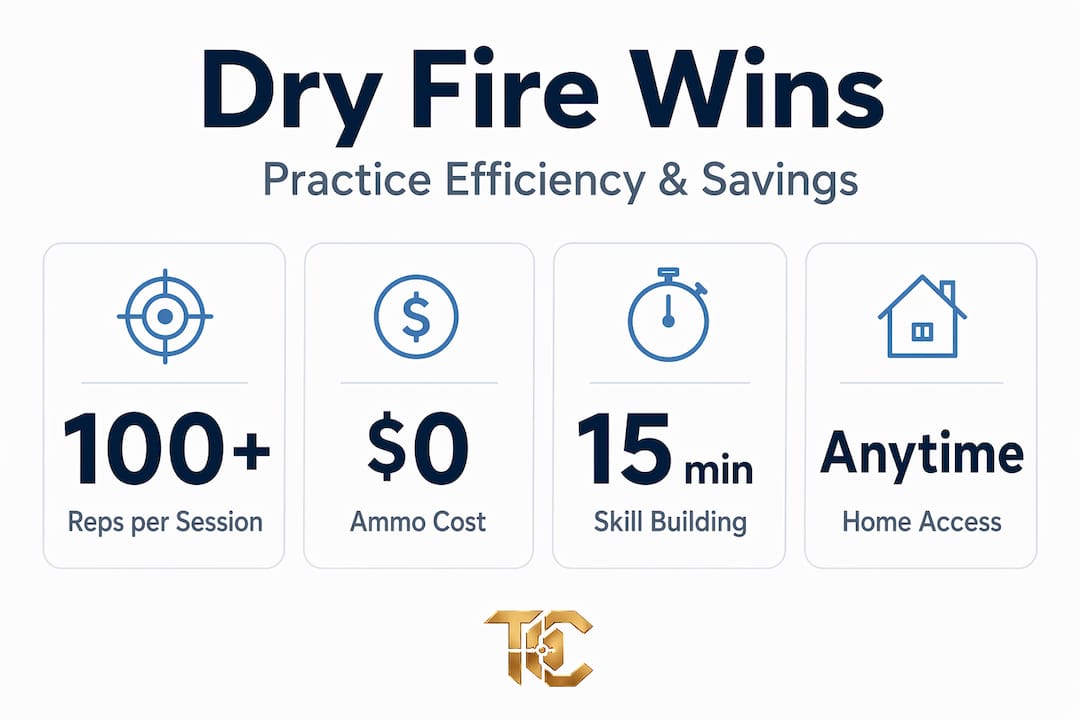
| Training method | Reps per 15 min | Estimated cost | Location required |
|---|---|---|---|
| Dry fire | 100+ | $0 | Home |
| Live fire | ~30 | $20 to $30+ | Range |
For concealed carry holders, dry fire covers skills that many ranges simply do not allow. Drawing from concealment, practicing retention positions, and running holster drills are often prohibited on public ranges. At home, those skills get built one rep at a time without restriction.
Competition shooters use dry fire to maintain stage visualization and movement patterns between matches. New shooters use it to build muscle memory before they ever touch live ammo, which makes their first range sessions far more productive. The benefits of dry fire apply equally regardless of experience level.
- Accessible any time of day without range scheduling
- No weather, travel, or range-fee barriers
- Concealed carry and draw skills practiced freely at home
- High rep volume accelerates motor learning at zero consumable cost
- Beginner-friendly introduction to firearm mechanics before live fire
My honest take on dry fire after years at the range
I spent years thinking range time was the only thing that moved the needle. I was wrong. The shift happened when I noticed that shooters who dry fired consistently showed up to live sessions and immediately performed better, while shooters who relied only on range time plateaued.
What I have learned is that the biggest failure in dry fire is mindless repetition. Pressing a trigger 200 times while watching television does not build skill. It builds a habit, and that habit might be the wrong one. Every rep needs your full attention on a specific mechanic.
The other mistake I see regularly is shooters who dry fire for weeks and then skip live fire validation entirely. Dry fire will give you confidence. Live fire will tell you whether that confidence is earned. You need both, and the ratio matters. I lean toward three to four dry fire sessions for every one live fire session, with the live session used to audit what the dry fire built.
One more thing: treat your dry fire firearm with the same respect you bring to the range. Consistent safety habits are not situational. They are the foundation of everything you build in training.
— Brian
Gear up your training at Tungstencreektactical
If dry fire has shown you what your fundamentals need, the next step is having a firearm that fits the way you train. At Tungstencreektactical, the custom guns service builds precision firearms tailored to your grip, ergonomics, and training requirements. A firearm built to your hand makes every dry fire rep more accurate and every live fire session more productive.

Beyond custom builds, Tungstencreektactical carries accessories that support both dry fire and range work, from adjustable stocks to training-ready handguns like the FN 502 Tactical, a low-recoil .22 LR platform that is ideal for high-volume live fire practice at a fraction of the centerfire cost. Explore the full catalog and use the Tungstencreektactical app to compare options, unlock VIP pricing, and make an informed decision about your next training tool.
FAQ
What does dry fire practice actually train?
Dry fire trains everything before the shot breaks: trigger control, sight alignment, grip consistency, and draw mechanics. Recoil management and flinch correction require live fire.
How often should you dry fire practice?
Three to five sessions per week, each lasting 10 to 15 minutes, produces better skill development than longer, infrequent range visits.
Is dry fire safe for your firearm?
Most modern centerfire pistols and rifles handle dry fire without damage. For rimfire firearms, use snap caps to protect the firing pin and prevent wear over time.
How do you keep dry fire sessions safe?
Remove the magazine, lock the slide back, inspect the chamber visually and physically twice, and remove all live ammo from the room before every session.
Can dry fire replace live fire entirely?
No. Dry fire cannot replicate recoil and flinch conditions that only live fire produces. Monthly live fire sessions are recommended to validate your dry fire progress.
Recommended
Related Post

Discover the 5 ways
An introduction to Tactical Luxury Guns & Coffee We founded
Top 5 Best PCC’s
In 2026, the Pistol Caliber Carbine (PCC) market is no